Amid global ESG pullback, tech giant posts 97.4% recycling, UN carbon credits
Jeong Soo-jeong’s compelling case for **sustainability at LG Electronics** is firmly rooted in quantifiable results and measurable impact.
“When it comes to proving impact, in the end, **numbers are the most effective thing**,” stated Jeong Soo-jeong, the head of LG’s **ESG Strategy Planning Team**. She shared these insights in a recent interview with The Korea Herald, ahead of her participation in H.eco Tech Festa 2026, where she will join a panel discussing how **environmental performance** is becoming a critical source of **competitive advantage** for businesses.
This steadfast conviction is clearly reflected in how the **global tech giant LG Electronics** has successfully integrated **sustainability outcomes** as commercial successes. For instance, LG notably received **carbon credits** from the executive board of the UN Framework Convention on Climate Change. These credits were awarded for the sale of **high-efficiency refrigerators** in India, which significantly reduce electricity consumption for consumers.
“The **carbon credits** were a direct return for the electricity savings we helped our customers achieve,” Jeong explained. She highlighted this as a prime example of how a strategic **environmental investment** can be transformed into a valuable, tradable asset on a company’s balance sheet, underscoring the financial benefits of robust **ESG initiatives**.
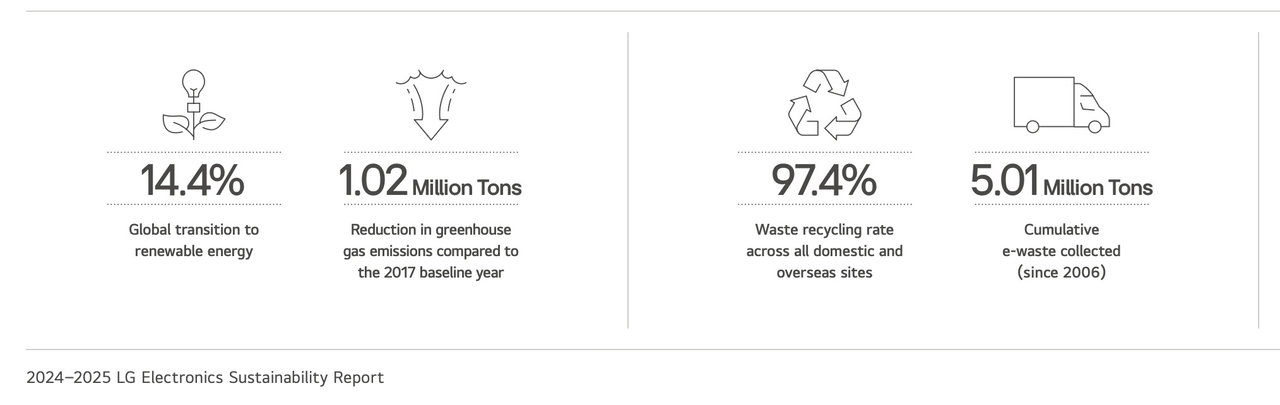
This results-oriented approach underpins **LG’s comprehensive 3C-and-3D framework**, which structures its **ESG agenda**. This framework prioritizes **carbon neutrality, circularity, and clean technology**, alongside crucial aspects like **workplace safety, diversity, and accessibility**. Operating under this robust structure, LG impressively surpassed its 2030 **waste recycling target** of 95 percent six years ahead of schedule, achieving an outstanding 97.4 percent across its domestic and international sites in 2024. Furthermore, the company has diligently tracked use-phase **carbon emissions** for its seven core product lines over several years, consistently reporting a decline in these figures annually.
Jeong asserts that these significant and **measurable ESG gains** effectively answer the crucial question increasingly posed by corporate boards to **ESG teams**: whether environmental spending delivers tangible financial returns and strategic benefits.
“Very simply, reducing **carbon emissions** translates directly into saving energy and cutting operational costs,” she emphasized. “When our commitment to **sustainability** resonates with customers and stakeholders, it profoundly influences their future partnership decisions. This, too, represents a significant financial advantage.”
External validation further reinforces LG’s leadership in **corporate sustainability**. **LG Electronics** has been recognized in the top 1 percent of S&P Global’s **Corporate Sustainability Assessment** for two consecutive years, and consistently receives strong evaluations from prominent sustainability ratings agencies like MSCI and EcoVadis, as noted by Jeong.
The rapidly escalating global demand for electricity, largely driven by advancements in artificial intelligence (AI), is also fundamentally transforming the landscape where **environmental technology** offers significant payoffs, Jeong added. As **data-center and device power consumption** continues to climb worldwide, innovative **energy-saving solutions** such as **LG’s AI-enabled HVAC systems** are evolving from mere cost considerations into powerful **growth engines** for a manufacturer deeply committed to providing advanced **commercial climate solutions**.
Operating across numerous international jurisdictions presents unique challenges, which Jeong candidly acknowledges can feel like an additional burden on **ESG teams**. Diverse markets enforce varying refrigerant regulations, distinct disclosure frameworks—such as the EU’s Corporate Sustainability Reporting Directive—and often differing implications for product design and lifecycle management.
“It’s somewhat akin to needing an extra travel adapter because every country operates with a different electrical socket,” she illustrated with a relatable analogy.
Despite concerns about political shifts and potential pullbacks in ESG efforts in regions like Washington and elsewhere, Jeong’s message to students considering careers in the **sustainability field** was resolute and unwavering.
“People may suggest that **ESG initiatives** are diminishing, but my own workload has certainly not shrunk one bit.”
Jeong Soo-jeong is scheduled to join fellow panelists from Kakao Bank, Yulchon, and Eco&Partners at Yonsei University’s Baekyangnuri Hall on May 7 to further discuss these vital topics.
mjh