
Conglomerates Move to Amend Bylaws, Reshape Boards Ahead of Tighter Shareholder Rules
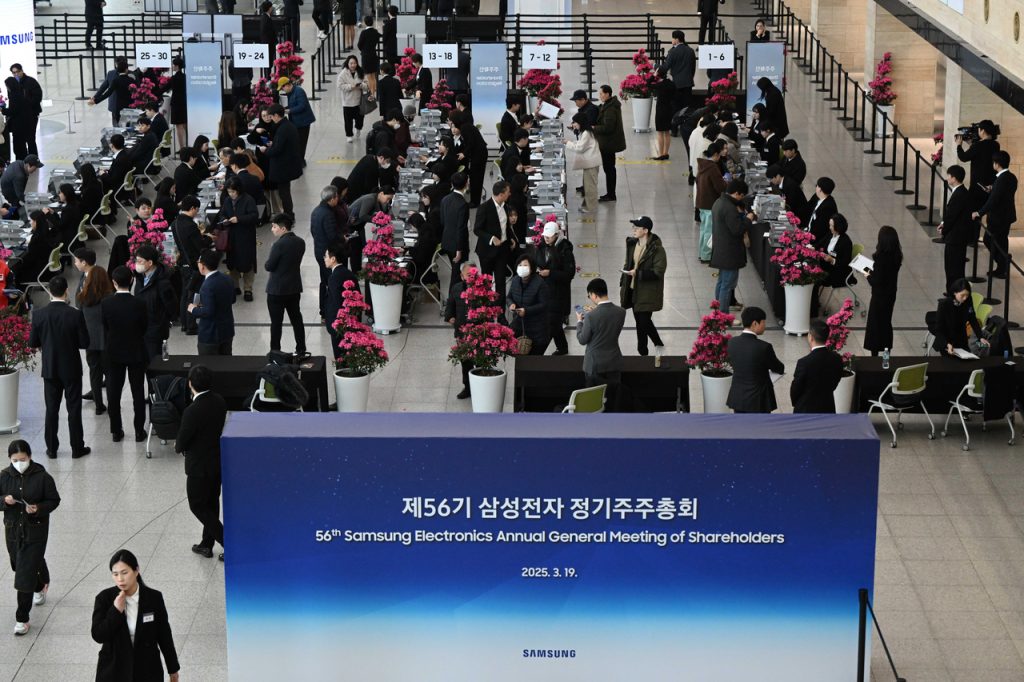
South Korea’s shareholder meeting season commences this week, with prominent conglomerates like Samsung Electronics and Hyundai Motor Group hosting annual general meetings centered on governance overhauls and corporate strategy.
This year’s meetings are attracting considerable attention as business groups expedite bylaw amendments and reinforce management control in anticipation of revisions to the Commercial Act, slated to take effect in the latter half of the year. With major conglomerates viewing these meetings as a crucial opportunity to fine-tune regulations in favor of controlling shareholders, increased friction is anticipated between corporate leadership and activist investors.
According to the Korea Securities Depository, a total of 211 listed firms will convene annual meetings this week alone – encompassing 102 companies on the main Kospi board and 107 on the Kosdaq market – creating a highly concentrated period that market observers have termed “shareholder meeting super week.”
The schedule includes some of the nation’s largest corporations. Hyundai Mobis will begin the week on Tuesday, followed by meetings on Wednesday at Samsung Electronics, Samsung SDI, and Samsung Electro-Mechanics.
Thursday will see meetings at Hanwha Ocean, LG Display, and Hyosung Heavy Industries, with Friday hosting sessions at Kia, Samsung Biologics, and LG Energy Solution.
The following week will feature meetings from additional companies, including Korea Zinc – currently embroiled in a heated management control dispute – on March 24, SK hynix on March 25, and Hyundai Motor, Hanwha Corp., and LG Corp on March 26.
Governance Changes Take Center Stage
Corporate governance restructuring is a key focus this year, as companies work to proactively adjust before amendments to the Commercial Act become effective. These amendments aim to bolster oversight of corporate boards and strengthen the rights of minority shareholders.
Effective July 23, the voting rights of top shareholders and related parties will be capped at 3 percent when electing audit committee members. From Sept. 10, companies will also be required to implement cumulative voting and increase the number of separately elected audit committee members from one to two.
In response, numerous companies are preemptively modifying their boardroom structures before the rules take effect.
Samsung Electronics and Samsung SDS are proposing to replace fixed three-year director terms with a more adaptable “within three years” structure. Hanwha affiliates are seeking to extend terms from “within two years” to “three years or within three years.”
Governance advocates contend that such flexibility enables director terms to be strategically staggered, diminishing the number of seats contested at any single meeting. This, in turn, reduces the probability of minority shareholder-backed candidates securing board seats under cumulative voting rules.
Concurrently, certain major companies are moving to decrease the maximum number of board members and then nominating that precise number. With no vacant positions, alternative candidate slates are effectively blocked, hindering minority shareholders from gaining board representation.
Hyosung Group affiliates have proposed reducing board caps from 16 directors to a range of seven to nine, while Hanwha Galleria aims to reduce its board from 13 to seven, and LS Electric from nine to five.
Beyond governance reforms and shareholder return policies, this year’s meetings are also expected to address business strategies and future visions.
At Samsung Electronics, shareholders will likely concentrate on the outlook for the semiconductor division, particularly the company’s position in high-bandwidth memory chips, as well as foundry investments and the potential for special dividends following the recent performance rebound.
Hyundai Mobis will submit Executive Chair Chung Euisun’s reappointment as an inside director to a shareholder vote. Hyundai Motor intends to add vehicle rental business to its corporate purpose, indicating a broader expansion into mobility subscription and vehicle leasing services.
sahn


