
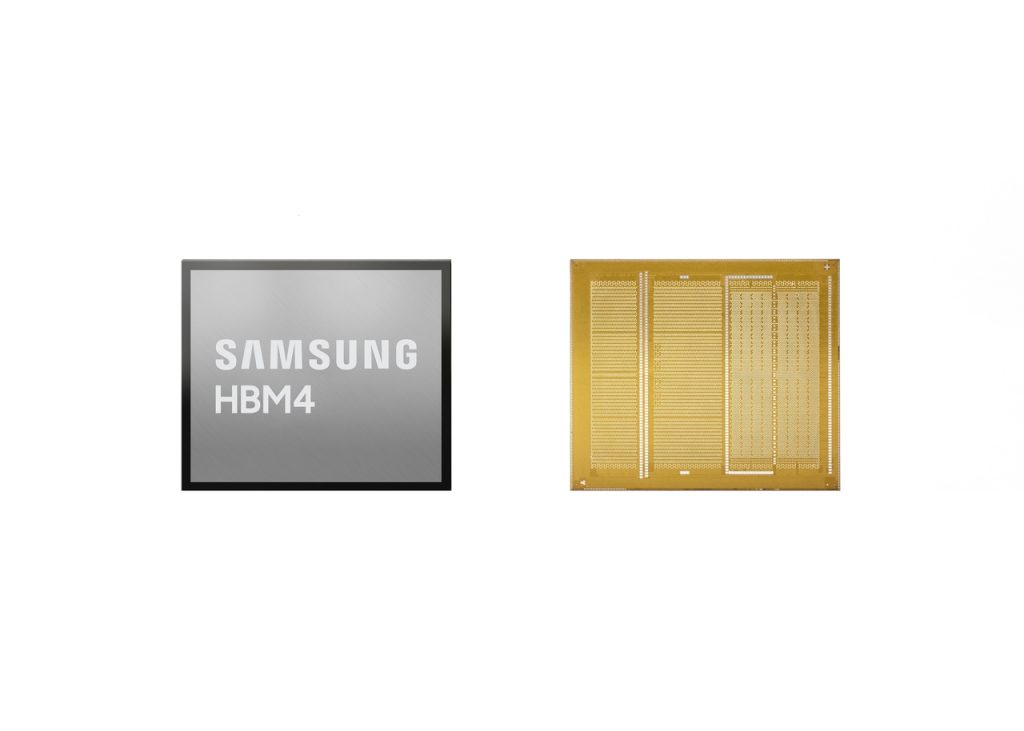
Tech Giant Showcases Next-Generation AI Memory for Nvidia’s Future Platforms
Samsung Electronics unveiled its seventh-generation HBM4E chip at Nvidia’s GPU Technology Conference (GTC), reinforcing its ambition to lead the AI memory market.
Samsung announced its participation in GTC 2026 in San Jose, California, from Monday to Thursday, presenting its advanced HBM4E technology alongside a suite of memory solutions designed to power Nvidia platforms.
At GTC, Samsung featured an “HBM4 Hero Wall” highlighting its latest high-bandwidth memory innovations. The company also showcased a physical HBM4E chip and a core-die wafer for the first time, offering a tangible look at its cutting-edge technology.
The HBM4E is engineered using Samsung’s 1c DRAM process and a 4nm foundry base-die design. This design leverages Samsung’s integrated device manufacturer model, combining memory, logic, foundry, and advanced packaging capabilities.
This advanced memory solution is expected to deliver speeds of up to 16 gigabits per second per pin, resulting in a memory bandwidth of up to 4 terabytes per second.
Samsung also presented its hybrid copper bonding technology, a next-generation packaging technique aimed at enhancing thermal efficiency and stacking capabilities for increased memory density.
Compared to traditional thermal compression bonding methods, this technology reduces thermal resistance by over 20 percent, enabling the stacking of 16 memory layers or more.
The company also demonstrated memory solutions optimized for Nvidia’s new Vera Rubin platform, highlighting its collaborative efforts to drive AI innovation.
In the “Nvidia Gallery” zone, Samsung displayed HBM4 for Rubin GPUs, SOCAMM2 memory modules for the Vera CPU, and its PCIe Gen6-based server SSD PM1763. These components were presented as an integrated part of the Vera Rubin system architecture.
The SOCAMM2, an LPDDR-based server memory module, has recently completed Samsung’s rigorous quality validation and is now shipping commercially, ready for deployment in advanced server environments.
Samsung also demonstrated a server equipped with its PCIe Gen6-based PM1763 SSD, positioned as the primary storage device for the Vera Rubin platform. The demo featured Nvidia’s SCADA workload running smoothly on the system, showcasing the performance capabilities of the solution.
Beyond the Nvidia-centric displays, Samsung organized its booth into three thematic areas: AI factories for data center infrastructure, local AI for on-device computing, and physical AI. These zones featured next-generation memory products including GDDR7, LPDDR6, and the PM9E1 SSD.
On the second day of GTC, Samsung AI Center head Song Yong-ho is scheduled to present at a special session hosted by Nvidia. He will outline Samsung’s vision for memory technologies that will power the next wave of AI systems.
yeeun


