Circuit Breaker Activated as Foreign Investors Sell Off Amid Oil Surge, Fueling Inflation Fears
Soaring global oil prices, spurred by escalating Middle East tensions, sent shockwaves through South Korea’s financial markets on Monday. Investor anxiety mounted over renewed inflation concerns, impacting both the Korean stock market and the local currency, the won.
The Kospi, Korea’s primary stock index, experienced a sharp downturn, triggering market-wide volatility control mechanisms.
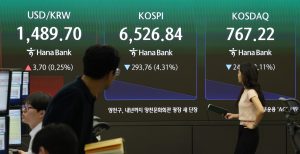
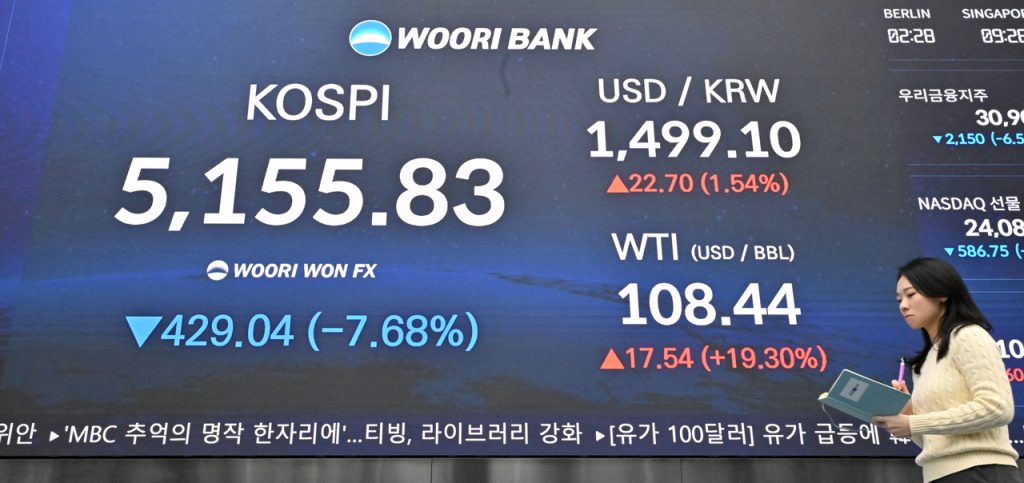
The Kospi opened at 5,265.37, a 5.72 percent decrease from the previous trading session, and further plummeted to a low of 5,096.16 during the day. As of 2 p.m. KST, the index stood at 5,112.01, reflecting an 8.47 percent drop.
A sell-side sidecar was activated on the main bourse at 9:06 a.m. KST, temporarily halting program sell orders for five minutes. This was followed by a circuit breaker activation at 10:31 a.m. KST, suspending trading for 20 minutes.
This circuit breaker marks the second instance this month, following the first on March 4, and the eighth overall in market history.
Foreign and institutional investors spearheaded the sell-off, divesting a net 2.96 trillion won ($1.9 billion) and 1.73 trillion won worth of shares, respectively. Retail investors countered the trend, purchasing a net 4.61 trillion won in shares.
The benchmark’s decline was exacerbated by substantial losses in major stocks. Samsung Electronics saw a decrease of 10.89 percent, while SK hynix plummeted 12.45 percent to 848,000 won. Hyundai Motor fell by 10.67 percent, and LG Energy Solution declined by 6.89 percent.
The technology-heavy Kosdaq index also experienced a significant drop, opening down 5.04 percent at 1,096.48.
While the Kosdaq initially showed some stability in early trading, it later extended its losses, triggering a sell-side sidecar at 10:31 a.m. As of 2 p.m. KST, the Kosdaq stood at 1,075.83, a 6.83 percent decrease from the previous session.
“Rising oil prices can affect the Korean economy through several channels,” explained Jo Ah-in, a researcher at Samsung Securities, highlighting potential impacts on transportation costs, energy expenses, and inflationary pressures through global liquidity.
“However, if the oil price surge stabilizes within one to two months, the risk of it feeding into broader global inflation remains limited,” she added.
The Korean won also weakened significantly against the US dollar. The currency opened at 1,493.0 won per dollar, a 16.6 won decrease compared to the previous session, and continued to fluctuate around the 1,490 won mark.
This represents the weakest daytime trading level for the won since March 12, 2009, when it briefly reached an intraday low of 1,500 won per dollar during the global financial crisis.
Although the won had weakened to 1,507 per dollar during after-hours trading on March 4 of this year, Monday’s depreciation is considered more significant due to the typically lower trading volumes during after-hours sessions.
Amid the won’s sharp depreciation, the Bank of Korea (BOK) issued a statement widely interpreted as a verbal intervention.
“Given that interest rates and exchange rates are showing excessive volatility and diverging from economic fundamentals due to risks stemming from the Middle East, we will take appropriate market stabilization measures if necessary,” said Bank of Korea Senior Deputy Gov. Ryoo Sang-dai during a task force meeting the same day.
Following the BOK’s remarks, the won partially recovered and was quoted at 1,490.29 per dollar as of 2 p.m. KST.
silverstar