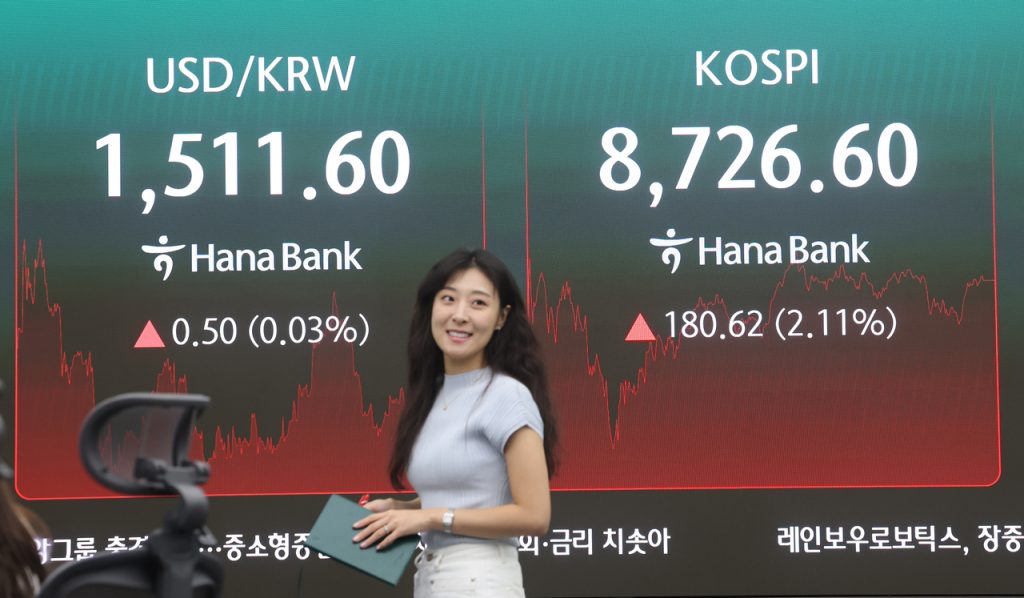
The **Seoul stock market** experienced a significant rally on Tuesday, with shares climbing over 2 percent and extending their **winning streak** for a fourth consecutive day. This surge was fueled by strong **optimism surrounding a potential US-Iran deal** aimed at resolving the conflict and facilitating the **reopening of the Strait of Hormuz**. Despite the market’s strong performance, the **South Korean won weakened against the US dollar**.
The **benchmark Korea Composite Stock Price Index (KOSPI)** notably advanced by 180.62 points, marking a 2.11 percent increase, to successfully close the trading day at 8,726.6.
This positive sentiment followed an overnight **rally in US stock markets**, which surged after **US President Donald Trump** announced that a preliminary agreement to resolve the **conflict with Iran** had been signed. He further stated that the crucial **Strait of Hormuz** would be “completely opened” by Friday, signaling a significant de-escalation of **geopolitical tensions**.
Major **US market indices** reflected this buoyancy, with the **S&P 500** climbing 1.7 percent and the **tech-heavy Nasdaq 100** recording an impressive 3.1 percent gain. Concurrently, the **Dow Jones Industrial Average** achieved a **record high**, underscoring robust market confidence.
In the **global energy market**, **oil prices experienced a significant retreat**. **Brent crude** notably decreased by 4.76 percent, settling at **US$83.17 per barrel**, while **US West Texas Intermediate (WTI)** saw a 4.87 percent drop to **$80.75 per barrel**. This substantial fall in **crude oil prices** effectively eased widespread **concerns over inflation**.
The **South Korean stock market** witnessed moderate trading activity, with a **trade volume** of 582.36 million shares exchanged, collectively valued at 39.42 trillion won ($26.08 billion). Market breadth was positive, as **winning stocks** significantly outnumbered **losing stocks**, with 518 advancing against 359 declining.
**Foreign investors** and **institutional investors** were significant net buyers, acquiring 1.54 trillion won and 703.53 billion won respectively. Conversely, **individual investors** acted as net sellers, offloading a total of 2.18 trillion won, reflecting a shift in **market liquidity**.
Explaining the market dynamics, **Lee Kyoung-min, an analyst at Daishin Securities**, noted, “The primary catalyst for gains in the **local stock market** was significant buying by **foreign investors**, driven by **easing geopolitical tensions** in the wake of the **US-Iran deal** and declining **global oil prices**, which collectively bolstered **investor risk appetite**.” He further added, “The robust performance observed in **US tech stocks** additionally provided strong support for sentiment within **South Korea’s crucial semiconductor sector**.”
**South Korean tech shares** recorded widespread gains across the board, signaling strong confidence in the **technology sector**.
Among **tech industry leaders**, **market bellwether Samsung Electronics** saw its stock price increase by 1.78 percent, reaching 343,000 won. Its key industry rival, **SK Hynix**, a leading semiconductor manufacturer, posted an impressive 4.11 percent gain, closing at 1,382,000 won. Furthermore, **SK Square**, an emerging **artificial intelligence investment firm**, experienced a significant surge of 6.23 percent, with its shares trading at 1,501,000 won.
The **defense sector** also exhibited robust growth, with **South Korean defense stocks** trading markedly higher. **Industry leader Hanwha Aerospace** saw its shares advance by 9.13 percent to 1,183,000 won. Its smaller but formidable rival, **LIG D&A**, recorded an exceptional jump of 18.85 percent, reaching 1,002,000 won, following the announcement of a strategic partnership with German defense firm **Rheinmetall** for collaboration on advanced **air defense systems**.
**Daewoo Engineering & Construction** recorded a remarkable surge, with its stock price soaring by 19.87 percent to 27,450 won. This impressive gain was driven by heightened expectations for lucrative new **business opportunities in the Middle East**, particularly as **geopolitical tensions have eased**, creating a more favorable **construction sector outlook** in the region.