Chinese automotive giant BYD is strategically expanding its presence in the South Korean market with the imminent launch of its first plug-in hybrid electric vehicle (PHEV) later this month. This move marks BYD’s entry into the country’s competitive hybrid vehicle segment, diversifying its portfolio beyond its successful battery-electric vehicle (BEV) offerings.
BYD Korea recently unveiled its innovative Dual Mode Intelligent (DM-i) technology during a comprehensive briefing held in Seoul. This advanced PHEV system is set to debut in the Korean market with BYD’s first DM-i-equipped model at the highly anticipated 2026 Busan Mobility Show, scheduled from June 26 to July 5 in Busan. Industry insiders widely expect this new model to be the BYD Sealion 6 DM-i, a compact sport utility vehicle (SUV), poised to attract a significant market share.
This strategic PHEV launch underscores BYD’s ongoing efforts to broaden its product lineup, building on its impressive growth in South Korea’s electric vehicle market. Since its entry in January 2025 with the popular all-electric Atto 3, BYD has rapidly achieved cumulative EV sales exceeding 10,000 units, establishing the fastest sales pace among imported car brands in the region.
By introducing its advanced PHEVs, BYD aims to capture a significant portion of South Korea’s hybrid vehicle market, an arena currently dominated by established players such as Hyundai Motor, Kia, and leading Japanese automakers.
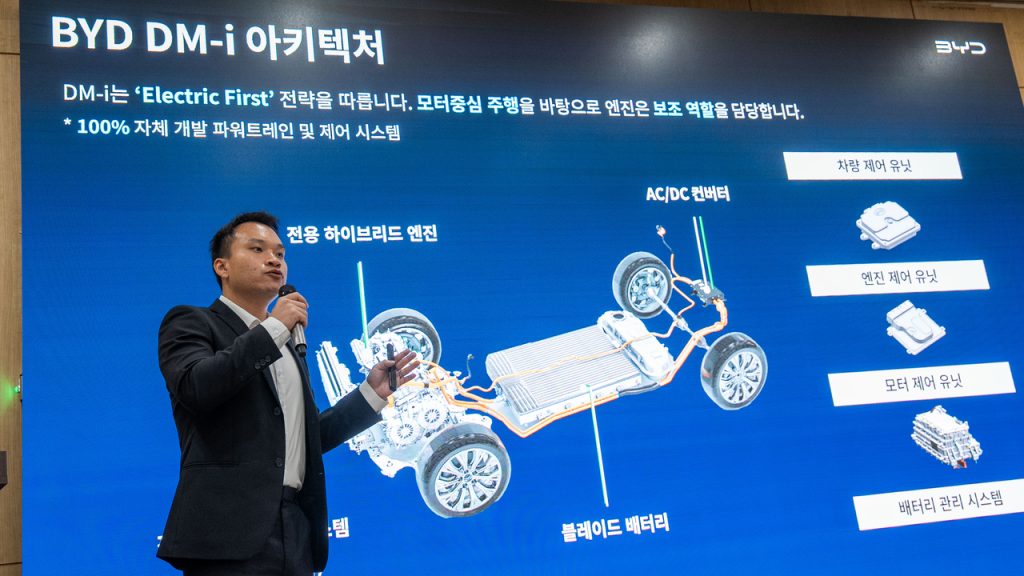
Kelvin Lai, Vice President of Product Strategy for BYD’s Asia-Pacific Passenger Vehicle Business, highlighted the distinctive nature of the DM-i system, describing it as an “electric-first hybrid.” This innovative approach fundamentally differentiates BYD’s PHEVs from conventional hybrid models.
Unlike traditional hybrid vehicles that typically rely heavily on their gasoline engines, BYD’s DM-i technology prioritizes electric driving. The electric motor efficiently handles over 80 percent of daily driving scenarios, with the gasoline engine primarily functioning as a sophisticated power generator or a supplementary power source during demanding conditions or extended journeys.
“The DM-i system represents a next-generation hybrid built fundamentally on an electric-first philosophy,” Lai explained. “It offers the seamless experience of an electric vehicle for urban commutes while leveraging the efficiency of the engine for longer trips, ensuring optimal fuel economy and performance.”
Lai further emphasized that high fuel prices and the associated maintenance costs of internal combustion engine (ICE) vehicles continue to be a significant burden for consumers globally.
“Through our state-of-the-art PHEV technology, we are committed to providing consumers with a superior and sustainable new mobility option that addresses these concerns,” he affirmed.
At the core of BYD’s DM-i technology is a highly efficient 1.5-liter turbocharged Xiaoyun engine, meticulously engineered specifically for hybrid applications. This is complemented by an advanced Electric Hybrid System (EHS) and BYD’s renowned Blade battery. The EHS intelligently manages the vehicle’s power distribution, ensuring a smooth and instantaneous transition between electric and engine power modes.
BYD Korea confirmed that the DM-i system supports rapid charging capabilities of up to 18 kilowatts. This allows the Blade battery to charge from 30 percent to 80 percent in approximately 30 minutes, offering unparalleled convenience. An international version, equipped with an 18.3-kilowatt-hour battery pack, boasts an impressive electric-only driving range exceeding 70 kilometers, while its combined driving range—utilizing both battery and gasoline power—can reach up to 1,080 kilometers.
BYD strongly emphasized that its DM-i technology closely emulates the driving experience of a pure battery-electric vehicle, standing apart from many conventional PHEV models currently available in the South Korean market.
“Many of the plug-in hybrids that Korean consumers are accustomed to, particularly those from prominent German brands, are primarily engine-driven, with the electric motor playing a secondary, supporting role,” stated Shim Jung-ho, Head of Product Planning at BYD Korea. “With our DM-i technology, the electric motor is engineered to be the principal source of propulsion, offering a fundamentally different and more electric-centric driving experience.”
“Upon the successful launch of our DM-i models, we project that PHEV sales will surpass our current EV sales by more than threefold, signifying a massive expansion in market reach,” he concluded, highlighting BYD’s ambitious growth expectations.
sahn