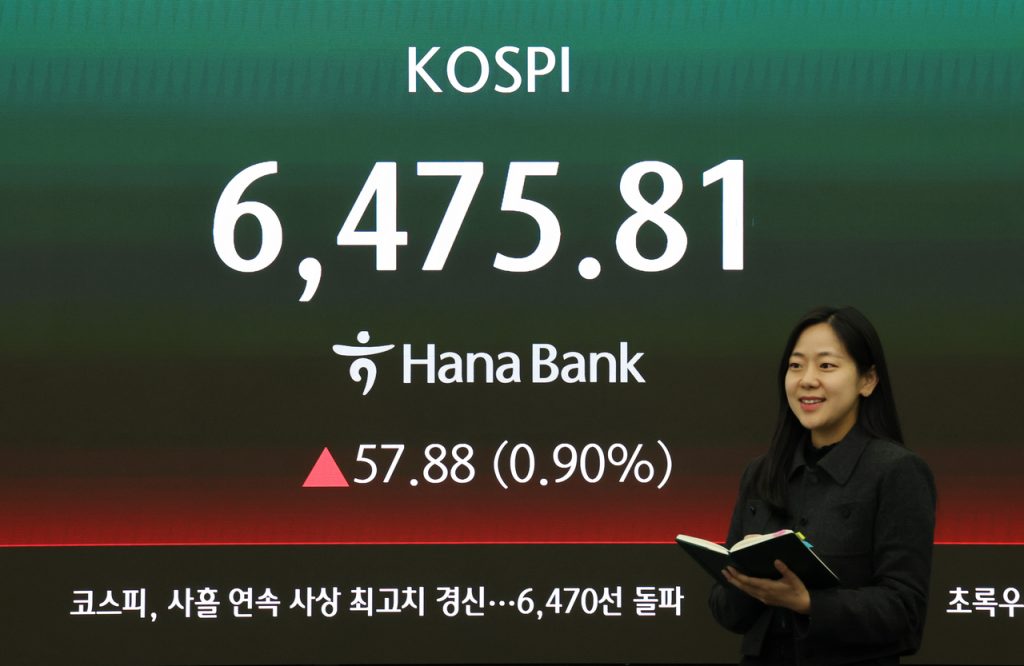
South Korean stocks achieved a fresh record high on Thursday, with the benchmark index nearing the significant 6,500-point level. This surge in the South Korean stock market was driven by robust investor focus on corporate earnings, further bolstered by the United States’ indefinite extension of its ceasefire in the conflict with Iran. Concurrently, the local currency, the Korean Won, experienced a slight depreciation against the US dollar.
The benchmark Korea Composite Stock Price Index (KOSPI) recorded an impressive climb of 57.88 points, or 0.9 percent, to conclude the trading day at an unprecedented 6,475.81, establishing a new all-time record for the index.
This marks a notable period for the KOSPI, which surpassed its previous all-time high earlier in the week on Monday, breaking a two-month hiatus. The index has since demonstrated consistent upward momentum, setting new record highs for three consecutive trading sessions, reflecting sustained investor confidence in the Korean market.
Opening 1.1 percent higher, the KOSPI tracked positive overnight gains from Wall Street. Despite experiencing some intra-day volatility, briefly dipping into negative territory, the index successfully recovered to close with a modest yet significant gain, showcasing resilient trading activity throughout the session.
Investor sentiment received a notable boost following an announcement by US President Donald Trump. He confirmed the indefinite extension of a two-week ceasefire with Iran, a decision made amidst stalled peace talks aimed at de-escalating the conflict. This development helped alleviate some geopolitical uncertainties that had been weighing on global markets.
Further underpinning confidence in the South Korean economy, recent data revealed that South Korea’s real gross domestic product (GDP) achieved its fastest quarterly expansion in five and a half years. The first quarter saw robust growth of 1.7 percent, underscoring the nation’s economic resilience even amidst ongoing global challenges.
Commenting on the broader market landscape, Peter Tuchman, a veteran trader at the New York Stock Exchange, suggested that the direct market impact of the US-Iran conflict has largely been absorbed. He highlighted that the primary remaining variable influencing market dynamics and investor decisions is now predominantly centered on global oil prices.