Korean Brokerages Struggle for Global IPO Shares: Allocation Failure in SpaceX Raises Alarm for Upcoming OpenAI, Anthropic Blockbusters
Mirae Asset Securities’ recent inability to secure any SpaceX Initial Public Offering (IPO) shares for its clientele has amplified existing concerns regarding the competitive standing of Korean brokerages within the fiercely contested global IPO market. This comes at a critical juncture, with a highly anticipated wave of artificial intelligence (AI) blockbuster listings, spearheaded by industry titans like OpenAI and Anthropic, poised to reshape the investment landscape.
According to industry experts, this incident starkly underscores the limited leverage Korean financial institutions often possess during the crucial final share allocation process for highly coveted global offerings. Such a disadvantage could effectively marginalize domestic investors, preventing their participation in some of the most sought-after Initial Public Offerings worldwide.
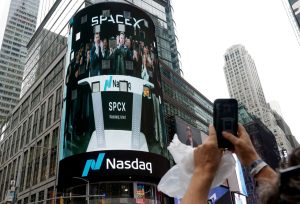
Goldman Sachs, serving as the lead underwriter for the monumental SpaceX offering, implemented a stringent “take-it-or-leave-it” policy. This approach saw the IPO price fixed at $135 per share, with Goldman Sachs solely dictating the maximum demand each syndicate member, including Mirae Asset, could submit.
Mirae Asset initially submitted an order for 2.31 million shares, valued at approximately $312.5 million, with an initial expectation of securing around 30 percent of its requested allocation. However, as the SpaceX offering rapidly became more than four times oversubscribed, Goldman Sachs subsequently notified all participating underwriters that allocations would be significantly curtailed.
Ultimately, Mirae Asset received no shares whatsoever from the SpaceX IPO.
The Korean brokerage’s predicament was not isolated. Mizuho Securities from Japan, for instance, reportedly sought approximately $6.2 billion worth of shares but only secured about 35 percent, amounting to $2.2 billion. Indeed, other syndicate members also experienced substantial reductions in their share allocations amidst the overwhelming demand.
This unfavorable outcome compelled Mirae Asset to initiate full refunds of all subscription deposits to Korean investors who had eagerly participated in the offering.
Adding to the complexity, Mirae Asset had proactively curtailed its effective subscription volume following interventions from foreign exchange authorities. These authorities had voiced apprehensions regarding the potential impact of heightened dollar demand on the South Korean won. Furthermore, the brokerage had granted investors the flexibility to withdraw their subscriptions until the preceding Thursday.
Financial regulators, acutely concerned by the won’s sharp depreciation, had actively encouraged brokerages to restrict participation primarily to professional investors, rather than broader retail clients, and to subsequently scale back the overall offering size to mitigate currency pressures.
From the vantage point of global underwriters, industry insiders suggest that the Korean order might have been perceived as a “soft order.” This designation typically applies to demand that is deemed potentially withdrawable, consequently carrying less weight during critical final share allocation decisions in a highly competitive IPO.
Within the investment banking sector, it is a common practice that when an Initial Public Offering (IPO) becomes significantly oversubscribed, “soft orders” are among the initial allocations to be reduced or entirely eliminated.
While Korean brokerages have progressively strived to establish themselves as key gateways for overseas IPO investments, their influence wanes significantly in megadeals characterized by intense global demand. In such scenarios, final share allocations are predominantly shaped by powerful Wall Street firms and their extensive, long-standing institutional investor networks.
“Irrespective of any specific brokerage’s culpability, the SpaceX IPO incident serves as a stark illustration of the current level of allocation competitiveness Korean financial firms face within dynamic global capital markets,” commented a senior industry official.
“As the pipeline for large-scale technology Initial Public Offerings continues to accelerate, the robustness of global networks and the deal-sourcing capabilities of Korean brokerages will undoubtedly be subjected to renewed scrutiny and rigorous testing,” the official added.
This recent experience is also projected to fundamentally alter how Korean investors appraise future overseas IPO opportunities.
Historically, participation within an underwriting syndicate was often considered a reliable proxy for investors to gain access to highly sought-after shares. However, analysts now suggest that prospective investors will likely scrutinize factors such as genuine allocation authority, anticipated allocation ratios, and robust investor protection mechanisms much more closely.
These growing concerns emerge as global attention increasingly converges on a significant potential pipeline of highly anticipated AI-related Initial Public Offerings.
OpenAI and Anthropic are broadly acknowledged as two of the preeminent and most valuable enterprises within the burgeoning global AI industry. They are consistently cited as prime candidates for future public listings in the coming years. Any such public offering would inevitably draw colossal demand from leading technology funds, formidable pension funds, expansive sovereign wealth funds, and specialized AI-focused investors across the globe.
“Should either OpenAI or Anthropic proceed with a public listing, it is poised to become one of the most intensely scrutinized and closely watched IPOs in recent memory,” remarked another financial official.
“Furthermore, if the competition within the bookbuilding process escalates significantly, the share allocation ultimately available to Asian investors could prove to be substantially smaller than initially anticipated,” the official concluded.