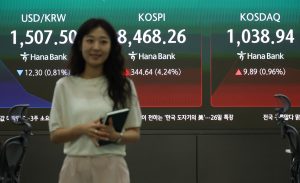
South Korean equities experienced a sharp decline on Thursday, mirroring an overnight tech sector slump on Wall Street. This market downturn was primarily driven by investor concerns over the valuation of artificial intelligence (AI) shares and escalating geopolitical tensions between the United States and Iran, impacting global market stability.
After an initial fall of 2.86 percent, the benchmark Korea Composite Stock Price Index, commonly known as Kospi, saw extended losses. Within the first 15 minutes of trading, the Kospi plunged by 288.94 points, or 3.74 percent, reaching 7,441.88. This significant drop underscores broader market anxieties.
The steep decline of the Kospi directly aligned with the substantial overnight losses observed across major US indexes, spearheaded by a significant tech stock sell-off that reverberated globally.
On Wall Street, the Dow Jones Industrial Average closed 1.87 percent lower, while the S&P 500 experienced a 1.62 percent fall. The tech-heavy Nasdaq composite index, a key indicator for technology stocks, shed 1.98 percent, reflecting widespread investor retreat from growth-oriented sectors.
Prominent AI chip manufacturers were among the hardest hit amid growing concerns of an “AI bubble.” Industry leader Nvidia saw its shares dip by 3.73 percent, Broadcom slid 5.12 percent, Super Micro Computer tumbled by a considerable 28 percent, and AMD dropped 4.86 percent, signaling caution in the rapidly expanding AI market.
Adding to the pressure on market sentiment was news of additional US strikes against Iran. This was further exacerbated by Iran’s threat to target any vessel attempting passage through the critical Strait of Hormuz, sparking fears of a potential re-escalation into full-scale conflict between the two nations and increasing geopolitical risks for global markets.
Seo Sang-young, an analyst at Mirae Asset Securities, noted that while the US Consumer Price Index (CPI) for May, a crucial piece of inflation data, came in softer than anticipated, it was insufficient to alleviate investor anxieties regarding a potential hawkish shift in monetary policy by the US Federal Reserve. This uncertainty continued to weigh on global economic outlooks.
In Seoul, a wide range of big-cap shares, representing some of South Korea’s largest companies, experienced significant declines.
Market leader Samsung Electronics, a top-cap entity, shed 3.47 percent. Its primary chipmaking competitor, SK hynix, also saw a fall of 2.54 percent, highlighting the impact on the vital semiconductor industry.
AI investment firm SK Square plummeted 7.86 percent, while Samsung Electro-Mechanics dipped 4.54 percent. The broader SK Group backtracked 6.91 percent, reflecting a challenging day for tech-related conglomerates.
The automotive sector was also heavily impacted, with top automaker Hyundai Motor slipping 5.81 percent. Its sister company, Kia, contracted 5.13 percent, and auto parts manufacturer Hyundai Mobis dropped 4.56 percent, indicating sector-wide vulnerability.
Leading battery manufacturer LG Energy Solution lost 3.76 percent, and its rival Samsung SDI went down 5.14 percent, underscoring challenges in the electric vehicle (EV) battery supply chain.
Finally, power plant manufacturer Doosan Enerbility decreased 5.93 percent, and home appliances giant LG Electronics was down 4.91 percent, showcasing a broad-based market correction across various industrial sectors.