
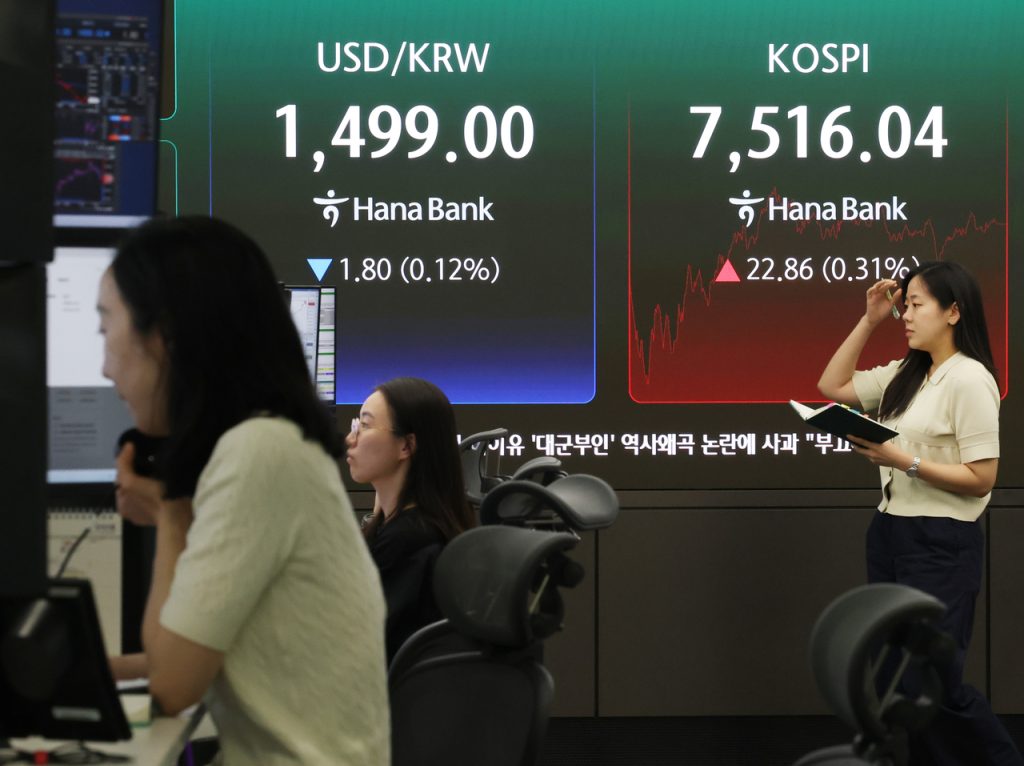
South Korean equities rallied on Monday, recovering from a sharp decline in the prior session, as investors actively purchased shares of key chipmakers, notably market leader Samsung Electronics. The local currency also strengthened against the US dollar.
Following volatile trading, the benchmark Korea Composite Stock Price Index (KOSPI) advanced by 22.86 points, or 0.31 percent, concluding the day at 7516.04.
Trading volume remained moderate, totaling 561.4 million shares valued at 43.4 trillion won ($28.9 billion). Declining stocks significantly outnumbered advancers, with 685 losers against 203 winners.
The previous Friday saw the KOSPI plunge over 6 percent, driven by sustained foreign sell-offs of technology shares and escalating inflation concerns amidst the ongoing geopolitical tensions in the Middle East.
The Korean stock market initially opened lower, mirroring declines observed on Wall Street last week. This initial downturn was fueled by increasing global bond yields and persistent inflation concerns.
The KOSPI further deepened its losses during early trading, briefly dropping to 7,142.71, representing an approximate 5 percent decline. This prompted the local bourse operator to trigger a five-minute sell-side sidecar program.
However, the index later reversed course, gaining momentum from advances in large-capitalization chip stocks. This positive shift followed a district court’s partial acceptance of Samsung Electronics’ injunction request to prevent a scheduled strike on Thursday.
Meanwhile, management and the company’s largest labor union also recommenced government-mediated wage negotiations.
“The KOSPI index significantly reversed its trend and moved higher due to the strong rebound in Samsung Electronics shares,” stated Lee Kyung-min, an analyst at Daeshin Securities. He added that strategic bargain hunting played a key role in the KOSPI’s recovery.
Foreign investors were net sellers, offloading 3.65 trillion won worth of South Korean shares, thereby extending their selling streak to an eighth consecutive trading session. Conversely, institutional and retail investors were net buyers, acquiring 1.39 trillion won and 2.21 trillion won, respectively.
Across the broader market, most large-capitalization stocks closed mixed, though technology shares notably led the market’s gains.
Samsung Electronics shares surged 3.88 percent, closing at 281,000 won, despite an initially sharp decline. Fellow chip giant SK Hynix also saw gains, rising 1.15 percent to finish at 1,840,000 won.
In contrast, the AI investment firm SK Square experienced a slight decline of 0.46 percent, settling at 1.09 million won. Leading battery manufacturer LG Energy Solution also dipped 2.16 percent to 408,000 won.
Automotive shares were notably among the day’s underperformers. Industry giant Hyundai Motor saw its stock lose 5.29 percent, closing at 663,000 won, while its auto parts manufacturing affiliate, Hyundai Mobis, fell significantly by 9.22 percent to 571,000 won.


