
Samsung’s Opaque Bonus System Sparks Strike Threat Amidst SK Hynix’s Transparent Profit-Sharing Model
Samsung Electronics and its primary labor union re-entered mediation talks on Monday, just three days before a major 18-day strike involving up to 50,000 workers is set to begin. Negotiators continue to grapple with the same fundamental disagreement that has derailed all previous discussions regarding employee compensation.
The core dispute isn’t about the amount of bonuses, but rather the method of calculation and allocation.
The union demands that 15 percent of the chip division’s operating profit be formally designated as the bonus pool, and that the current cap, limited to 50 percent of annual salary, be eliminated. In contrast, management’s latest proposal retains both the existing cap and the current Overall Performance Incentive (OPI) framework. It introduces a conditional special bonus: 9 to 10 percent of operating profit, payable only if the Device Solutions (DS) division achieves 200 trillion won ($133 billion) in operating profit, and only for a trial period of three years before renegotiation.
Contrasting Compensation Philosophies: Samsung vs. SK Hynix
Samsung Electronics compensates its semiconductor employees through a multi-tiered system. Their annual salary is divided into 20 segments, distributed via monthly payments and biannual Target Achievement Incentives. The Overall Performance Incentive (OPI) is then applied at the beginning of each year, based on divisional performance. The OPI is capped at 50 percent of annual salary and is derived from Economic Value Added (EVA), a metric that accounts for capital cost deductions from operating profit.
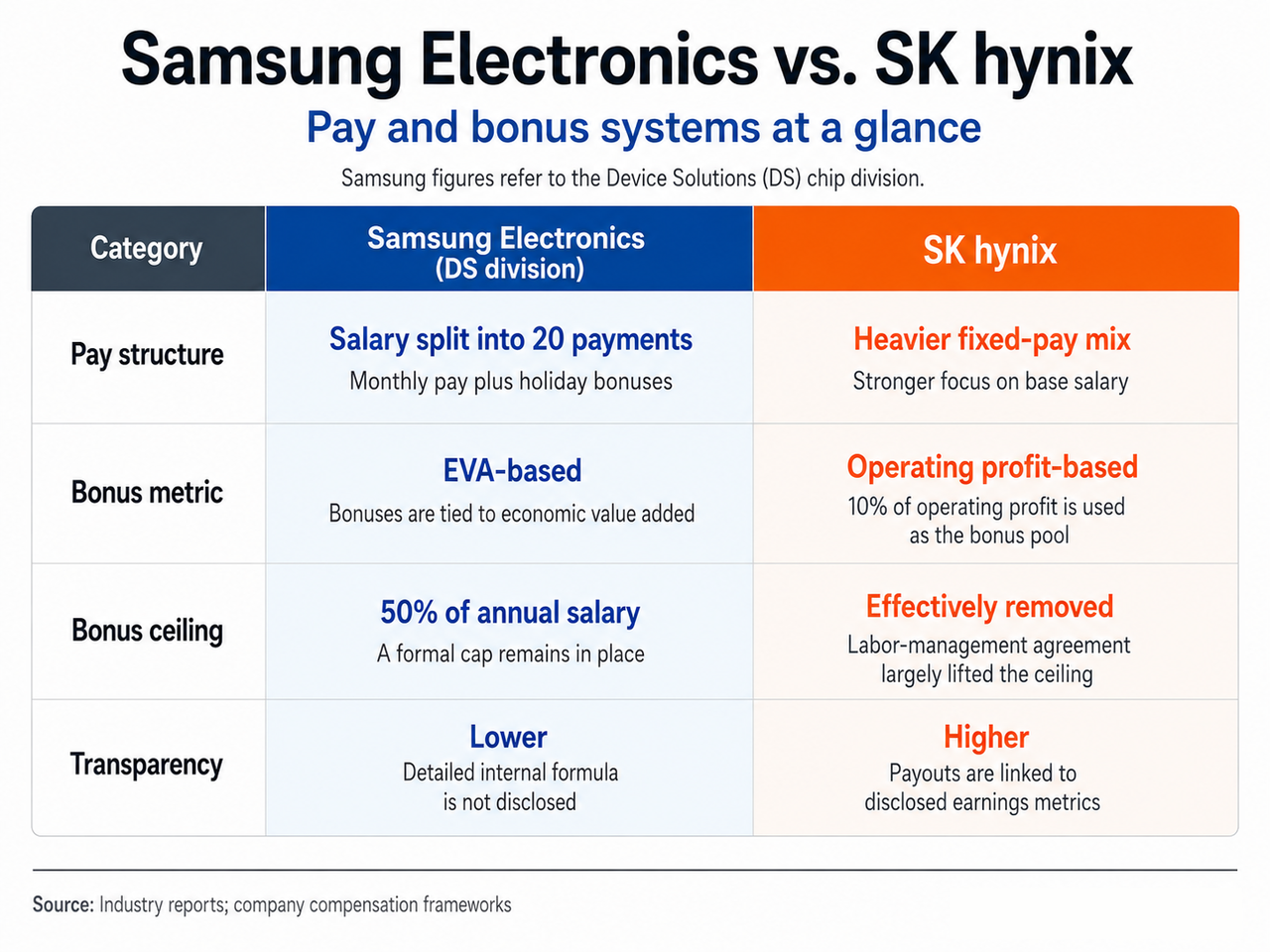
Crucially, the precise EVA formula and capital-cost assumptions remain undisclosed to Samsung employees. This lack of transparency allows the company flexibility in adjusting inputs, even when earnings show significant improvement.
SK hynix operates a distinct compensation model. Its profit-sharing bonus, disbursed annually, is directly linked to a fixed 10 percent of operating profit. A labor agreement in 2025 effectively abolished the bonus cap. Additionally, a separate productivity incentive, approximately 100 percent of base salary, is paid twice yearly. Special bonuses during the peak of the current AI memory boom have propelled total annual compensation for SK hynix employees into the hundreds of millions of won.
While a tangible cash gap exists, the real differentiator for workers is the predictability gap. SK hynix employees can readily estimate their potential bonus based on publicly reported earnings, a luxury not afforded to their Samsung counterparts.
An industry insider informed The Korea Herald that SK hynix’s 2025 policy shift was driven more by strategy than sheer generosity. Following an internal backlash in 2021 over an opaque EVA-based formula, similar to Samsung’s, the company likely concluded that the “persistent cost of formula disputes, employee attrition, and internal disengagement outweighed the benefit of a fixed 10 percent rule,” the official explained.
Samsung Electronics, however, has not adopted a similar strategic concession.
“The fundamental issue revolves around institutionalization and transparency,” a Samsung HBM mass-production engineer, who requested anonymity, told The Korea Herald. “Even if the company promises to match SK hynix-level compensation for memory, the problem is it’s often a one-off payment, partly in restricted stock for three years. That doesn’t constitute a sustainable system.”
Samsung Management’s Stance: Why Institutionalization is Resisted
Samsung management’s reluctance to codify a fixed bonus structure stems from its complex business portfolio, a challenge SK hynix does not face. The Device Solutions (DS) division encompasses memory, which currently enjoys a significant AI market windfall; foundry, responsible for custom chip manufacturing for clients like Tesla and Nvidia; and system LSI, which designs mobile processors. Foundry and system LSI segments have reportedly incurred losses amounting to trillions of won in recent years.
Samsung’s former lead negotiator, Vice President Kim Hyung-ro, articulated management’s rationale during talks reviewed by Reuters. He stated that the logic chip businesses “posted losses in the trillions of won, and honestly, if it had not been for our company, they probably would have gone out of business or closed down.” Kim emphasized, “Those critical investments are being funded with profits generated from the memory business.”
Institutionalizing a fixed share of the DS division’s operating profit would severely restrict management’s flexibility to reallocate vital memory cash flow into other strategic businesses that Chairman Lee Jae-yong has publicly committed to expanding. Consequently, management has only offered a three-year trial for new bonus terms, not a permanent, institutionalized system.
The Central Labor Relations Commission’s initial proposal, suggesting an additional 12 percent of operating profit as a special bonus if the chip division leads the industry in both revenue and operating profit, represents a middle ground between the two parties. The immediate question for Monday’s session was whether negotiations would converge around a 12 to 13 percent figure.
The more profound question remains whether any numerical agreement can hold without being formally integrated into the company’s system. Union chair Choi Seung-ho has been unequivocal: “We do not trust the company’s promises. We are demanding clear institutionalization,” he has reiterated since talks broke down on May 13.
mjh


