
US Investment Bank Goldman Sachs Lifts Kospi Target to 9,000 on Robust Chip Earnings, AI Demand, and Improving Shareholder Returns
Leading US investment bank, Goldman Sachs, has significantly raised its 12-month Kospi target to 9,000. This ambitious projection, among the highest from major brokerages, underscores their conviction that South Korean stocks offer substantial upside potential, even after the benchmark index has soared over 75 percent this year.
In a swift move, Goldman Sachs elevated its target from 8,000 in a recent Thursday report, barely three weeks after its last upgrade. The firm declared South Korea its “highest conviction view” in Asia, remarking that even this updated forecast remains “conservative.” Key drivers cited include robust earnings growth, attractive valuations, and significant improvements in corporate shareholder returns.
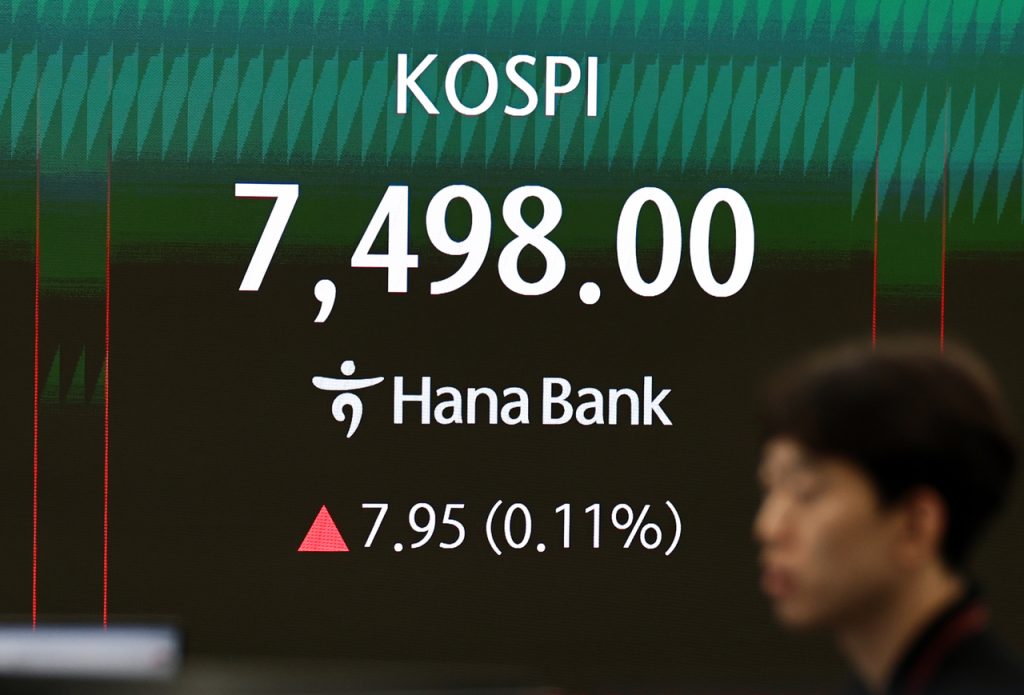
This rapid recalibration of targets highlights the dramatic shift in market expectations for Seoul, as the Kospi continues to break new records despite persistent external risks. The benchmark index has surged an impressive 14 percent this month alone, climbing from approximately 6,600 to a new record close of 7,498 on Friday. Earlier, on Thursday, it even touched an all-time intraday high of 7,531.88, showcasing robust market momentum.
Goldman Sachs emphasizes that the sustained rally in South Korea is fueled by deep-rooted structural factors rather than mere short-term momentum. They specifically point to the strong semiconductor memory cycle, burgeoning demand from artificial intelligence (AI) advancements, and the government’s impactful “Value Up” program as pivotal forces driving a comprehensive market rerating.
The investment bank’s forecast for Korean earnings growth this year is a staggering 300 percent—the strongest projected for any Asian market since the 1999 rebound following the Asian financial crisis. This phenomenal growth outlook significantly surpasses the 45 percent growth estimate for Taiwan, another technology-heavy market that Goldman also recently upgraded.
Goldman analysts contend that the market is currently underpricing the long-term durability of earnings, especially given the prospect of sustained high profits within the semiconductor memory sector. They highlight that South Korean chip stocks continue to trade at remarkably low single-digit forward price-to-earnings (P/E) ratios, despite the immense scale and potential of the current memory upcycle.
Further bolstering the bullish outlook, Goldman also identifies a balanced positioning across foreign, retail, and domestic institutional investors. Additionally, potential capital inflows resulting from relaxed foreign retail investment rules are expected to provide further support for continued market gains.
Both South Korea and Taiwan have spearheaded the region’s recovery post-Iran-war tensions, largely attributed to their significant exposure to the technology hardware and semiconductor sectors, as per Goldman’s analysis. From its March low, Korea’s market has surged an impressive 62 percent, while Taiwan has seen a 35 percent rise, positioning both markets comfortably above their pre-war peak levels.
This optimistic sentiment is echoed by other prominent global and domestic brokerages. Citi, for instance, revised its Kospi target upwards to 8,500 from 7,000 on Thursday, and NH Investment & Securities elevated its projection to 9,000 from 7,300. Both firms significantly upgraded their forecasts, originally issued in February.
The robust market rally is also attracting significant capital inflows into Korea-focused investment funds. According to market data platform FnGuide, as of Sunday, net assets of domestic equity ETFs have surpassed an astonishing 200 trillion won ($136.5 billion), indicating a strong trend where retail investors are increasingly leveraging ETFs to capitalize on the Kospi’s powerful surge.
Assets held in ETFs that track locally listed South Korean shares have demonstrated phenomenal growth, more than doubling from 40 trillion won at the close of 2024 to 93 trillion won by December 2025. This rapid expansion saw assets more than double again in just approximately four months as the market rally gained further momentum. Consequently, their share of the Kospi’s total market capitalization climbed from 2.08 percent to 3.47 percent during this period.
Signifying a notable strategic shift, domestic equity ETFs now constitute 46.64 percent of all Korea-listed ETF assets, a substantial increase from 24.32 percent at the end of 2024. This trend clearly indicates a renewed investor focus on local South Korean equities, moving away from previous years where ETFs were predominantly utilized for international market exposure.
jwc


