
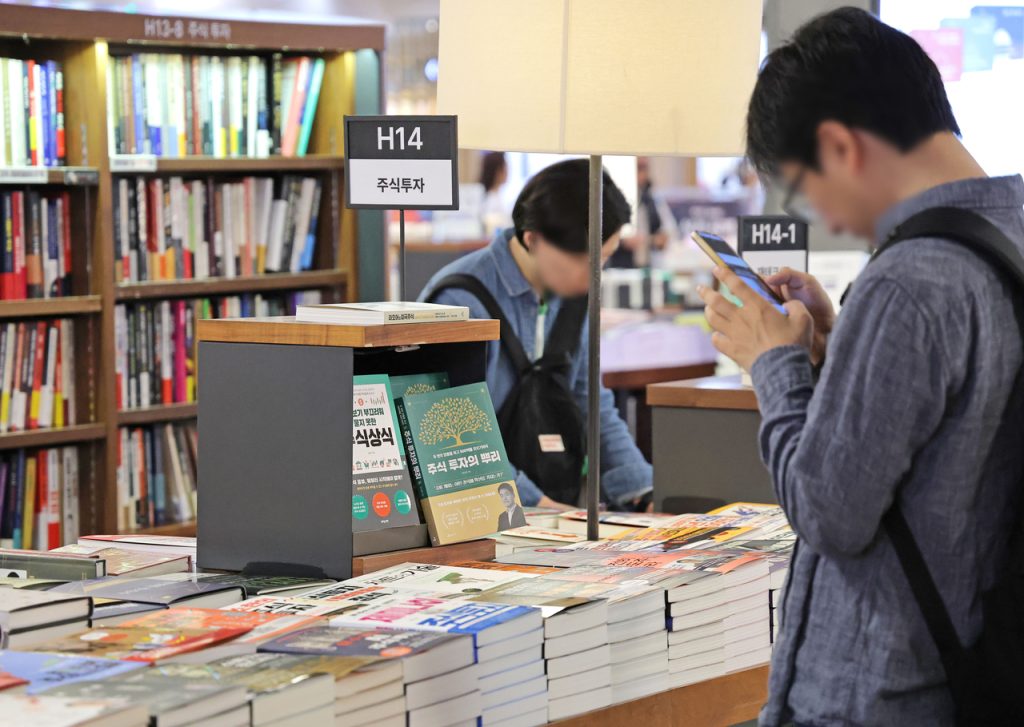
As South Korea’s benchmark **Kospi index** extends its **record-breaking rally**, investor enthusiasm is significantly boosting activity in bookstores. This surge reflects a growing public interest in **stock market investment** and **personal finance** across the nation.
Data from Yes24, **South Korea’s largest online bookseller**, reveals a remarkable trend: sales of books focused on **domestic stocks** and **investment strategies** soared by 305 percent during the Jan. 1-May 6 period, compared to the same timeframe last year. This highlights the intense public interest in understanding the nuances of the **Korean stock market**.
The **Kospi benchmark** concluded Friday’s trading session at an impressive 7,498 points, marking approximately a 74 percent increase from the initial trading day of the year. This substantial market surge is primarily fueled by widespread optimism concerning the escalating global demand for **artificial intelligence (AI) chips** and the broader expansion of the **AI technology ecosystem**.
**SK hynix**, one of **South Korea’s prominent chipmakers** alongside **Samsung Electronics**, exemplifies this robust performance. Its shares closed Friday almost 150 percent higher than their value at the beginning of the year, showcasing the profound impact of the **AI boom** on **Korean semiconductor stocks**.
This **unprecedented market rally** has inevitably led many potential investors to experience **FOMO**, or the “fear of missing out.” This sentiment is driving a significant influx of **retail investors** into the market, prompting a renewed quest for comprehensive **stock market knowledge** and effective **investment strategies** through educational resources.
Yes24’s reports confirm a sharp escalation in **stock investment book sales** coinciding with the **Kospi** crossing key psychological thresholds. Sales surged by 319 percent in January and 294 percent in February, relative to the previous year, as the **benchmark index** successfully breached the 5,000 and 6,000 points, respectively, further illustrating the strong correlation between market performance and investor education demand.
milaya


