
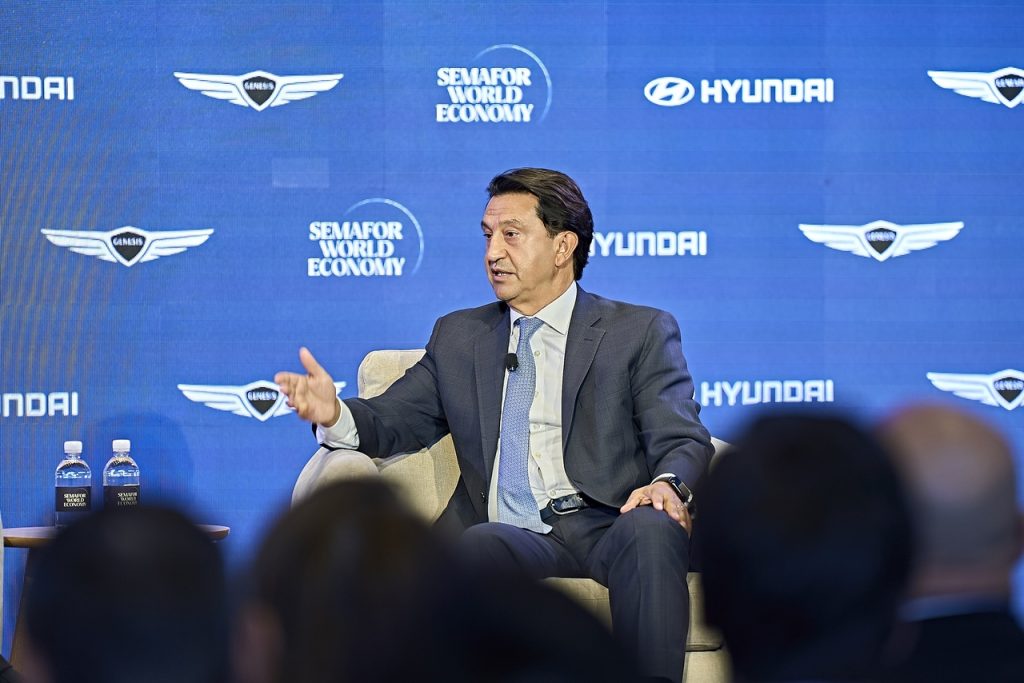
Hyundai Motor CEO Jose Munoz confidently projected that the company’s advanced autonomous vehicles, particularly those built on the Ioniq 5 platform, are poised to become a ubiquitous presence across the United States.
Speaking at the prestigious Future of Mobility track session during the 2026 Semafor World Economy summit held Tuesday in Washington, Munoz detailed Hyundai’s comprehensive mobility strategy, which hinges on three transformative pillars: autonomous driving, advanced robotics, and sustainable hydrogen energy.
“Autonomous driving is not the future — it is the present,” Munoz emphatically stated. He highlighted current deployments, noting that consumers can already experience Waymo vehicles in San Francisco and Ioniq 5-based Motional robotaxis in Las Vegas. Looking ahead, he envisioned the Ioniq 5 autonomous vehicle becoming a widespread fixture throughout the entire U.S.
Hyundai is actively securing its leadership in self-driving technology through Motional, its strategic autonomous driving joint venture with Aptiv, a key collaboration for Hyundai Motor Group.
Through Motional, Hyundai Motor Group plans to deploy its proprietary autonomous technologies on a large scale, with future plans to integrate even more advanced self-driving capabilities into its consumer vehicle lineup.
Transitioning to robotics, Munoz reaffirmed Hyundai’s strategic commitment to expanding the use of advanced robotics in manufacturing. This includes integrating cutting-edge Atlas humanoid robots, developed by Hyundai Motor Group’s subsidiary, Boston Dynamics, into production lines.
He elaborated on the immediate benefits: “By deploying Boston Dynamics’ ‘Atlas’ on production lines, we will be able to see humanoids that assist with work that is difficult for humans to perform, enhancing efficiency and safety.”
Crucially, Munoz emphasized that these advanced robots are designed to support human workers, not replace them.
He further clarified Hyundai’s philosophy, stating, “We do not view robots as a means of workforce reduction; robots are meant to make workers’ lives more comfortable.” He added, “Increasing productivity, reducing costs, and improving quality is precisely what we aim to achieve through ‘physical AI,’ driving innovation in manufacturing.”
Munoz then pivoted to discuss Hyundai’s recent robust growth, attributing it directly to the company’s flexible and broad-ranging powertrain strategy.
He explained, “We have pursued a strategy of parallel deployment of internal combustion engines, hybrids, plug-in hybrids, and EVs,” showcasing Hyundai’s versatile approach to meet diverse market demands.
As a testament to this adaptability, Hyundai recently adjusted production plans at Hyundai Motor Group Metaplant America (HMGMA), its advanced electric vehicle production line in Georgia, to include hybrid vehicle manufacturing alongside EVs.
“This is an exemplary demonstration of how we initially focused on electrification but quickly pivoted our strategy in agile response to evolving consumer demand,” Munoz highlighted, underscoring the company’s market responsiveness.
Shifting focus to future energy, Munoz strongly emphasized hydrogen’s pivotal role as a key future energy source. He noted that significant advancements in hydrogen technology have not only enhanced effectiveness but also substantially reduced operational expenses.
He elaborated, “With significant advancements in hydrogen technology, stack efficiency and the performance of hydrogen fuel cell vehicles have markedly improved, while operating costs have decreased.” He provided a tangible example, confirming, “In fact, we are currently using hydrogen electric trucks in HMGMA logistics operations, demonstrating real-world application.”
Munoz further underscored hydrogen’s versatile applications across various sectors. “We must overcome vague fears about hydrogen and enable it to be utilized efficiently in land, air, and maritime transportation, unlocking its full potential,” he urged.
The prestigious Semafor World Economy conference, organized by the US-based news platform Semafor, convenes an influential gathering of chief executives from Fortune 500 companies, esteemed government officials, and leading business figures from across the globe.
Hyundai’s prominent involvement was further highlighted by the attendance of Hyundai Motor Group Executive Chair Chung Euisun, a distinguished member of the Global Advisory Board of the Semafor World Economy. This year’s crucial Future Mobility track session itself received sponsorship from Hyundai’s luxury brand, Genesis, underscoring the company’s commitment to shaping the future of transportation.
sahn


