
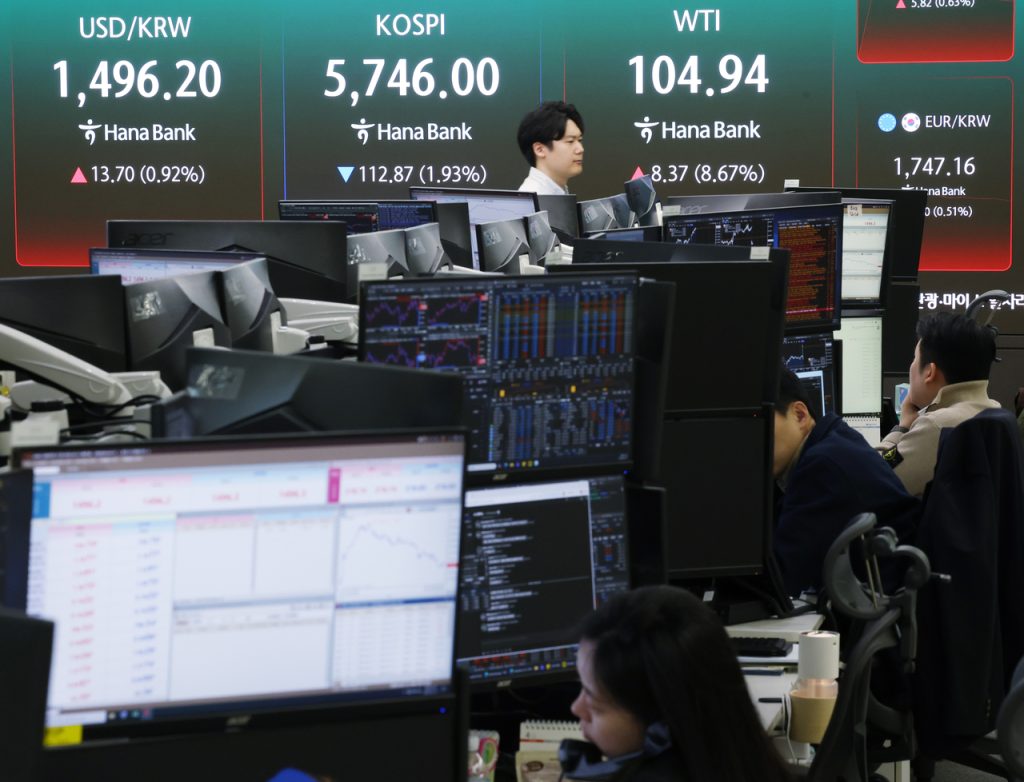
Global Investors Inject 5 Trillion Won into South Korean Shares in April, Reversing Previous Outflows
After being significant net sellers of Korean equities in February and March, foreign investors have notably reversed course this month, becoming net buyers and providing crucial support to the benchmark Kospi index.
According to data released Monday by the Korea Financial Investment Association, the total market value of foreign-held shares reached 1,821 trillion won (approximately $1.22 trillion) as of last Friday. This accounts for a substantial 38 percent of the Kospi’s overall market capitalization and represents a rapid increase from 1,509 trillion won recorded on March 31, achieved over just eight trading sessions.
Foreign ownership had initially surged from 1,306 trillion won at the beginning of the year to 1,982 trillion won by February 26, a period when the Kospi briefly touched the 6,000-point mark. However, these gains were subsequently pared back following renewed tensions in the Middle East.
Between April 1 and 10, global investors executed net purchases totaling 5.25 trillion won worth of Kospi-listed shares. This positive inflow follows substantial net sales of 35 trillion won during the preceding month, highlighting a notable shift in sentiment among international investors.
Investor confidence appears to have improved after initial hopes for a ceasefire agreement emerged, easing concerns stirred by the Middle East crisis. Nevertheless, the stalled ceasefire talks involving the US and Iran continue to cast a shadow, suggesting that short-term market volatility may persist for South Korean stocks.
“The magnitude of foreign buying since February 12 represents one of the most significant shifts on record,” noted Lee Jaewon, an analyst at Yuanta Securities. “Selling pressure has visibly eased in April, with a clear focus on acquiring large-cap and leading technology stocks.”
Foreign capital inflows have been particularly robust into prominent semiconductor manufacturers. Following net sales of 18.24 trillion won in Samsung Electronics and 8.15 trillion won in SK hynix last month, international investors have turned net buyers this month, acquiring 2.35 trillion won and 1.55 trillion won in these respective companies.
This turnaround coincides with Samsung Electronics reporting exceptional first-quarter earnings, fueling optimistic projections for memory chip stocks across the sector. FnGuide data indicates that 16 brokerage firms have raised their target prices for Samsung Electronics this month, while eight have similarly upgraded SK hynix. SK hynix is anticipated to announce its preliminary first-quarter results on April 23, with market expectations widely pointing to record earnings.
“Rising memory prices are driving upgrades to earnings forecasts for both the current and upcoming years, while long-term supply contracts enhance earnings visibility,” explained Han Dong-hee, an analyst at SK Securities. “Despite ongoing macro uncertainties, the compelling investment case for Artificial Intelligence (AI) remains firmly in place.”
Some market analysts advise caution, suggesting that future gains in South Korean equities will largely depend on how companies strategically deploy the substantial cash generated from their record-breaking earnings.
“Simply holding cash does not yield high returns,” stated Jung Woo-sung, an analyst at LS Securities. “Any additional upside will necessitate credible reinvestment strategies, such as significant new technology investments or substantial share buybacks, demonstrating clear returns and improved capital efficiency.”
Several brokerage houses are forecasting that the Kospi index could reclaim the significant 6,000-point level this week, driven by strong earnings momentum. NH Investment & Securities has projected a trading range of 5,400–6,200, identifying earnings upgrades as a primary supporting factor, while also highlighting geopolitical risks and inflationary pressures as potential headwinds for the Korean stock market.
“The US earnings season is scheduled to commence in earnest with Goldman Sachs on April 13 and JPMorgan on April 14,” commented Na Jung-hwan, an analyst at NH Investment & Securities. “Earnings momentum and valuations are showing improvement, and a de-escalation of geopolitical risks could rapidly restore investor risk appetite.”
He further cautioned that the upcoming release of the US March producer price index on April 14 could signal building inflation pressures, as rising commodity costs are potentially passed on from wholesalers to consumers.


