
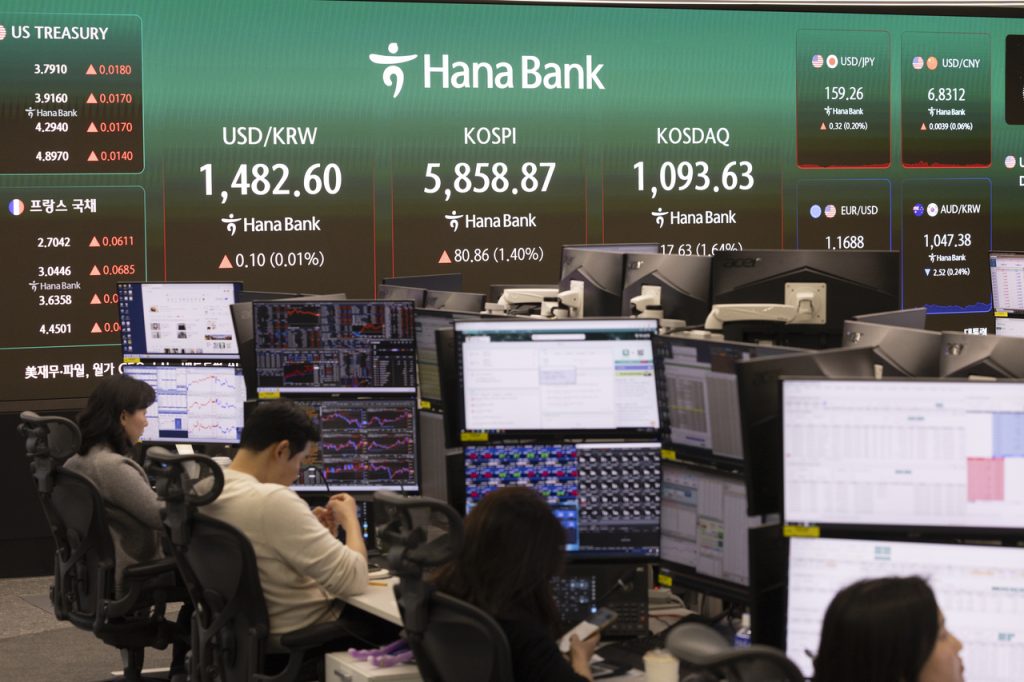
Analysts suggest that the substantial sell-off of South Korean equities by offshore investors this year primarily stems from portfolio rebalancing rather than a fundamental downturn in market sentiment. Foreign investors have offloaded a net 50.76 trillion won ($34.2 billion) worth of shares year-to-date through Friday, with experts pointing to the rebalancing of Korea’s portfolio weighting as the principal driver.
This rebalancing is likely triggered by Korea’s recent strong equity performance, which may have pushed its weighting within global pension and sovereign wealth fund portfolios to the upper limits of their strategic allocations,” explained Yeom Dong-chan, an analyst at Korea Investment & Securities. “This outperformance necessitated selling to bring portfolios back into balance.”
The offshore sell-off of Korean stocks commenced in February, coinciding with the benchmark Kospi nearing its rally peak. That month saw 19.86 trillion won in net sales, followed by 35.71 trillion won in March, according to Korea Exchange data. Yeom further noted that given the Kospi’s robust rally in February, this selling appears to be a consequence of portfolio construction rules enforced by major institutional investors, including pension funds and sovereign wealth funds.
Indeed, countries with significant sovereign wealth and pension fund exposure, such as Canada, the Netherlands, Singapore, and Saudi Arabia, have emerged as major sellers of Korean equities this year. Financial Supervisory Service data reveals that the Netherlands divested a net 954 billion won in Korean shares in February, while Singapore and Canada recorded net sales of 1.38 trillion won and 1.52 trillion won, respectively, during the same period.
“Furthermore, foreign investors’ net short positions in futures ceased increasing in mid-February,” Yeom added, “which could indicate improving conditions for future spot inflows, as index futures positioning often foreshadows spot market trends.”
Echoing this sentiment, KB Securities analyst Lee Eun-taek stated that recent foreign selling reflects ongoing portfolio rebalancing, rather than a shift towards a bearish market outlook. Lee elaborated, “Foreign investors had accumulated significant positions in semiconductor and auto stocks. As the share prices in these key sectors surged, they were effectively compelled to rebalance their portfolios to mitigate excessive concentration risk.”
Despite this substantial sell-off, foreign ownership of the benchmark Kospi remains robust, holding above 37 percent — a level close to a six-year high. This suggests continued net buying in other sectors, with foreign ownership standing at 37.33 percent as of Friday.
However, Lee cautioned that foreign investors might still be ‘overweight’ in Korean equities, potentially leaving scope for additional rebalancing-driven selling in the future.
silverstar


