
South Korean Won Strengthens Over 10 Won as KOSPI Recovers on Easing Geopolitical Tensions
South Korea’s KOSPI benchmark index experienced a significant uplift on Friday, driven by a notable return of foreign investors who became net buyers of Seoul stocks for the first time in over two weeks. This resurgence in investor confidence was largely fueled by growing optimism that geopolitical tensions related to the Middle East conflict could be easing.
According to data from the Korea Exchange, overseas investors infused a substantial net 810 billion won (approximately $537 million USD) into KOSPI-listed shares. This marked a decisive end to a prolonged 12-session selling spree, during which foreign entities had divested a considerable net 2.3 trillion won from the South Korean market.
Preceding Friday’s robust performance, early indications of a market turnaround were observed throughout the week. Foreign investors progressively reduced their net selling, which had peaked at 3.84 trillion won on Tuesday, narrowing to 640 billion won by Wednesday, and further decreasing to 140 billion won on Thursday.
The strong gains witnessed on Friday primarily reflected a significant ‘relief rally’ across the South Korean market. This sentiment was largely driven by renewed hopes for the full reopening of the critical Strait of Hormuz, which notably revitalized investor risk appetite. Reports indicating that Iran and Oman were actively collaborating on protocols for safe passage through this vital waterway significantly alleviated concerns about a protracted disruption, even as global oil prices maintained their elevated levels.
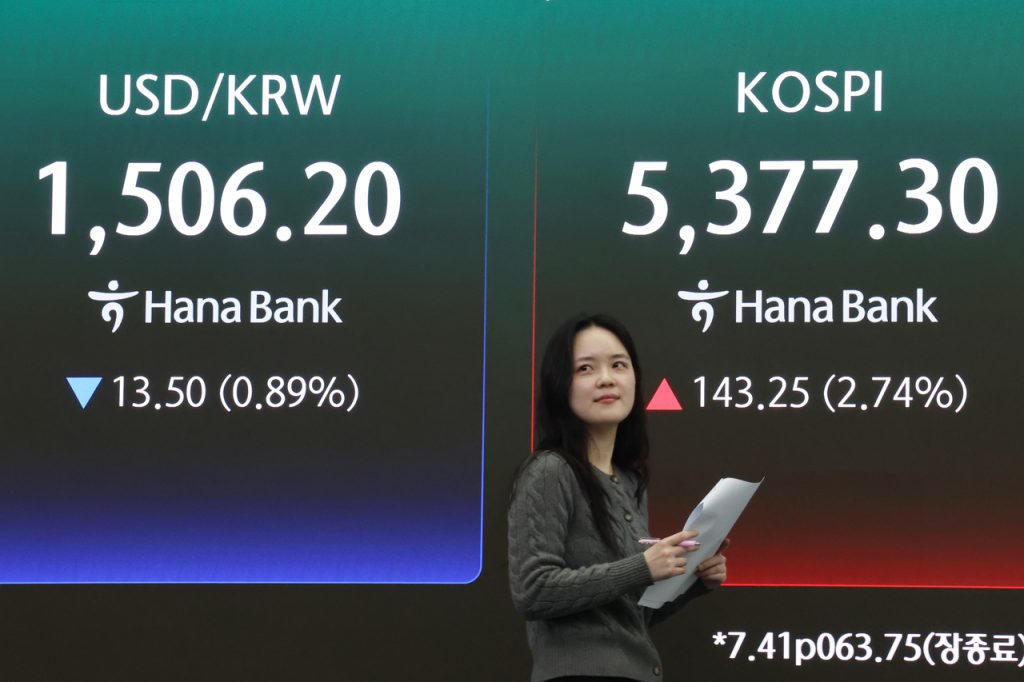
The KOSPI benchmark index concluded Friday’s trading session up 2.7 percent, settling at 5,377. Although the index surged to an intraday high of 5,419.45 during morning trade, it pared some of these gains, closing just below the 5,400 threshold. This was primarily due to a significant sell-off by retail investors, who offloaded a net 2.1 trillion won worth of shares. However, institutional investors provided crucial support to the rally, acquiring a net 720 billion won in conjunction with foreign buying.
Market heavyweights within the KOSPI played a pivotal role in leading these gains. South Korean tech giant Samsung Electronics, a bellwether stock, saw its shares climb by over 4 percent, while the nation’s second-largest chipmaker, SK Hynix, experienced an impressive 5.5 percent increase. Interestingly, foreign investors showed a diversified approach to these two semiconductor giants, opting to sell Samsung Electronics shares while actively purchasing SK Hynix.
The performance of other significant South Korean stocks presented a mixed picture. Hyundai Motor, a leading automotive manufacturer, advanced by 1.2 percent, and Hanwha Aerospace saw a 2.3 percent increase. Conversely, battery maker LG Energy Solution experienced a 1.5 percent decline, and pharmaceutical firm Samsung Biologics fell by 2 percent.
This positive shift in market sentiment also significantly alleviated the considerable pressure on the South Korean won. The national currency had been under heavy strain in recent days, largely due to escalating global crude oil prices, which had pushed its value as low as 1,523.3 per U.S. dollar on Thursday.
With the diminishing fears of a prolonged Strait of Hormuz blockade, the Korean won staged a robust recovery. It concluded daytime trading at approximately 1,505 against the U.S. dollar, marking an impressive strengthening of over 14 won compared to its previous session’s close of 1,519.7. The currency even touched an intraday high of 1,504.7 during trading hours.
Mirroring the broader market trend, the tech-heavy KOSDAQ index also experienced gains, rising by 0.7 percent to close at 1,063.75. On the KOSDAQ, individual investors were net buyers, acquiring 400 billion won, while both foreign and institutional investors remained net sellers.
Several market analysts suggested that the recent foreign selling activity observed earlier in the week was less indicative of a widespread withdrawal from South Korean assets and more akin to strategic profit-taking in sectors that had already enjoyed significant rallies. This perspective implies that overseas investors may now have increased capacity to reallocate capital if the current earnings momentum expands beyond the semiconductor sector.
Kim Min-gyu, an analyst at KB Securities, elaborated on this trend, stating, “While the selling volume was substantial, the overall shift in foreign ownership remained relatively contained. The recent net selling was notably concentrated in high-performing sectors like semiconductors, where share prices had already seen considerable appreciation.”
Kim further emphasized the strategic advantage for foreign investors, noting that “with foreign portfolios now optimized and lighter, their agility and capacity for strategic movement have expanded.” He highlighted a broadening of positive earnings revisions, which “once primarily concentrated in semiconductors, are now increasingly evident in other sectors.” Kim pointed to promising areas such as defense and aerospace, chemicals, batteries, entertainment, and IT hardware, while also recognizing sustained foreign interest in the energy sector, nuclear-related businesses, banking institutions, and trading companies.
jwc


