
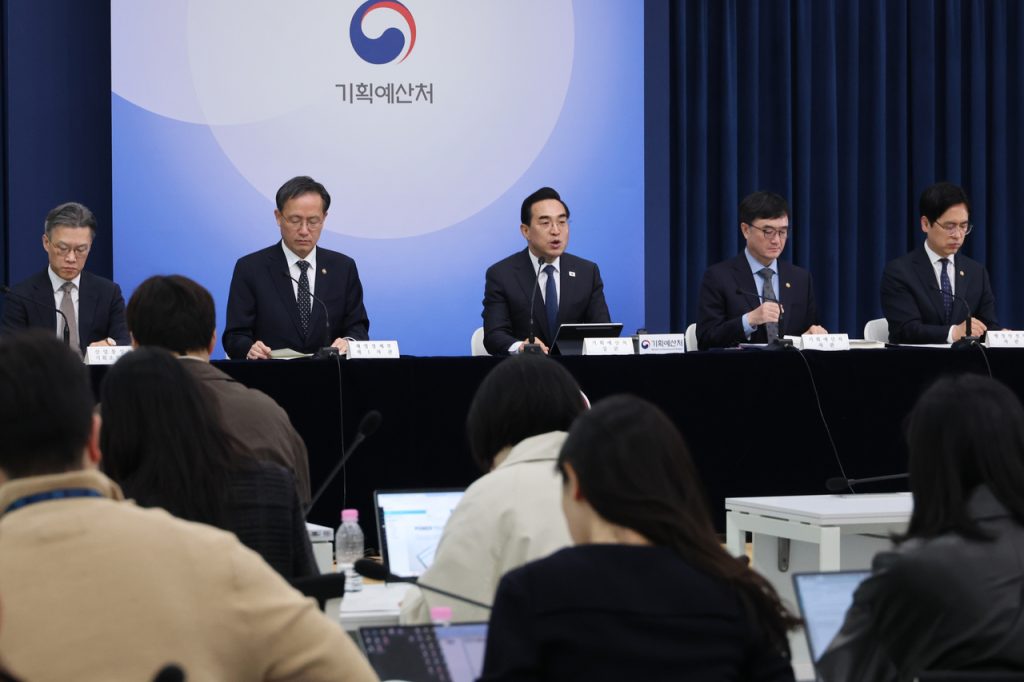
The South Korean government announced a proposed supplementary budget of 26.2 trillion won ($17.1 billion) on Tuesday, primarily aimed at mitigating the impact of rising fuel costs amidst escalating geopolitical tensions in the Middle East. A key feature of the budget is direct cash assistance for approximately 70% of the population.
According to the Ministry of Planning and Budget, the proposal, already approved by the Cabinet, is structured around three core objectives: addressing high oil prices, stabilizing livelihoods, and minimizing industrial disruption while securing critical supply chains.
“Our economy is facing a significant wave of crises, triggered by increasing uncertainties both domestically and internationally, which originate from heightened tensions in the Middle East,” stated Budget Minister Park Hong-keun to reporters.
Global oil prices have seen a sharp increase following the effective closure of the Strait of Hormuz after reported U.S.-Israeli actions in Iran in late February, leading to disruptions in global oil supplies. South Korea is particularly vulnerable due to its heavy reliance on energy imports.
The minister emphasized that elevated oil prices and subsequent inflation are disproportionately affecting vulnerable populations, including small business owners and younger generations.
A significant element of the proposed budget is a 4.8 trillion won allocation for cash handouts to the lowest 70% of income earners, the ministry detailed.
Approximately 35.8 million individuals will receive payments ranging from 100,000 won to 600,000 won per person, with the amount varying based on income level, geographical region, and whether the recipients reside in areas experiencing population decline.
The highest payments, reaching up to 600,000 won per person, will be directed towards recipients of basic livelihood security benefits who live outside the Seoul metropolitan area.
An additional 5.1 trillion won is earmarked to support a fuel price cap program and measures aimed at mitigating potential supply disruptions of naphtha, a vital raw material used extensively in the petrochemical and other industrial sectors.
The price cap system, introduced in March, allows the government to set maximum prices for fuel products supplied by oil refiners to gas stations and retail distributors every two weeks, reflecting fluctuations in international oil prices.
From the 5.1 trillion won, 87.7 billion won will be dedicated to temporarily increasing the public transportation refund rate by up to 30 percentage points for a six-month period, supporting the recent implementation of a mandatory five-day vehicle rotation system.
The government has implemented the vehicle rationing system within the public sector, encouraging voluntary participation from the private sector, and promoting the use of public transportation.
The ministry also announced that 9.7 trillion won will be allocated to substantially reinforce the financial stability of local governments.
Other expenditures include 1.9 trillion won for initiatives supporting youth entrepreneurship and job creation, 500 billion won for the transition to renewable energy sources, and 700 billion won for stabilizing supply chains.
The supplementary budget will be financed without issuing additional government bonds. It will utilize 25.2 trillion won in tax revenue and 1 trillion won from public funds.
“The increase in tax revenue is attributed to strong economic performance under the current administration, driven by a boom in the semiconductor industry and a robust stock market,” Park concluded.


