
Hyundai CEO Unveils $26B US Investment, Production Expansion Amid Tariff Concerns
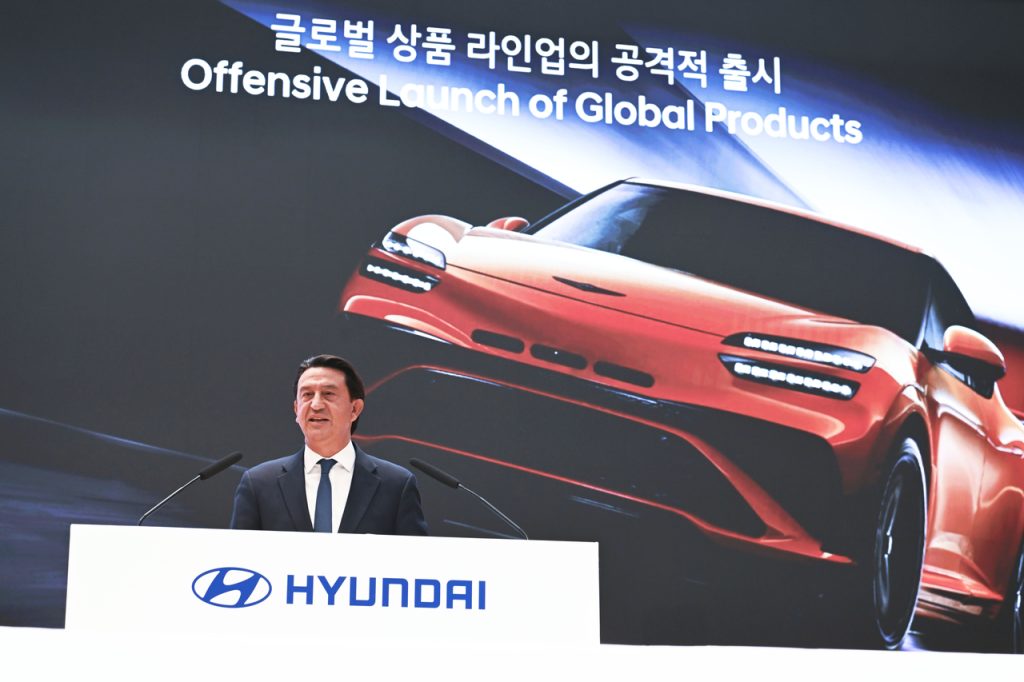
Hyundai Motor CEO Jose Munoz has announced ambitious plans to introduce 36 new vehicles to the North American market by 2030. This expansion is supported by a significant investment in US production, strategically aimed at bolstering profitability despite ongoing tariff challenges.
At Thursday’s shareholders meeting, Munoz emphasized North America as Hyundai’s “most profitable market.” He detailed plans for extended-range electric vehicles boasting over 600 miles of driving range, set to debut in 2027. Furthermore, Hyundai intends to penetrate the lucrative midsize pickup truck segment with its first body-on-frame model before 2030.
Hyundai Motor Group Metaplant America in Georgia, completed last year, will be pivotal in manufacturing this new vehicle lineup. Currently, the facility produces the Ioniq 5 SUV and Ioniq 9 SUV. Hybrid vehicle production is slated to begin this year, along with prototype manufacturing of Ioniq 5 models featuring Waymo’s autonomous driving technology.
Munoz highlighted Hyundai’s commitment to shifting from Korea-based exports to increased US localization, stating that the company will invest $26 billion between 2025 and 2028. This figure surpasses Hyundai’s total US investment since its market entry in 1986.
This substantial investment includes $12 billion for expanding annual US production capacity to 1.2 million vehicles, $7 billion to fortify the parts and logistics supply chain (including a new steel mill in Louisiana), and another $7 billion to advance autonomous driving, robotics, artificial intelligence, and other future technologies through partnerships with US-based firms.
Despite a 15 percent US tariff on automobiles, Hyundai’s North American sales experienced an 8 percent year-over-year increase, reaching 1.2 million units last year. This marked a fifth consecutive year of record retail sales and a third straight year of record total sales. Several key models, including the Tucson, Elantra, Santa Fe, Palisade, Ioniq 5, and Venue, achieved annual sales records.
Munoz stressed that Hyundai’s multipowertrain sales strategy, encompassing hybrids, fully electric vehicles, and advanced internal combustion engine vehicles, has resonated positively with consumers in the region. Electric vehicles accounted for 26 percent of the retail mix. Hyundai’s premium Genesis brand also achieved a record year, selling 82,000 units in the US.
Hyundai intends to extend its aggressive, region-specific expansion strategy to emerging markets.
In China, the company plans to launch 20 new models over five years, with the aim of achieving annual sales of 500,000 units. In Europe, five new models, including the Ioniq 3 sedan, will be introduced within the next 18 months. All European models will offer electrified versions by 2027. For the Indian market, Hyundai will introduce the country’s first locally developed electric SUV and launch the Genesis brand by 2027, as part of a broader plan to introduce 26 new models over the decade, supported by a $5 billion investment through 2030.
As part of its strategic transformation into a technology-driven company, Munoz emphasized that Hyundai’s partnerships with Nvidia, Google DeepMind, and Waymo, alongside investments in its subsidiaries 42dot and Boston Dynamics, are strengthening its capabilities in physical AI and autonomous driving.
He also reiterated the automaker’s commitment to deploying Boston Dynamics’ Atlas humanoid robots in manufacturing, with the goal of scaling annual production to 30,000 units by 2028.
hyejin2


