
Chip giant eyes valuation rerating, builds W100tr war chest for AI push
SK hynix announced Wednesday it has confidentially filed for a potential US listing, signaling a strategic move to attract global investors and address its valuation gap amidst the burgeoning demand for memory driven by artificial intelligence.
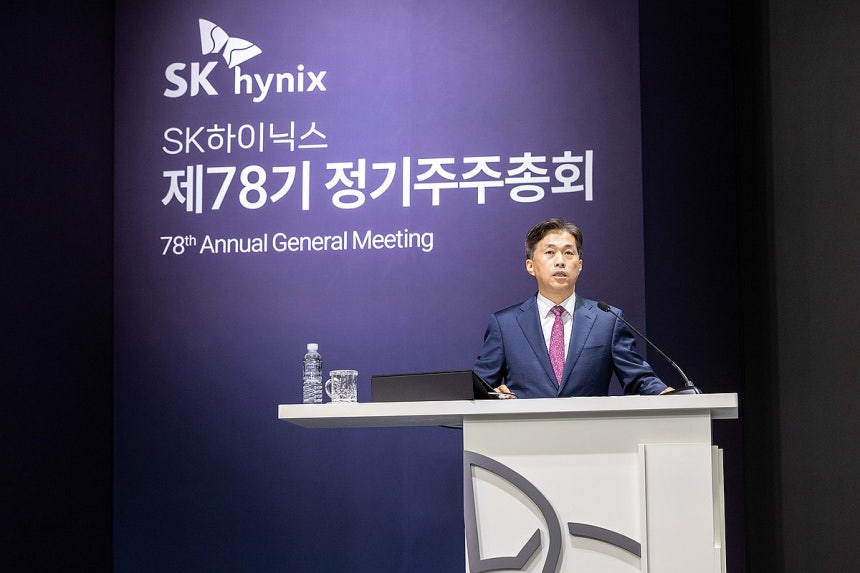
During a shareholder meeting, the South Korean chipmaker also unveiled plans to bolster its financial foundation, aiming for a net cash reserve exceeding 100 trillion won ($66.7 billion) to fuel long-term investments. This initiative reflects the company’s anticipation of sustained growth in memory demand, propelled by the increasing prevalence of AI and expanding computing requirements.
In a regulatory filing submitted in Seoul, SK hynix confirmed the submission of a draft registration statement on Form F-1 to the US Securities and Exchange Commission (SEC) on the preceding day. The filing pertains to a proposed offering of American depositary shares (ADS), or ADR.
“This action is part of our broader strategy to facilitate a reassessment of the company’s valuation within the US market, recognized as the world’s premier equity market and a pivotal listing destination for leading global semiconductor entities,” stated CEO Kwak Noh-jung at the shareholder meeting.
“While the definitive size and structure of the offering remain to be determined, we are committed to pursuing this opportunity with a primary focus on enhancing shareholder value,” he emphasized.
The company intends to utilize the ADR structure, which enables foreign corporations to engage in trading on US exchanges through securities that represent their underlying shares, bypassing the need for a complete domestic listing.
This listing initiative is underway as SK hynix continues to trade at a lower valuation compared to its international counterparts, despite demonstrating robust earnings growth driven by the burgeoning AI sector.
As of late 2025, SK hynix was trading at approximately 11 times its earnings, in contrast to Micron Technology, a US-based competitor, which traded at around 29 times earnings. This valuation disparity persists despite SK hynix reporting an impressive operating profit of 11.38 trillion won in the third quarter alone—roughly double that of Micron’s during the same timeframe.
Kim Jung-kyu, CEO of SK Square — the largest shareholder of SK hynix with a 20.1 percent stake — suggested that a US listing could be instrumental in bridging the valuation gap by drawing in a more diverse global investor base.
Kwak also elaborated on strategies to fortify the company’s financial standing: “While our financial health has improved, it still trails that of top-tier global competitors. Our goal is to accumulate over 100 trillion won in net cash over time to finance strategic investments and research.”
According to its annual report, SK hynix’s net cash reserves stood at 12.69 trillion won at the end of 2025. Achieving the stated target would bring the company closer to the financial capabilities of larger rivals, such as Samsung Electronics, which is estimated to hold approximately 92 trillion won in net cash.
Addressing the recent surge in share prices, Kwak clarified that the company has no immediate plans for a stock split, noting that such decisions necessitate careful evaluation of trading volume, investor demographics, and prevailing market conditions.
Regarding product development, Kwak reaffirmed SK hynix’s commitment to spearheading advancements in high-bandwidth memory (HBM), a crucial component for AI chips.
“Leveraging our accumulated production experience and technological expertise, we aim to solidify our leadership position in HBM4, which is poised to dominate the AI memory market this year,” he stated.
“We are dedicated to ensuring the timely delivery of high-performance HBM4 products and to developing customized HBM solutions as planned.”
Furthermore, SK hynix announced its intention to accelerate the transition to the most advanced sixth-generation 10-nanometer-class DRAM process (1c) and to broaden its product portfolio to encompass LPDDR5, GDDR7, CXL, and high-bandwidth flash memory, alongside 321-layer NAND flash memory and enterprise solid-state drives (SSDs).


