
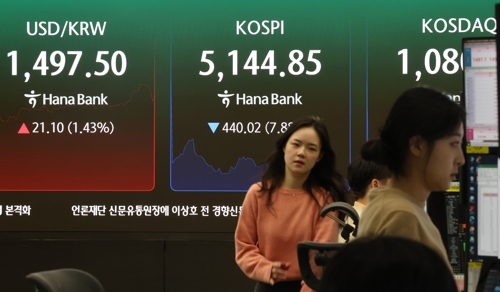
South Korean stocks experienced a significant drop on Monday, plummeting nearly 6 percent. The Korea Exchange (KRX) temporarily halted trading during the morning session due to extreme market volatility, reportedly triggered by US-Israeli airstrikes on Iran. Concurrently, the South Korean currency depreciated sharply against the US dollar.
The Korea Composite Stock Price Index (KOSPI) declined by 333 points, a 5.96 percent decrease, ultimately closing at 5,251.87.
Early in the trading day, the KRX implemented a circuit breaker, suspending all trading activities on the main bourse for a 20-minute period. This measure was activated after the KOSPI remained 8 percent below the previous session’s closing level for a continuous minute.
This marks the second instance of a circuit breaker activation within the past week. The KRX previously triggered one on Wednesday following a steep 12.06 percent decline in the KOSPI, representing the most substantial single-day drop since September 12, 2001, which occurred in the immediate aftermath of the September 11th terrorist attacks in the United States.
It is the first time that circuit breakers have been activated twice within a single month since March 2020, the period when the COVID-19 pandemic first impacted the market.
Shortly after the market opened, the KRX also activated a sell-side sidecar, which resulted in a five-minute suspension of sell orders. This measure is automatically triggered when the KOSPI 200 Futures index fluctuates by 5 percent or more for at least one minute.


