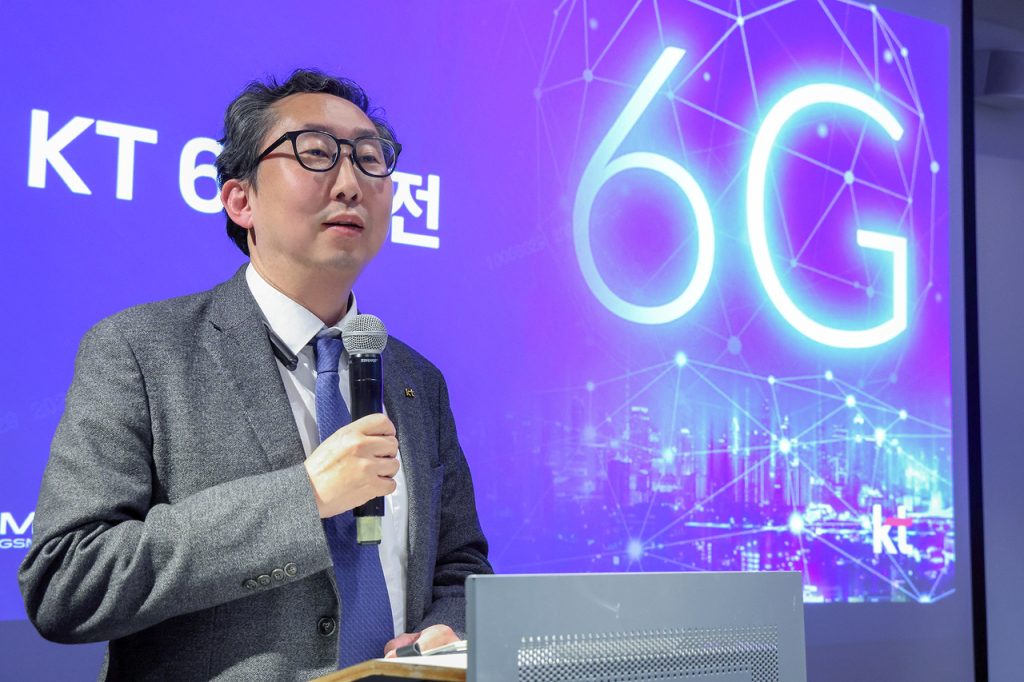
KT, a leading Korean telecom operator, outlined its vision for 6G technology at Mobile World Congress (MWC) in Barcelona, emphasizing its strategic shift towards AI integration and satellite-enhanced coverage rather than solely focusing on speed improvements.
During a press briefing, KT revealed plans to develop 6G as an “intelligent infrastructure” tailored for the artificial intelligence era. The focus will be on enhanced network reliability, automation capabilities, and expanded geographic reach, prioritizing practical applications over sheer download speeds.
“6G represents more than just a new radio specification; it embodies our comprehensive future network strategy,” stated Lee Jong-sik, head of KT’s Future Network Lab. “While 5G marked a significant advancement, we questioned its transformative impact. With 6G, our objective is to deliver tangible benefits that our customers can directly experience.”
KT highlighted the importance of integrated coverage, aiming to combine conventional terrestrial mobile networks with satellite communication via its affiliate, KT SAT. This synergy will extend connectivity to underserved remote areas and provide crucial communication support during disaster scenarios.
At their MWC exhibit, KT showcased a “supercell” configuration already deployed at 51 key locations nationwide. This infrastructure is designed to ensure network coverage across approximately 90% of South Korea’s land area during emergencies.
Furthermore, KT emphasized their commitment to network automation. The company is actively developing AI-powered systems to optimize traffic management and proactively address potential network faults. This strategic approach aims to enhance service quality while effectively managing operating costs as data demand continues to surge.
Traffic efficiency is another critical area of focus. In a demonstration involving a 5G router and CCTV footage, KT demonstrated a reduction of over 50% in uplink bandwidth usage by transmitting only essential object data instead of complete video streams.
Regarding the timeline for 6G deployment, Lee anticipates that detailed 6G standards will be finalized around March 2029 by the 3rd Generation Partnership Project (3GPP), the global standards body for cellular technology. The International Telecommunication Union (ITU) established the high-level IMT-2030 framework for 6G in 2023. While standards may be set by 2029, Lee suggests that widespread commercialization is more likely to occur between late 2030 and 2032, contingent on equipment availability and ecosystem readiness.
KT also highlighted its operational experience with a standalone 5G core network as valuable preparation for the transition to 6G. “As the only Korean operator with standalone 5G capabilities, we believe our independent 5G architecture experience provides us with a significant advantage as we move towards 6G,” Lee concluded.
mjh