
Optical Fiber Boom Pushes Samsung’s Corning Stake to $6.2 Billion
Samsung Electronics’ enduring, half-century partnership with Corning is evolving, now fueled by the growing demands of artificial intelligence.
A significant surge in Corning’s stock price, propelled by the escalating demand for optical fiber crucial for AI data centers, has boosted the value of Samsung’s investment in the U.S. materials company by over 3 trillion won ($2.7 billion). Beyond the financial gains, this surge underscores the transformation of a 1970s industrial alliance into a pivotal position within the infrastructure of the AI economy.
From TV Glass to AI Fiber Optics
Corning is widely recognized for its Gorilla Glass, a staple in smartphones. However, the company’s current growth is primarily driven by optical fiber and cable – the physical foundation that connects AI data centers and supports high-bandwidth computing.
As hyperscale companies expand their AI capabilities, the demand for fiber optics has increased dramatically. Corning’s stock experienced an 84% increase in 2024, climbing from $47.52 at the close of 2023 to $87.56 by year-end. This upward trend has continued into the current year, with shares rising over 50% and trading near record highs.
This rally has directly translated into substantial investment gains for Samsung. According to Samsung Display’s 2025 audit report, the company held 68 million Corning shares at the end of last year, a decrease from 74 million the previous year following phased sales. Despite holding a smaller stake, the investment’s value surged to 8.54 trillion won from 5.17 trillion won – a significant increase of approximately 3.37 trillion won.
Corning’s financial performance mirrors this shift. The company reported a net income of $1.59 billion in 2025, more than tripling the previous year’s figures, while revenue increased by 19% to $15.6 billion. A $6 billion long-term agreement to supply Meta Platforms with optical fiber through 2030 has solidified its central role in the ongoing development of AI infrastructure.
A Partnership Born from Crisis
This financial success adds a new dimension to a partnership that began in 1973.
At that time, Samsung was completely dependent on Japanese imports for bulb glass used in cathode-ray tube (CRT) televisions – a critical component representing roughly half of the total production costs. This reliance undermined Samsung’s export competitiveness and exposed the company to significant supply chain risks.
Samsung founder Lee Byung-chull partnered with Corning to establish Samsung Corning Precision Glass, a move that localized production and formed the bedrock of Samsung’s display business. By the 1980s, the joint venture had become a global leader in CRT glass manufacturing.
The collaboration deepened over the following decades. In 2013, Samsung Display divested its stake in the joint venture to Corning in exchange for convertible securities, which were later converted into common shares, making Samsung a major shareholder in Corning.
What started as an effort to localize supply has effectively grown into a long-term strategic investment in materials science.
From Supply Crisis to AI Infrastructure Backbone
Recent periodic share sales had led to speculation that the ties between the companies were weakening. However, senior executives from both companies have consistently emphasized the strategic importance of their partnership.
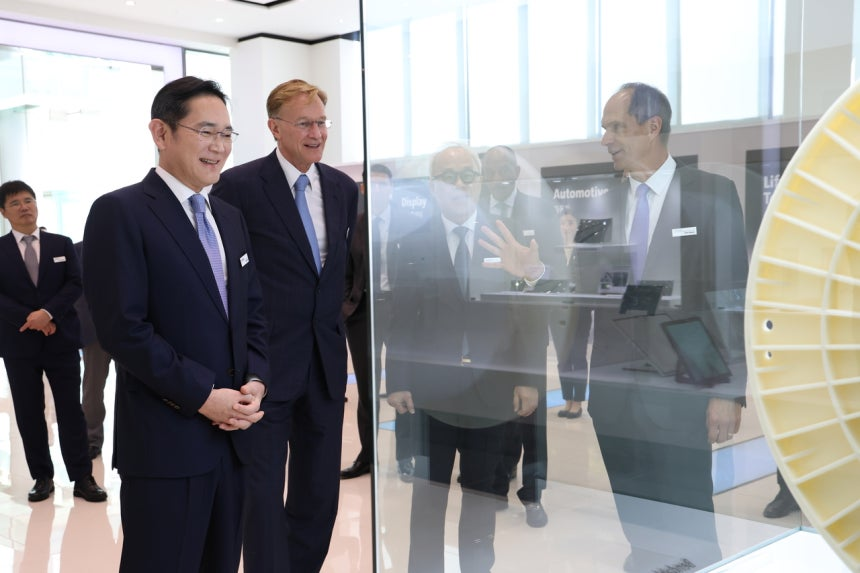
Samsung Electronics Chairman Lee Jae-yong attended Corning’s 50th-anniversary investment ceremony in Asan in 2023, acknowledging Corning’s early collaboration as essential to Samsung’s global expansion.
“Almost miraculously, 50 years ago, Corning extended its hand to Samsung, then a little-known company in a poor country on the other side of the globe,” Lee stated at the event. “Corning’s friendship and cooperation became a crucial stepping stone in Samsung’s rise as a global company.”
Weeks later, Corning Chairman Wendell Weeks joined Lee at a gala event in Washington – a clear indication of the unusually close corporate alignment that has spanned five decades.
Today, the strategic landscape has changed dramatically. The focus has shifted from CRT glass for televisions to fiber optics powering AI clusters. Instead of simply catching up industrially, the partnership now stands at the intersection of US-Korea technology supply chains.
Corning, established in 1851 and historically associated with glass and ceramics, first gained recognition for providing the glass for Thomas Edison’s light bulb. It later pioneered optical fiber, which revolutionized modern data transmission. This legacy has positioned Corning at the heart of the physical infrastructure supporting artificial intelligence.


