
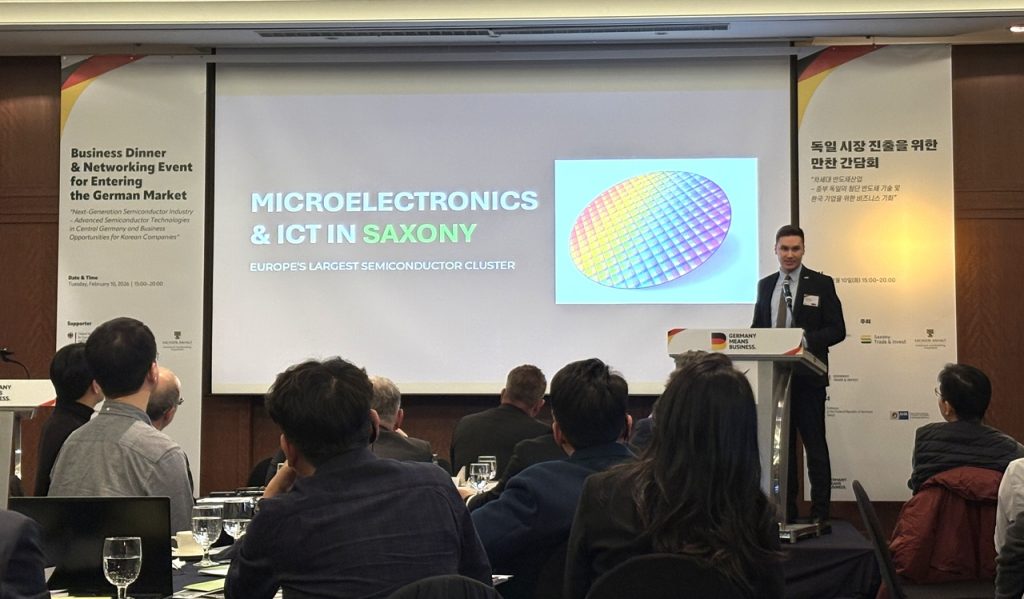
German states Saxony and Saxony-Anhalt are intensifying their efforts to attract South Korean semiconductor companies, presenting their regions as strategic gateways to the European market. This comes as Europe accelerates its drive for technological independence.
During an investment briefing held in Seoul, officials emphasized the regions’ central location, robust logistics infrastructure, and highly skilled workforce. They actively encouraged Korean chipmakers and suppliers to capitalize on what they described as the largest semiconductor cluster in Europe.
“Semiconductors are no longer just a supporting technology; they are now at the forefront of economic and geopolitical strategy,” stated Pascal Misoph, project lead for semiconductors and microelectronics at Saxony Trade & Invest.
He highlighted the growing demand for advanced chips driven by the shift towards electric and software-defined vehicles, as well as expanding needs from the robotics and aerospace industries.
“This presents a unique opportunity, particularly for South Korean companies, to strategically position themselves within the European market,” Misoph added.
Saxony highlighted its “Silicon Saxony” cluster, centered in Dresden, as Europe’s leading microelectronics hub. This region accounts for approximately one-third of Europe’s chip production and is home to around 3,650 companies and over 81,000 employees across the semiconductor and ICT value chain.
Key players in the region include GlobalFoundries, Lam Research, and Tokyo Electron. Taiwan’s TSMC is also establishing its first European fabrication plant in Dresden through a joint venture with Bosch, Infineon, and NXP, in a project valued at approximately 10 billion euros ($11 billion). Roughly half of this investment is expected to be supported by German government subsidies, with production targeted to begin in 2027.
Misoph emphasized that Saxony’s central location allows companies to maintain close proximity to major automakers, suppliers, and research institutions throughout the continent.
“For Korean investors, this means entering an environment where industrial relationships are already established and can be readily activated,” he said. “Market access, logistics, and collaboration opportunities naturally reinforce each other.”
Officials from neighboring Saxony-Anhalt also promoted their region as an emerging high-tech hub.
Robert Franke, managing director at IMG Sachsen-Anhalt, highlighted the state’s efficient public administration, highly qualified workforce, and strong collaboration between industry and research institutions.
“The groundwork is already laid for success stories similar to those of Daimler Truck, Novartis, and South Korea’s IDT Biologika,” Franke noted.
He showcased a 1,100-hectare High-Tech Park near Magdeburg, the state capital, as one of Europe’s largest development projects, designed to attract global semiconductor and advanced manufacturing investments.
This site was previously selected for a planned 30-billion-euro Intel megafab, although the project was later canceled due to weak market demand and internal restructuring within the company.
Katharina Viklenko, director of Germany Trade & Invest’s Korea office, projected that Germany’s semiconductor market would exceed $20 billion this year. She also mentioned that the German government offers substantial subsidies under the EU Chips Act, and Korean companies investing in Germany could be eligible for similar incentives.
The outreach event, organized by the Korean-German Chamber of Commerce and Industry, was part of a five-day visit to Korea by a delegation from the two German states and Germany Trade & Invest, aimed at promoting semiconductor investment and partnerships.


