(ATTN: ADDS photo)
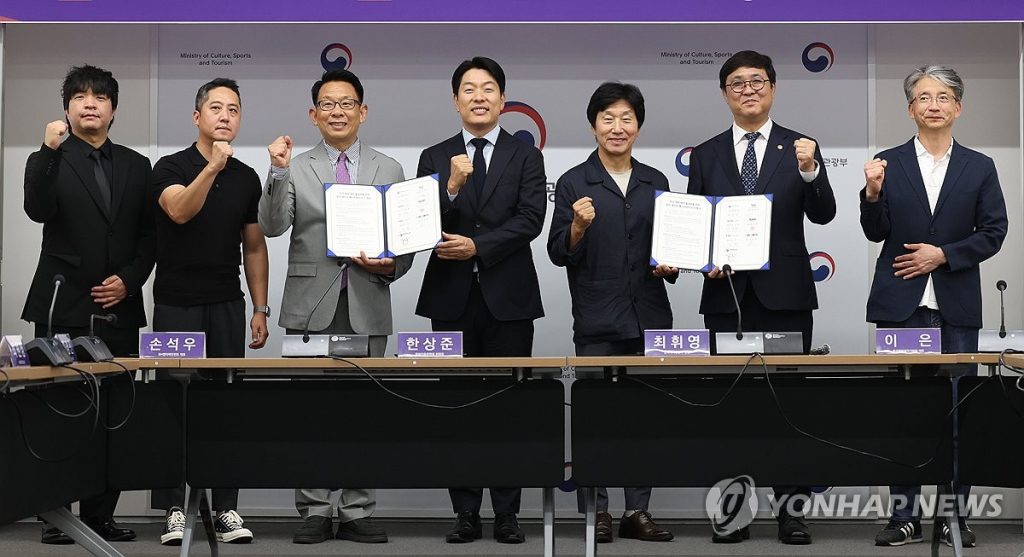
A pivotal agreement aimed at revitalizing the **Korean film industry** was officially signed in Seoul, announced the Ministry of Culture, Sports and Tourism and the Korean Film Council (KOFIC).
This non-binding accord commits the government, key agencies, and **film producers** to collectively ensure that actor fees for lead and supporting roles in movies financed through KOFIC’s dedicated program for mid- and low-budget films will remain strictly below a 10 percent threshold.
The issue of **actor fees** has been a significant burden contributing to escalating **film production costs**, especially as the industry grapples with declining theater audiences and reduced profitability stemming from the proliferation of streaming platforms. KOFIC data from 2024 revealed that these fees constituted 18 to 19 percent of the average 9.5 billion-won production budget, accounting for nearly half of all labor expenses within **K-cinema** projects.
Beyond this immediate measure, the participating parties intend to establish an industry-led consultative body. This group, comprising talent agencies, **film production companies**, and distributors, will work on developing longer-term strategies to enhance the overall filmmaking environment.
Prominent **Korean talent agencies** such as BH Entertainment, Management Soop, and J.Wide-Company are among the participants, alongside influential industry associations like the Korea Film Producers Association and the Producers Guild of Korea.
The culture ministry highlighted that this agreement underscores the voluntary commitment of actors and talent agencies in supporting the government’s strategic initiative to **revitalize Korean cinema**. The government initially launched its comprehensive film support program in 2025 with a 10 billion-won (US$6.7 million) fund, which has since expanded to 46 billion won this year.
During the signing ceremony, Culture Minister Chae Hwi-young commended the pledge, emphasizing that the voluntary decision to cap **actor salaries** transcends mere cost-cutting. Instead, it signifies “a warm sense of solidarity and a courageous, mature decision” essential for the resurgence of **Korean film production**.
“This wave of cooperation will become the most powerful energy in bringing audiences back to **Korean films**,” Chae asserted.
KOFIC Chairman Han Sang-jun articulated that dedicated support for mid-budget productions would act as “a catalyst for diversity and sustainable growth” within the local **film industry**, particularly amidst rising **production costs** and shrinking investment landscapes.
Son Seock-woo, Chief Executive of BH Entertainment, urged the industry to seize this opportunity to rectify structural imbalances and cultivate a healthier ecosystem. “I hope today’s agreement will serve as a first step in discussing how to create an industry that can endure together over the long term,” he concluded.