By Woo Jae-yeon
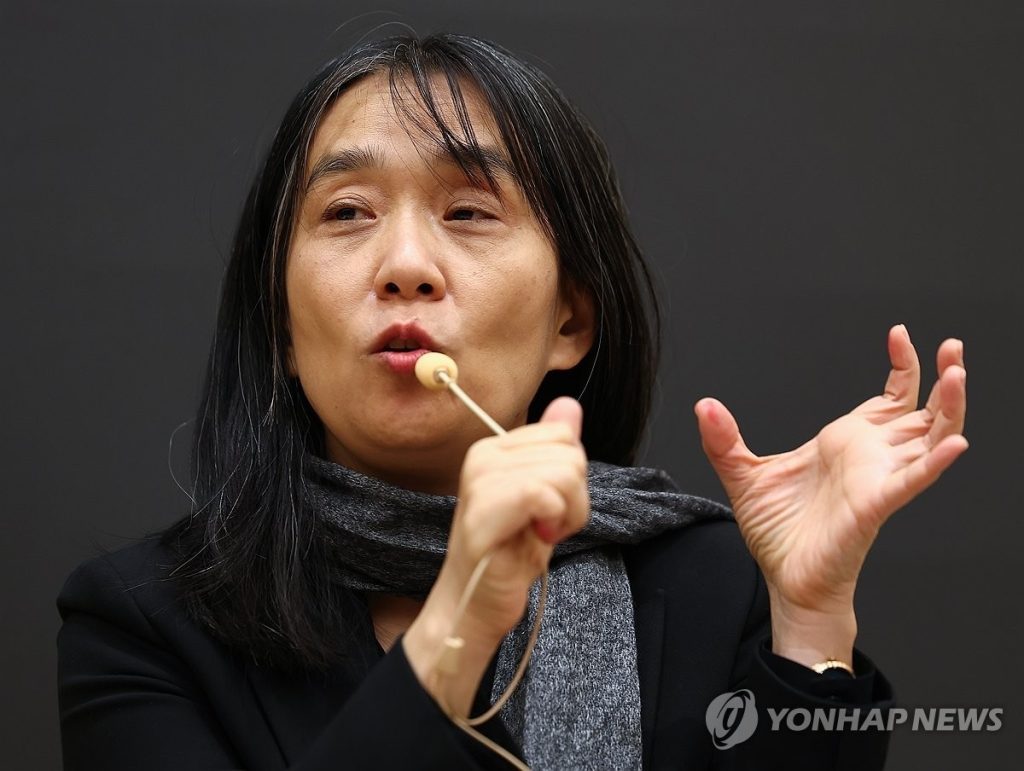
Han Kang’s Nobel laureate status is further solidified with her recent NBCC win, marking a historic moment as the first translated work of fiction to receive the prestigious prize. This recognition follows poet Kim Hye-soon’s groundbreaking achievement last year, becoming the first Korean to win the same award in the poetry category for the English translation of her collection, “Phantom Pain Wings.”
Within Korean literary circles, a growing chorus is advocating for increased government investment in translation quality and fairer treatment for translators, recognizing the vital role they play in bridging the linguistic gap for a language spoken by relatively few outside of Korea.
During her acceptance speech Thursday night in New York, Han Kang emphasized the importance of her translators, offering her first words of gratitude to e. yaewon and Paige Morris.
“I am so honored. Thank you to the two translators, e. yaewon and Paige Morris. I appreciate the incredible connection you have made for this book, from my mother tongue, Korean to English,” said David Ebershoff, vice president and editor-in-chief of Hogarth and executive editor of Random House, delivering the speech on behalf of Han Kang, who could not attend in person.
Han Kang has consistently highlighted the collaborative nature of translation. In November 2024, upon receiving the Nobel Prize in literature, she stated that she and her translators are “together in every sentence and in all sentences.”

This recognition builds upon Han Kang’s earlier success, including winning the 2016 International Booker Prize for “Vegetarian,” translated by Deborah Smith. This literary breakthrough introduced Han Kang to a global audience, and the award was shared between author and translator.
Following the 2016 win, Deborah Smith described translating a work of literature as “creatively rewriting it in another language, a process that involves varying degrees of interpretation and editorial decision” demanding both “literary sensibility” and “linguistic competency.”
Since then, Korean authors have steadily gained prominence on the international literary scene.

Chung Bora’s “Cursed Bunny,” a collection of dark and imaginative science-fiction short stories, was shortlisted for the Booker Prize in 2022. Cheon Myeong-kwan’s novel “Whale” followed suit in 2023, and Hwang Sok-yong’s “Mater 2-10” continued this impressive run the following year.
Chung Bora also received a nomination for the Philip K. Dick Award for “Your Utopia” in 2023, marking the first time a Korean author was a finalist for the prestigious science fiction award.
In the realm of children’s literature, Suzy Lee won the Hans Christian Andersen Award in 2022. Lee Geum-yi has been shortlisted for the same award this year, following a previous nomination two years ago.

The Literature Translation Institute (LTI) of Korea has been instrumental in supporting literary translators since its founding in 1996.
According to the LTI, overseas sales of Korean books, supported by its translation and publication program, reached 1.2 million copies last year, a 2.3-fold increase compared to the previous year. The number of Korean books translated by the LTI reached a record high of 194 last year, a significant leap from just 15 in 2001.
“Han Kang’s win reflects how her profound literary depth was seamlessly conveyed through high-quality translation,” stated LTI President Chon Soo-young.
“We are committed to supporting Korean literature and ensuring it continues to reach readers worldwide, transcending language barriers,” she added.
Poet Kwak Hyo-hwan, former LTI president from May 2021 to June 2024, emphasized the importance of widespread social recognition and improved conditions for translators, cautioning against a potential shortage of experienced professionals.
“One of the most significant challenges facing Korean literature translation is the limited number of reliable translators,” he stated. “It won’t benefit Korean literature in the long run if translators are spread too thinly across numerous projects.”