
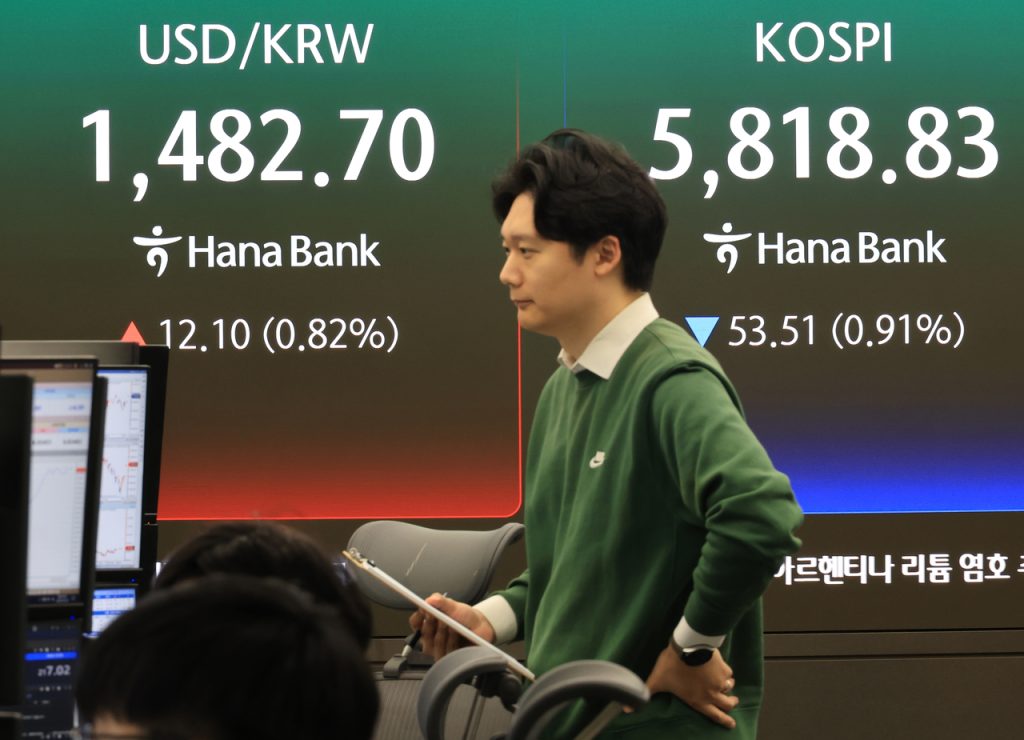
South Korean equities experienced a significant downturn on Thursday, ending a four-day rally, as market participants reacted to conflicting statements from the United States and Iran regarding the conditions of their recent two-week ceasefire agreement. This geopolitical uncertainty also led to a depreciation of the Korean won against the U.S. dollar.
The benchmark Korea Composite Stock Price Index (KOSPI) specifically shed 94.33 points, or 1.61 percent, closing at 5,778.01 amid the renewed global tensions.
Trading activity was robust, with 1 billion shares changing hands, totaling 29.4 trillion won (approximately $19.8 billion). Market breadth was negative, as decliners significantly outpaced advancers, with 509 stocks falling against 356 rising.
Foreign investors were net sellers, offloading 874 billion won worth of shares, while individual investors bought a net 298 billion won. Institutions also showed buying interest, acquiring a net 206 billion won.
The downturn follows an announcement earlier in the week that the United States and Iran had reached a two-week ceasefire agreement on Tuesday (US time). A key component of this provisional deal was the commitment to reopen the strategically vital Strait of Hormuz.
However, market uncertainties quickly resurfaced due to significant disagreements between the two nations over a crucial detail: whether the ceasefire explicitly includes a halt to Israel’s ongoing military offensive against Lebanon.
Tehran has explicitly stated its readiness to withdraw from the agreement, and consequently, its commitment to keeping the Strait of Hormuz open, should Israel persist with its attacks on Lebanon. In stark contrast, Washington maintains that the cessation of the Israel-Lebanon conflict is not stipulated within the terms of the current ceasefire.
Market analysts attribute the prevailing investor caution to these fundamental disagreements between the United States and Iran concerning the ceasefire’s scope, especially ahead of critical negotiations scheduled for the upcoming weekend.
Lee Kyoung-min, a researcher at Daishin Securities, commented, “Amid such evolving geopolitical developments, renewed concerns regarding a potential shutdown of the Strait of Hormuz have significantly driven global crude oil prices higher, naturally keeping investors on high alert.”
Echoing this sentiment, Kim Seok-hwan, an analyst at Mirae Asset Securities, added, “The continued Israeli attacks on Lebanon suggest a persistent risk of renewed regional escalation. While the US and Iran have agreed to a ceasefire, fundamental disagreements over key terms remain a significant hurdle.”
The tech sector experienced a downturn as investors opted to realize recent gains. Bellwether stocks like Samsung Electronics saw a 3.09 percent decline, closing at 204,000 won, while chipmaker SK hynix fell 3.39 percent to 998,000 won.
Defense-related equities also retreated, with Hanwha Aerospace dropping 2.22 percent to 1,451,000 won and Hyundai Rotem declining 1.69 percent to 203,000 won.
Conversely, oil refiners posted gains, benefiting from the rebound in global crude prices spurred by the ongoing geopolitical uncertainties. SK Innovation advanced 2.00 percent to 124,000 won, and S-Oil surged by 6.69 percent to 119,600 won.
Mobile network operators also emerged as winners, with SK Telecom climbing 5.39 percent to 93,800 won and LG Uplus adding a modest 0.37 percent to 16,190 won.


