
South Korean Telecom Leaders Vow Major Security Overhaul After Data Breaches
South Korea’s ICT minister and the chief executives of the nation’s three leading telecom operators have jointly pledged significant reforms. Their commitments aim to restore public trust, alleviate household communication expenses, and accelerate investment in crucial artificial intelligence (AI) infrastructure.
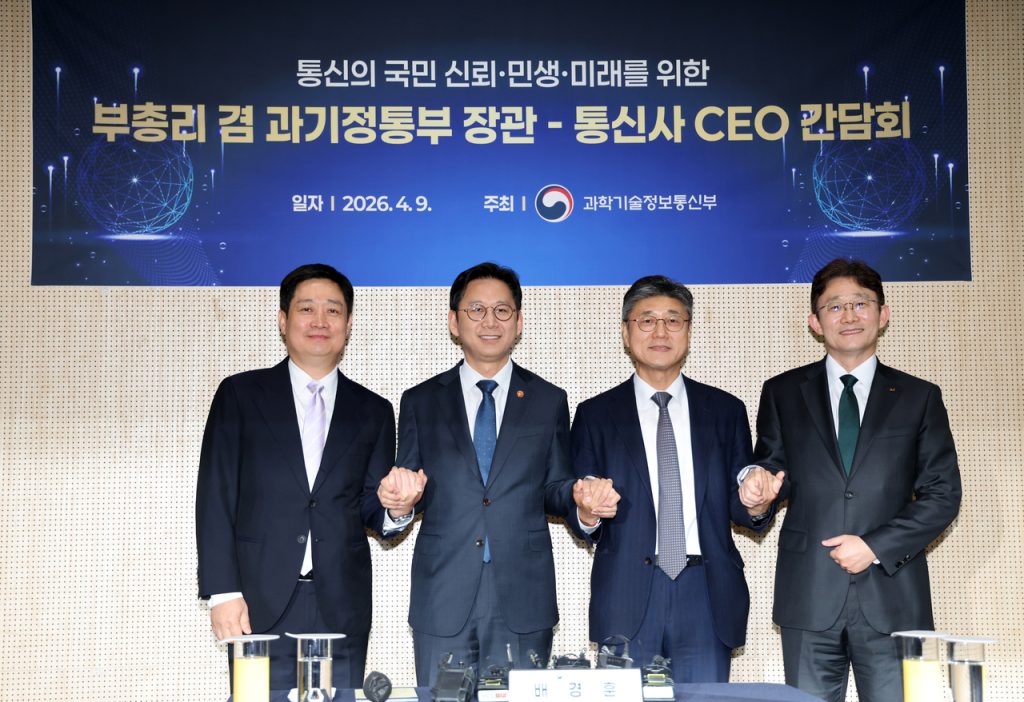
The Ministry of Science and ICT announced that Deputy Prime Minister and ICT Minister Bae Kyung-hoon convened with SK Telecom CEO Jung Jai-hun, KT Corp. CEO Park Yoon-young, and LG Uplus CEO Hong Bum-shik in Seoul. This gathering marked their first collaborative meeting since new leadership transitions at SK Telecom and KT.
The summit occurred during a period of rapid evolution within the telecom industry, which is under increasing pressure to re-establish consumer credibility while adapting to fast-paced technological advancements.
Issuing a joint declaration, the three major operators committed to bolstering cybersecurity measures, aligning more closely with government policies for universal digital connectivity, and substantially increasing their investment in cutting-edge AI and next-generation network technologies.
Their declaration emphasized building a robust security framework to withstand diverse cyber threats, ensuring all citizens have access to high-quality telecommunication services, and spearheading AI-driven innovation to enhance Korea’s global digital competitiveness.
During his opening remarks, Minister Bae underscored recent cybersecurity incidents as a pivotal moment for the sector.
“Following last year’s hacking incidents, the immense responsibility and critical role of telecom operators have become unmistakably clear,” he stated. “Now is the time for genuine transformation that truly resonates with the public, moving beyond mere promises not to repeat past mistakes.”
He further added, “It is vital to support people’s livelihoods by guaranteeing universal basic telecommunications access and to proactively invest, thereby leading the way in shaping the future of an AI-driven society.”
Restoring public trust was a top priority on Thursday’s agenda. The government called for a comprehensive overhaul of cybersecurity practices and the implementation of stronger safeguards to prevent future data breaches. Furthermore, telecom operators were urged to develop robust support systems for vulnerable users during digital incidents, in compliance with the recently revised Digital Inclusion Act.
Addressing telecom costs also took center stage. The three carriers agreed to align with government initiatives focused on basic connectivity and to expand practical benefits, including enhanced voice and messaging support specifically for older users.
Discussions also covered innovative pricing schemes, particularly bundled plans offering 5G services within the 20,000 won (approximately $13.50) range, as part of a broader restructuring of the current fee model. The current average cost for 5G plans is around 53,000 won.
Commitments to enhancing service quality were also made. The companies agreed to continuously upgrade public network infrastructure, including transitioning subway Wi-Fi from LTE to 5G and improving connectivity on high-speed rail networks. They also plan to collaborate on developing public services built upon their proprietary AI models, leveraging their advanced telecom platforms.
Looking to the future, Minister Bae highlighted the critical importance of investing in next-generation and intelligent networks, describing these as “essential national infrastructure investments.”
He reaffirmed the government’s commitment to supporting research and development (R&D) and large-scale pilot projects, while simultaneously urging telecom operators to significantly expand their investments in AI data centers and advanced network capabilities.
The minister also stressed the need for vigilant monitoring of potential supply chain disruptions stemming from geopolitical tensions in the Middle East, calling on companies to ensure stable service delivery under all circumstances.
Minister Bae concluded by stating the government’s intention to institutionalize these collaborative meetings.
“We will regularize these meetings to ensure today’s agenda is not a one-off discussion, and we will strengthen public-private cooperation to guarantee that tangible results, felt by the people, are delivered effectively on the ground without disruption,” the minister affirmed.
“Telecommunications forms a core foundation for both daily life and national competitiveness. We expect the industry to play a pivotal role in stabilizing livelihoods and solidifying Korea’s global leadership in the emerging AI era,” he added.
yeeun


