
Kia CEO Unveils Ambitious Growth Plan Driven by EVs, Hybrids, and Autonomous Technology
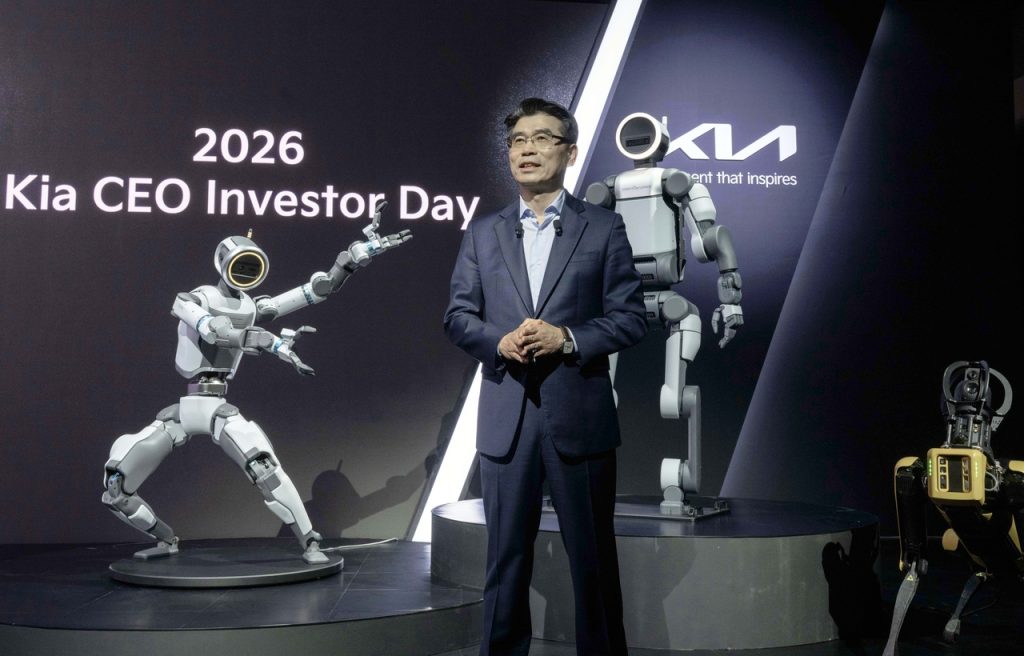
Kia CEO Song Ho-sung announced an ambitious strategy to sell 4.13 million vehicles globally by 2030, aiming to overcome anticipated market slowdowns. This bold vision is powered by a strong focus on electrification, advanced autonomous driving, and cutting-edge robotics, signaling Kia’s commitment to next-generation mobility.
During Kia’s 2026 CEO Investor Day in Seoul, Mr. Song detailed specific targets: achieving 3.35 million unit sales and a 3.8 percent global market share by 2026, further escalating to 4.13 million units and a 4.5 percent market share by 2030.
Central to this “outperforming growth” strategy is a robust eco-friendly vehicle lineup. Kia targets selling 1 million electric vehicles (EVs) by 2030, aiming for a 3.8 percent EV market share. The company will initiate its EV expansion this year with compact SUVs like the EV2 and Syros EV, ultimately growing its electric portfolio from 11 to 14 models across passenger cars, SUVs, and purpose-built vehicles (PBVs).
Kia is also developing an advanced next-generation EV platform designed to significantly enhance performance, promising up to a 40 percent increase in battery capacity and a 9 percent boost in motor output. This platform will integrate Level 2++ autonomous driving features, offering drivers enhanced convenience and safety comparable to Level 3 conditional autonomous driving, which permits hands-off, eyes-off operation under specific conditions.
South Korea is designated as Kia’s central global EV production hub, with manufacturing concentrated at its Gwangmyeong and Hwaseong plants in Gyeonggi Province. Simultaneously, Kia is committed to localizing EV production across key markets. This includes building models like the EV2 and EV4 in Europe, the EV6 and EV9 in the US, and strategic EVs such as the Syros EV and Carens EV in India, ensuring tailored offerings that meet specific regional demands and regulatory requirements.
Acknowledging varied electrification rates worldwide, Kia will also significantly expand its internal combustion engine (ICE) and hybrid vehicle lineups. By 2030, the company plans to introduce nine new gasoline-powered models and maintain a portfolio of 13 hybrid models, targeting sales of 1.98 million ICE vehicles and 1.15 million hybrids, encompassing both plug-in and extended-range variants.
Notable hybrid models in Kia’s pipeline include popular SUVs like the Telluride and Seltos, alongside the K4 sedan. Following its entry into the pickup segment with the Tasman in 2025, Kia intends to launch a body-on-frame extended-range electric vehicle (EREV) pickup truck lineup specifically for the North American market by 2030.
To realize its ambitious 2030 global sales target, Kia has defined a profit-driven strategy for the crucial US market. This involves aggressively expanding its hybrid offerings, reinforcing its popular SUV portfolio, and establishing a presence in the pickup segment, with a goal of 1.02 million sales and a 6.2 percent market share.
In Europe, Kia aims to solidify its EV leadership, targeting 746,000 unit sales and a 4.8 percent market share, with battery-electric vehicles projected to comprise 66 percent of total sales. For emerging markets, Kia plans to achieve 1.48 million sales through strategic lineup expansion, increased eco-friendly model offerings, and bolstered local production capabilities, especially in high-growth regions like India.
Regarding its autonomous driving initiatives, Kia is implementing a dual-track strategy. This involves accelerating market entry via global partnerships, notably with Nvidia, while simultaneously enhancing its proprietary end-to-end self-driving capabilities through comprehensive automotive data utilization.
Kia targets the completion of its inaugural Software-Defined Vehicles (SDVs) by 2027, featuring Level 2+ highway autonomy. This will be succeeded by Level 2++ capabilities for both highway and urban driving by 2029, underpinned by Hyundai Motor Group’s advanced SDV architecture, next-generation infotainment platform, and sophisticated AI systems.
Hyundai Motor and Kia’s dedication to securing a technological advantage extends beyond traditional vehicles, venturing into the rapidly expanding robotics sector.
With an objective to commercialize general-purpose humanoid robots developed by Hyundai Motor Group’s US-based subsidiary, Boston Dynamics, within the next decade, the group is pursuing a three-pronged strategy: harnessing its extensive manufacturing network for critical data collection, fostering advanced AI partnerships with industry leaders like Google DeepMind and Nvidia, and accelerating supply chain integration with its automotive parts division, Hyundai Mobis.
In manufacturing operations, the advanced humanoid robot Atlas is slated for deployment at the Hyundai Motor Group Metaplant America in Georgia by 2028, followed by Kia’s Georgia plant in 2029. This initiative marks a gradual expansion across global facilities, with initial deployment focusing on 16 critical automotive production processes to significantly enhance safety, productivity, and overall quality.
To capitalize on the burgeoning $288 billion last-mile delivery market, the group is also committed to developing a comprehensive full-stack solution. This innovative approach will seamlessly integrate Kia’s Purpose-Built Vehicles (PBVs) with advanced Stretch and Spot robots.
CEO Song affirmed that Kia is strategically positioned for “accelerated growth, propelled by advancements in EVs, hybrids, autonomous driving, and robotics, building upon five years of innovation across its brand, EV, PBV, and ESG (environmental, social, and governance) initiatives.” He further emphasized Kia’s proactive stance in responding to dynamic market shifts with differentiated strategies, even amidst increasing global uncertainties.
hyejin2


