
AI Seen as Key to Tackling Aging, Chronic Disease Challenges
Artificial intelligence is being hailed as a game-changer in addressing the growing challenges of aging populations and the rising prevalence of chronic diseases, and Europe is looking to South Korea as a vital partner in this endeavor.
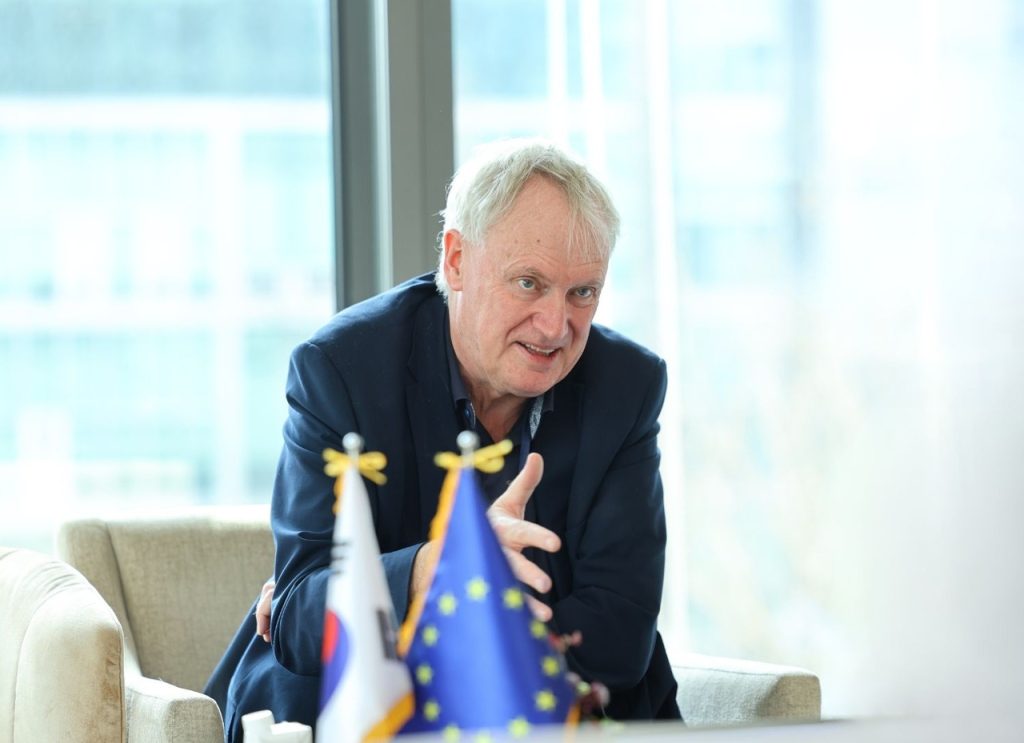
The European Union is intensifying its efforts to strengthen research collaborations with Korea, with AI emerging as the most promising area for joint projects, according to Luke O’Neill, a member of the scientific council at the European Research Council and a distinguished biochemist and immunologist at Trinity College Dublin.
“AI has to be the big one,” he stated in an interview with The Korea Herald in Seoul on Tuesday. “It has the potential to revolutionize disease diagnosis and accelerate the process of drug discovery.”
The increasing interest in AI collaboration coincides with a shift in the global research landscape, where uncertainty surrounding science funding in the US is creating new opportunities for Europe. “The US was once the undisputed leader,” he noted. “However, with the US stepping back to some extent, Europe is presented with a significant opportunity.”
Europe is actively seeking to attract more global talent by expanding access to Horizon Europe, the world’s largest multilateral research and innovation funding program.
Korea’s participation as an associated member has paved the way for closer collaboration, enabling Korean researchers to participate in EU-funded projects.
Korea joined Horizon Europe in January of last year, becoming the first Asian country and the third from outside Europe to achieve this status. It is actively involved in joint research programs focused on tackling global challenges and enhancing industrial competitiveness.
For O’Neill, AI represents more than just another research field; it’s a powerful tool that has the potential to transform how scientists approach complex biological systems.
“Disease is incredibly intricate,” he explained. “And with AI, we can gain a much deeper and more comprehensive understanding.”
He compared the impact of AI to earlier scientific breakthroughs that revolutionized the way researchers observe and understand the natural world. “It’s akin to the invention of the microscope, which allowed us to see germs for the first time,” he said. “Without AI, we may struggle to find cures for diseases such as Alzheimer’s.”
He emphasized that medical research is an area where AI could deliver immediate benefits, particularly in improving diagnosis and predicting how patients will respond to treatment.
“If AI demonstrates tangible benefits for human health, it will garner widespread support,” he said.
Beyond AI, O’Neill highlighted that Europe and Korea share common challenges, including aging populations and an increasing burden of chronic diseases, making collaboration even more crucial.
Practical challenges remain, such as the complexity of funding systems, especially for researchers working across borders. “We need to simplify the application process,” he urged.
Nevertheless, the core principle remains straightforward. “All you need is a compelling idea,” he said. “Bring us your best ideas.”
His advice to young Korean researchers was simple: “Go for it,” he encouraged. “If you aspire to develop your career as a leading scientist, Europe offers excellent opportunities.”
yeeun


