South Korean stocks closed higher on Friday, fueled by growing optimism that the ongoing conflict involving the U.S., Israel, and Iran may conclude sooner than initially anticipated. This development has offered some respite to global financial markets.
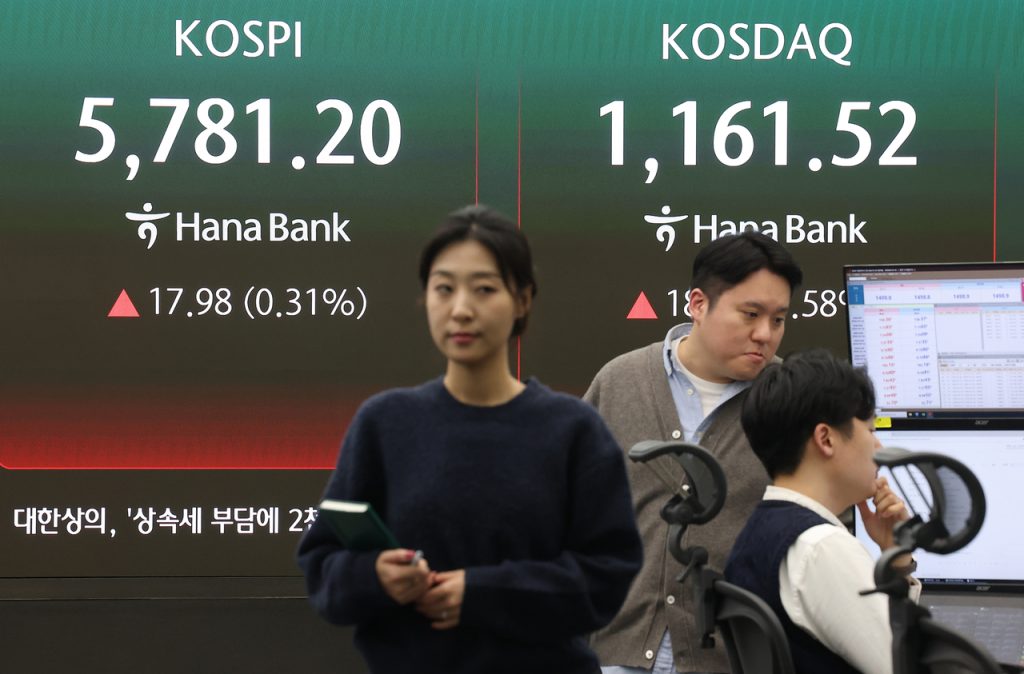
The benchmark Korea Composite Stock Price Index (KOSPI) rose by 17.98 points, or 0.31 percent, to close at 5,781.2.
The KOSPI started the day nearly 1 percent higher but pared back gains as foreign investors net sold 2.6 trillion won ($1.7 billion) worth of shares. In contrast, retail investors purchased 2.2 trillion won, and institutions bought 414.8 billion won of local shares.
Trading volume was robust, with 1.46 billion shares changing hands, valued at 31 trillion won. Advancing stocks outnumbered declining ones by 742 to 158.
Overnight in the U.S., the Dow Jones Industrial Average closed down 0.44 percent, the tech-heavy Nasdaq composite lost 0.28 percent, and the S&P 500 decreased by 0.27 percent. However, these indices recovered most of their earlier losses after Israeli Prime Minister Benjamin Netanyahu suggested that the conflict with Iran might end sooner than expected. Furthermore, reports indicated that U.S. President Donald Trump had requested no further attacks on Iranian energy infrastructure.
Earlier in the week, reports indicated Israel targeted the South Pars gas field, Iran’s largest, while Iran retaliated by striking a major liquefied natural gas (LNG) site in Qatar.
Comments from U.S. Treasury Secretary Scott Bessent, hinting at the potential lifting of U.S. sanctions on Iranian oil at sea, also contributed to the improved market sentiment.
“Although geopolitical risks in the Middle East remain, optimism regarding energy supply stabilization has spread among investors, driven by recent statements from U.S. and Israeli officials,” said Lee Kyoung-min, an analyst at Daishin Securities.
“The easing of oil prices has contributed to a resurgence in risk appetite within the South Korean stock market,” Lee added.
In Seoul, market heavyweight Samsung Electronics edged down 0.55 percent to 199,400 won, while its competitor, SK hynix, decreased by 0.59 percent to 1 million won.
Leading battery manufacturer LG Energy Solution gained 1.21 percent to reach 375,500 won, and power plant builder Doosan Enerbility jumped 3.1 percent to 109,600 won.
Biopharmaceutical giant Samsung Biologics increased by 1.01 percent to 1.6 million won, and trading firm Samsung C&T rose by 2.23 percent to 297,500 won.
Financial stocks also performed well, with Shinhan Financial rising 1.45 percent to 97,900 won and Mirae Asset Securities gaining 1.5 percent to 67,700 won.
Conversely, defense stocks declined on the hopes of a swift resolution to the conflict involving Iran.
Hanwha Aerospace fell 4 percent to 1.32 million won, and Hyundai Rotem dropped 3.33 percent to 180,100 won. Hanwha Systems decreased by 3.55 percent to 136,000 won.
Major shipbuilder HD Hyundai Heavy lost 1.41 percent to 559,000 won, while its rival Hanwha Ocean went down 0.69 percent to 129,100 won.
Leading automaker Hyundai Motor also declined, losing 0.96 percent to 517,000 won, and its affiliate Kia contracted by 1.17 percent to 168,500 won.
The Korean won was quoted at 1,500.6 won against the U.S. dollar at 3:30 p.m., a slight increase of 0.4 won from the previous session.
This marked the second consecutive day that the local currency traded below the psychologically significant level of 1,500 won. On Thursday, the won was quoted at 1,501 won, its weakest point since March 10, 2009, when it reached 1,511.1 won during the global financial crisis.