
Won Weakens Past 1,500 Per Dollar for First Time in 17 Years
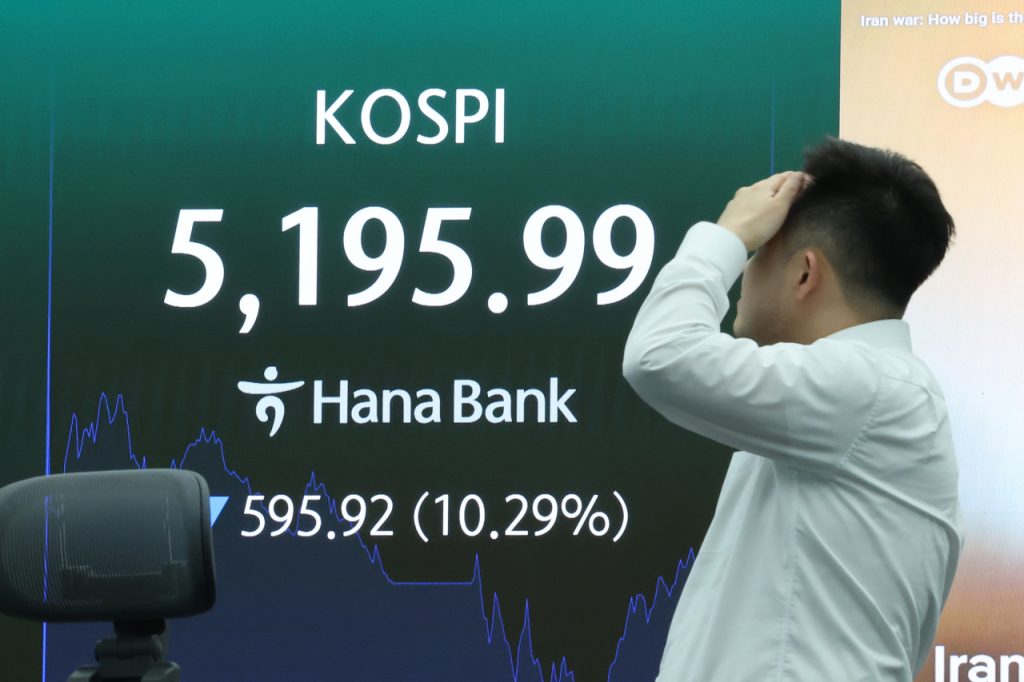
South Korean shares experienced a sharp decline on Wednesday, leading the Korea Exchange to implement a temporary trading halt on both the KOSPI and KOSDAQ markets for 20 minutes.
The Korea Exchange triggered a circuit breaker, suspending KOSPI trading for 20 minutes at approximately 11:19 a.m. This followed a separate trading suspension on the KOSDAQ, which was activated at 11:16 a.m.
A circuit breaker is activated when an index falls by more than 8 percent from the previous session’s closing level and remains at or below that threshold for at least one minute.
This marked the seventh circuit breaker ever triggered on the KOSPI and the 11th for the KOSDAQ. It was the first instance since August 5, 2024, that the Korea Exchange activated circuit breakers on both markets in a single trading session.
Earlier in the day, the bourse operator had already implemented sell-side sidecars – an initial measure to curb excessive market volatility – on both the KOSPI and KOSDAQ, suspending program trading for five minutes. Sidecars are triggered when index futures experience a rapid, predefined drop within a short timeframe.
The KOSPI sidecar was activated at 9:06 a.m., shortly after the market opened, while the KOSDAQ sidecar followed at 10:31 a.m.
The KOSPI opened at 5,592.29, a 3.44 percent decrease from the previous session. Losses intensified throughout the session, with the index plummeting to a low of 5,059.45, a 12.65 percent decline and the largest intraday drop on record. As of 2 p.m., the KOSPI stood at 5,232.89, down 9.65 percent.
Retail investors were net buyers of shares, amounting to 244.3 billion won ($165 million), while institutional investors purchased 421.7 billion won. Foreign investors offloaded 847.8 billion won.
Major South Korean stocks experienced significant drops. Samsung Electronics fell by 9.58 percent, while SK Hynix declined by 7.45 percent. Hyundai Motor saw a decrease of 14.45 percent, and LG Energy Solution slid by 8.78 percent.
Wednesday’s decline followed a steep drop the previous day. On Tuesday, the KOSPI fell by 7.24 percent as risk aversion heightened due to increasing geopolitical tensions in the Middle East.
The KOSDAQ followed a similar downward trajectory, standing at 1,013.61, a 10.91 percent decrease from the previous session as of 2 p.m.
The Korean won also weakened significantly against the US dollar as increased dollar-buying flows exerted downward pressure on the currency.
The won opened at 1,479 per dollar, weakening by 12.9 won from the previous session. It stood at 1,479.38 as of 2 p.m.
In earlier overnight trading, the currency briefly surpassed the 1,500-won mark, reaching 1,505.8 per dollar due to reduced trading volume.
The won’s movement above the 1,500-won threshold marks its first return to this level in 17 years, since March 10, 2009, when it reached 1,511.50 won per dollar during the 2008 global financial crisis.
The 1,500-won level is widely considered a psychologically significant threshold in Korea, historically appearing only during periods of major financial instability, including the 1997 Asian financial crisis and the global financial crisis.
“Historically, the Korean won is one of the most sensitive emerging market currencies to global risk sentiment,” said Yan Wang, chief of emerging markets at research firm Alpine Macro.
“For now, this is primarily short-term volatility, as the Korean won’s fundamentals do not justify such weak levels,” he said, adding that the conflict is unlikely to cause lasting damage to the won or Korea’s external position unless it drags on far beyond expectations.
silverstar


