
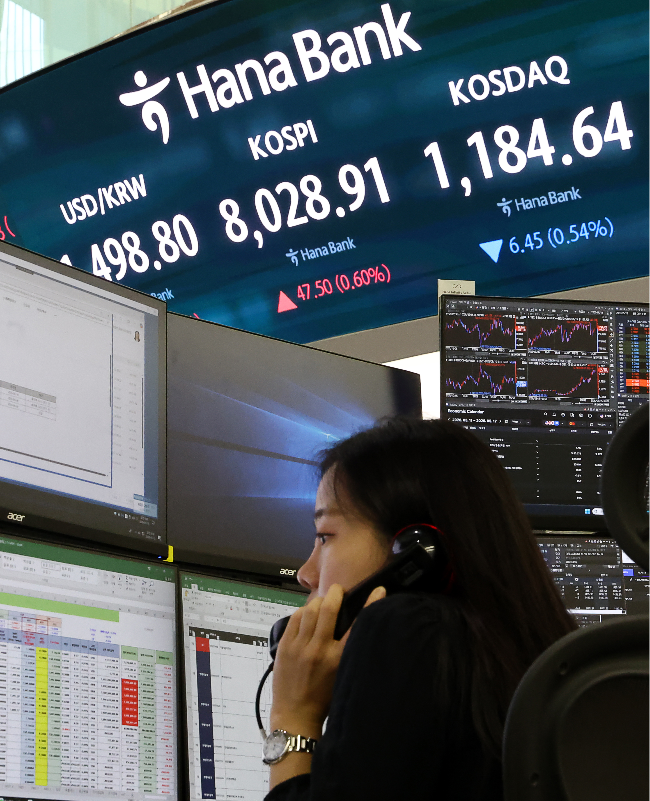
Kospi’s Brief 8,000 Rally Falters as Foreign Investors Deepen Profit-Taking
South Korea’s benchmark Kospi index experienced a swift reversal on Friday, plummeting below 7,600 after a historic, albeit brief, surge past the 8,000 threshold. The downturn was primarily driven by intensified profit-taking by global investors in key semiconductor stocks.
By approximately 2 p.m., the Kospi was trading below 7,550, marking a decline of over 5 percent from its previous closing price. Despite opening lower at 7,951, the equity benchmark briefly surged past 8,000 for the first time ever, just 15 minutes into the trading session, reaching an intraday high of 8,046.78.
This significant milestone was achieved rapidly, as the South Korean stock index took only seven trading days to climb from the 7,000-point level to 8,000.
However, the impressive rally quickly lost momentum. Following its intraday peak, the benchmark index retreated below the crucial 8,000 threshold around 9:40 a.m. and subsequently declined to an intraday low of 7,520.
Adding to the market’s volatility, a sell-side sidecar was triggered around 1:28 p.m. after Kospi 200 futures recorded a drop of more than 5 percent. This mechanism temporarily halted program sell orders for a duration of five minutes.
The index was significantly weighed down by substantial foreign selling pressure. By 2 p.m., overseas investors had net-sold 4.4 trillion won (approximately $2.94 billion) worth of Kospi shares, contributing to the staggering 27 trillion won they had already offloaded across the preceding seven trading sessions.
In contrast, local retail investors maintained their buying spree, largely absorbing the foreign sell-off with net purchases totaling nearly 5 trillion won. Institutional investors showed mixed activity in the morning, initially swinging between buying and selling, but ultimately leaned towards sales in the afternoon, offloading a net 350 billion won by midday.
Semiconductor giants, which had been the primary drivers of the recent market rally, spearheaded the losses. Samsung Electronics, the most heavily weighted stock on the South Korean exchange, saw its shares decline by approximately 5.4 percent to 280,000 won. Meanwhile, SK Hynix, another key chipmaker, fell by around 3.6 percent, trading at 1,899,000 won per share.
The broader market also saw declines, with most other heavyweight stocks across various sectors — including biotechnology, energy, and aerospace — experiencing losses. A notable exception among the market’s top 10 stocks was Hyundai Motor, which surged by as much as 8 percent in the morning to 774,500 won. This strong performance allowed it to surpass SK Square and claim the position of the third-largest company by market capitalization on the Kospi.
jwc


