
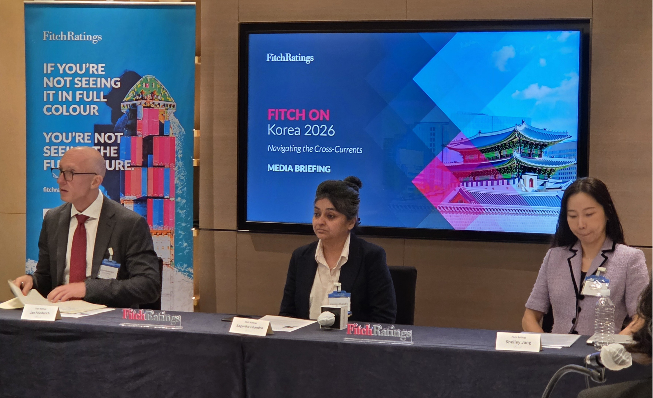
Fitch Ratings, a leading global credit ratings agency, recently reaffirmed South Korea’s AA- sovereign credit rating, maintaining a stable outlook. This positive assessment is attributed to the nation’s robust external finances, resilient export performance, and consistent macroeconomic stability, even in the face of ongoing geopolitical risks and various structural challenges. This confirmation underscores confidence in the Korean economy’s fundamental strength.
During a press conference held in Seoul, Sagarika Chandra, Fitch Ratings’ Asia-Pacific sovereign ratings director, emphasized, “We believe Korea possesses ample external and fiscal buffers to effectively navigate global challenges in the immediate future.”
Chandra highlighted that net exports are poised to remain a primary engine for economic expansion, with a notable surge in semiconductor shipments indicating potential upside for growth throughout the remainder of the year. The United States and China continue to be South Korea’s most significant export destinations, playing a crucial role in its trade balance.
Elaborating on recent economic performance, Chandra noted, “First-quarter growth saw a robust 3.6 percent year-on-year increase, surpassing expectations, predominantly driven by the strong performance of the semiconductor industry.” She reiterated the critical importance of the US and China as key export markets for Korean goods.
However, the ongoing conflict in the Middle East presents a notable risk for South Korea, primarily due to the country’s substantial reliance on crude oil imports from that region.
Chandra cautioned that the economic repercussions could manifest through elevated import costs, increased inflationary pressures, and a potential negative impact on overall growth. She added that proactive government mitigation measures are expected to help limit any broader economic fallout.
South Korea’s consistent current account surpluses also significantly bolster its credit profile. This strong position reflects a healthy savings-investment balance and robust external finances, according to Chandra. The nation’s net external creditor position stands impressively at approximately 20 percent of its GDP, slightly exceeding the AA median of 17.8 percent. Fitch anticipates South Korea will continue to record current account surpluses in both 2026 and 2027, further strengthening its financial resilience.
Looking ahead, Fitch projects the Korean won to appreciate against the US dollar by the end of 2026 and 2027. The won was observed trading near 1,490 per dollar recently, close to the weaker end of its recent range. This follows a slide from the mid-1,450s earlier this month, driven by a strengthening dollar and higher oil prices exerting pressure on various Asian currencies.
Regarding monetary policy, Fitch expects the Bank of Korea to maintain its policy rate at 2.5 percent throughout the current year and into the next, contingent on stable oil prices.
Nevertheless, Chandra stated, “Should an energy price shock translate into heightened inflationary pressures in 2026, while the growth outlook remains robust, this scenario could lead to a policy rate hike later this year.”
Fitch also assessed South Korea’s debt-to-GDP ratio, concluding it is not yet a cause for concern. Despite its steady increase, the ratio remains below the AA median. However, the agency warned that a sustained rise in government debt without a corresponding boost to potential economic growth from fiscal investment could introduce pressure on the sovereign rating.
Finally, the agency highlighted the current administration’s political backing as a key factor contributing to policy strength and stability.
Chandra explained, “The current government holds a majority in parliament, which empowers it to effectively pursue its policy goals, with the next legislative elections scheduled for 2028.”
jwc


