
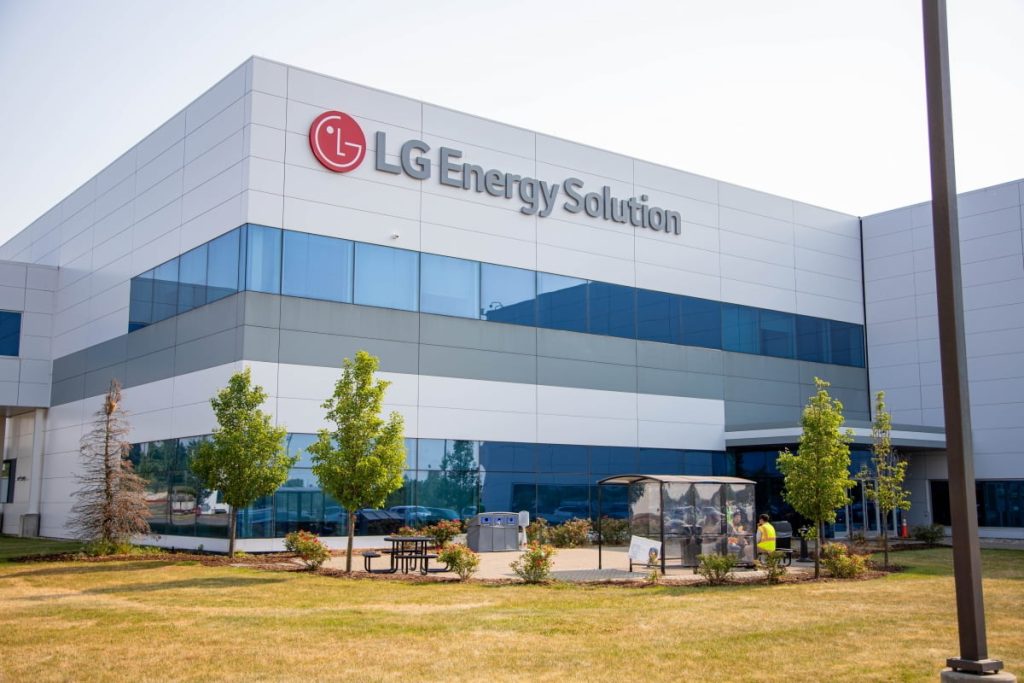
Despite reporting an operating loss in the first quarter, **LG Energy Solution** announced strong new order acquisition across its **electric vehicle (EV) battery** and **energy storage system (ESS)** segments, indicating promising future growth. The South Korean battery giant’s Q1 performance highlights a strategic shift and expansion despite current market challenges.
For the January-March period, **LG Energy Solution** recorded revenues of 6.55 trillion won ($4.41 billion) but faced an operating loss of 207.8 billion won. This represents a 2.5 percent decline in revenue year-over-year and a significant shift from the 374.7 billion won operating profit reported in the same period last year, reflecting evolving market dynamics.
During their recent earnings conference call, CFO Lee Chang-sil highlighted that sequential revenue saw a 1.2 percent increase from the prior quarter. This modest growth was primarily driven by robust demand for **energy storage systems** and **cylindrical batteries**, effectively offsetting weaker **EV battery** demand experienced in the North American market.
However, overall profitability was impacted by considerable ramp-up costs associated with newly established **ESS manufacturing facilities** in **North America**. These strategic expansions aim to significantly boost **energy storage capacity**, particularly to meet the surging electricity requirements of **artificial intelligence (AI) data centers**.
CFO Lee further emphasized the growing importance of the **ESS segment**, stating, “The share of **ESS** in our total revenue, which was below 10 percent last year, has now remarkably climbed to the mid-20 percent range.” **LG Energy Solution** plans to aggressively expand this business, targeting an increase in its revenue contribution to the mid-30 percent level or higher by year-end.
Despite facing near-term challenges from an industry-wide slump in global **EV demand**, **LG Energy Solution** successfully expanded its portfolio of new orders across both its **EV battery** and **ESS** segments, showcasing resilience and strategic foresight.
In the **EV battery** sector, the company achieved a significant milestone by securing over 100 gigawatt-hours of new orders for its cutting-edge **46-series cylindrical batteries**. This impressive intake has propelled its total **EV battery order backlog** to more than 440 gigawatt-hours. Mass production of the **4695 battery cells** commenced late last year at the Ochang plant in North Chungcheong Province. Looking ahead, **LG Energy Solution** intends to introduce a comprehensive **46-series lineup**, encompassing models from **4680 to 46120**, at its Arizona facility before the end of this year.
For **energy storage systems**, February saw **LG Energy Solution** finalize an additional supply agreement with a key strategic client for a large-scale **North American grid project**. Deliveries for this crucial **ESS project** are slated to commence in 2028. Notably, this project will integrate next-generation **lithium iron phosphate (LFP) batteries**, promising approximately a 15 percent improvement in total cost efficiency compared to existing solutions.
To strategically address the escalating **global ESS demand**, **LG Energy Solution** is actively expanding its **North American manufacturing footprint**. In March, a significant move involved converting a portion of an **EV battery production line** at its Ultium Cells plant in Tennessee for dedicated **ESS manufacturing**. This strategic shift increases its total **ESS production sites** in North America to five. Currently, facilities in Holland and Lansing, Michigan, alongside Windsor, Ontario, are operational. Furthermore, new **ESS plants** in Jeffersonville, Ohio, and Spring Hill, Tennessee, are slated to begin operations within this year. By year-end, **LG Energy Solution** is targeting over 50 gigawatt-hours of **ESS production capacity** across the region.
sahn


