
Samsung Electronics Falls Over 1 Percent Despite Record Earnings
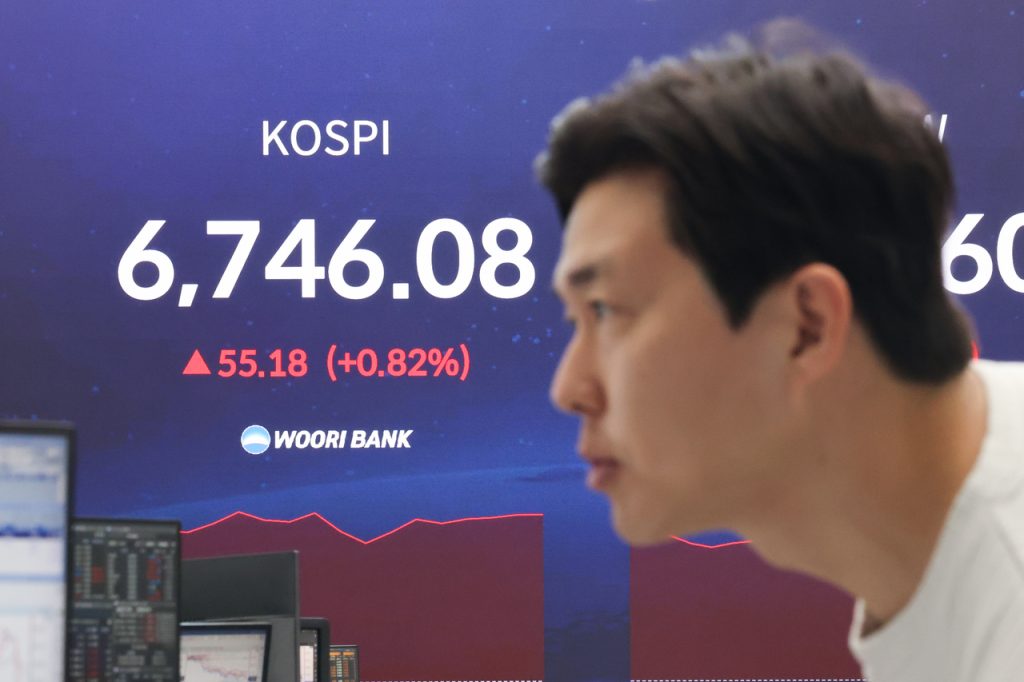
South Korea’s benchmark Kospi experienced significant volatility on Friday, initially reaching an unprecedented high above 6,750 points before reversing course in the afternoon. The index’s decline was primarily driven by intensified profit-taking from foreign and institutional investors.
By 2 p.m. local time, the Kospi index traded around 6,613 points, marking a 1.1 percent drop from its prior close. Earlier in the session, the Kospi had opened at a new record of 6,739.39 and soared to an all-time intraday peak of 6,750.27.
This market retreat in South Korea mirrored a mixed performance on Wall Street, where technology stocks largely outperformed. Strong first-quarter earnings reports from major tech giants like Alphabet, Amazon, and Microsoft buoyed the sector. The Nasdaq Composite registered a modest 0.04 percent gain, and the Philadelphia Semiconductor Index surged by 2.35 percent, contrasting with declines in the Dow Jones Industrial Average (down 0.57 percent) and the S&P 500 (down 0.04 percent).
Initially, Samsung Electronics’ stellar first-quarter earnings provided a significant boost to chip stocks. The South Korean tech giant reported a record-breaking 57.23 trillion won ($38.5 billion) in operating profit, marking its highest quarterly performance ever and a more than sevenfold increase year-over-year. Following this news, Samsung shares briefly surged to a new all-time high of 230,000 won. Fellow chipmaker SK Hynix also saw gains, rising by as much as 2.2 percent to 1,325,000 won, and Hanmi Semiconductor jumped an impressive 8 percent to a new annual high.
However, as the broader market sentiment weakened later in the trading session, the performance of the two major chipmakers diverged. Samsung Electronics’ stock was trading down over 1 percent by the afternoon, while SK Hynix, after erasing its earlier gains, traded nearly flat.
The earlier rally in SK Hynix also positively impacted its largest shareholder, SK Square, briefly elevating it to the position of the third-largest company in the local South Korean market. At one point, the investment holding company’s market capitalization exceeded 112 trillion won, surpassing Hyundai Motor, which was valued just under 110 trillion won.
By 2:30 p.m., SK Square’s shares were trading around 844,000 won, up 1.7 percent, making it one of the few market heavyweights to maintain positive territory.
Adding further pressure to market sentiment was the US Federal Open Market Committee’s (FOMC) decision to maintain current interest rates. On Wednesday, the FOMC opted to hold rates steady within the 3.5 percent to 3.75 percent range, citing persistent inflation concerns and the escalating impact of Middle East conflicts.
This interest rate freeze contributed to increased pressure on the local South Korean currency, the won, which opened Friday 7.5 won weaker, trading at 1,486.5 per US dollar.
Initially, foreign investors were the primary drivers of the market rally, accumulating 400 billion won in net purchases within the first 15 minutes of trading. However, as the Kospi index began to lose momentum, these flows reversed. Overseas investors became net sellers, offloading a net 260 billion won by 2:30 p.m. Institutional investors further exacerbated the selling pressure, remaining largely on the sell side and divesting approximately 410 billion won by the same time.
In contrast, retail investors demonstrated a different trend. After initially engaging in profit-taking earlier in the day, individual investors significantly increased their buying activity as stock prices declined. By 2:30 p.m., they emerged as net buyers of 720 billion won, effectively absorbing the substantial sell-off from foreign and institutional market participants.
Market analysts suggest that the Seoul stock market was due for a short-term correction following its recent sharp rally. They attribute the current pressures to escalating geopolitical tensions, persistent high oil prices, and ongoing currency volatility.
“The Kospi index has achieved an impressive gain of over 1,600 points, or more than 33 percent, since its late-March low, leading to accumulated concerns about short-term overheating and rally fatigue,” stated Lee Kyoung-min, a senior researcher at Daishin Securities. “As the market evaluates the discrepancy between investor expectations and first-quarter earnings realities, it is poised to enter a period of cooling and digestion of profit-taking activities.”
Noh Dong-gil, an analyst at Shinhan Securities, projected the Kospi’s potential trading range for May to be between 6,200 and 7,500 points. He emphasized that any market correction would likely signify a technical easing of overheated conditions, rather than a fundamental deterioration.
“A critical question remains,” Noh observed, “as to what extent corporate earnings can effectively absorb the discount gap created by adverse exchange rate movements and elevated oil prices.”
jwc


