
Renault Korea to Launch SDV in 2027, Begin EV Production in Busan by 2028
Renault Korea has announced ambitious plans to launch its first software-defined vehicle (SDV) in South Korea by 2027, alongside commencing electric vehicle (EV) manufacturing at its Busan plant in 2028. This strategic move aims to transform the Korean division into a central hub for the French carmaker’s premium segment vehicles and future mobility innovations.
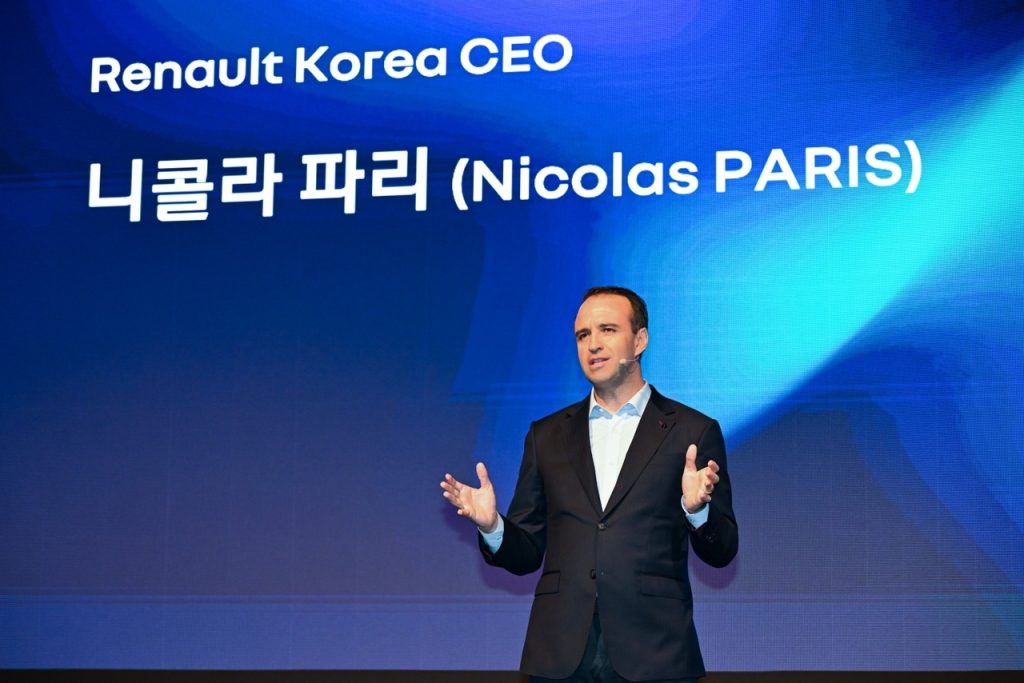
During his inaugural press conference since assuming leadership in September, Renault Korea CEO Nicolas Paris unveiled a clear roadmap: introducing one new model annually through 2029, a core component of the broader Renault Group’s “futureReady” strategy.
CEO Paris emphasized that this mid-term strategy for Renault Korea is not only about consistent new model launches but also about establishing leadership in quality and the premium vehicle segment. The company is committed to developing capabilities to design and mass-produce flagship models for the entire Renault Group.
The strategy for South Korea is built upon four foundational pillars: “Growth Ready,” “Tech Ready,” “Operational Ready,” and “Trust Ready.”
As part of the “Growth Ready” initiative, Renault Korea is positioning itself as Renault Group’s dedicated hub for D- and E-segment vehicles. A significant milestone under this strategy is the planned production of Renault’s next-generation electric vehicles (EVs) at the Busan plant starting in 2028.
Achieving this vision necessitates prioritizing the localization of EV battery production and fostering a robust domestic electric vehicle ecosystem. Paris highlighted the critical need for Renault Korea to accelerate its electrification efforts to remain competitive within the Korean market.
“The localization of full EV battery production is a key priority for the future. We will therefore focus on developing a competitive EV ecosystem in Korea to support this strategy,” Paris affirmed.
Renault Korea’s advanced plans include launching a fully software-defined vehicle (SDV) in 2027. While specific model details were not disclosed, this SDV represents a significant leap towards what Paris terms an “AI-defined vehicle,” promising intelligent and adaptable driving experiences.
These cutting-edge SDVs are designed to offer Level 2++ end-to-end autonomous driving capabilities, functioning seamlessly across both urban environments and highways. They will be equipped with Renault’s next-generation AI-based OpenR Panorama system, which CEO Paris envisions as transforming the vehicle into an “intelligent companion.”
Further demonstrating its commitment to innovation, Renault Korea aims for an expedited vehicle development cycle of under two years, citing the Grand Koleos — developed in just 24 months — as a successful precedent.
Addressing potential concerns that rapid development might compromise quality, Paris reaffirmed that maintaining superior quality remains Renault Korea’s utmost priority. The company plans to strengthen collaborations with key partners to optimize existing technologies and deliver the best products tailored for Korean customers.
sahn


