
Flitto Now Powering Training Pipelines of the World’s Largest AI Models
A pivotal moment in July 2013 saw global superstar Psy, with “Gangnam Style” soaring past a billion YouTube views, endorse a nascent Seoul startup. He directed his vast international following to “Use flitto.com to read my tweets in your own language,” marking the initial surge of global users for the then-fledgling translation service.
At that time, Flitto was a compact, Seoul-based translation application, strategically built around K-pop fans who translated celebrity posts in exchange for reward points. This unique approach leveraged the K-pop phenomenon, providing the young service with an immediate, engaged global community.
Fast forward thirteen years, and this humble app has transformed into a Kosdaq-listed artificial intelligence powerhouse, with its primary clientele now consisting of major US technology giants. In late June, Flitto announced a significant milestone: two data supply contracts with global IT clients had more than doubled, now totaling an impressive 31.6 billion won ($21.2 million). Notably, the larger of these two agreements, valued at 22.7 billion won, remarkably surpasses Flitto’s entire projected revenue for 2024.

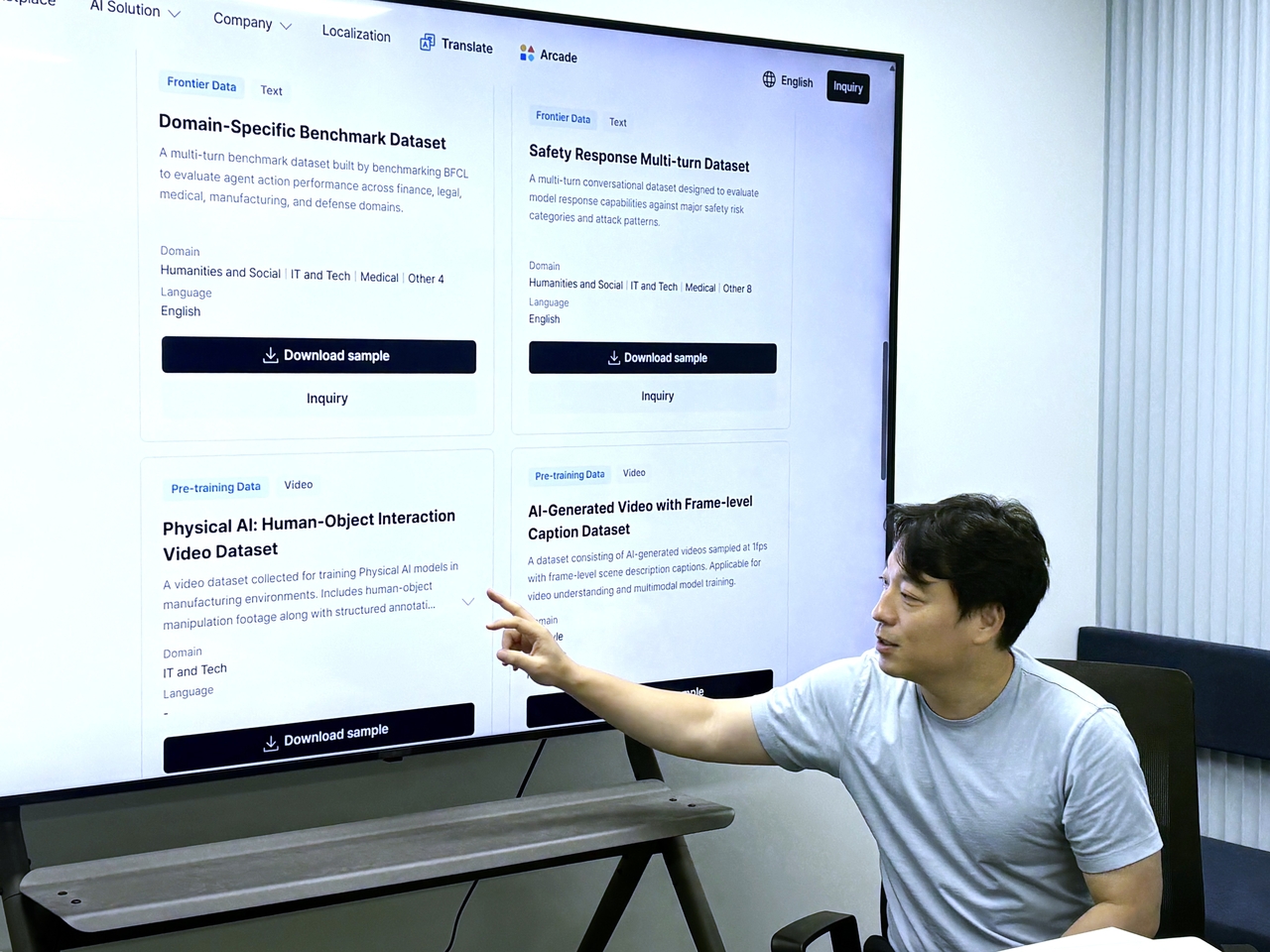
“When we first started, we consistently asserted we were a data company. Very few believed us then,” stated founder and CEO Lee Jung-soo, recognized globally as Simon Lee. He was positioned before a screen showcasing his latest innovation, Flitto Marketplace — an advanced platform designed to connect companies with surplus data with eager AI buyers. “I’m immensely relieved we could validate this vision before the company faced any significant setbacks.”
The tangible proof of this vision is now evident in the company’s robust financial performance. Last year, revenue surged by 77 percent, reaching 36 billion won. The operating margin made a dramatic swing from negative 2 percent in 2024 to a healthy 17 percent in 2025, marking the first substantial annual profit in Flitto’s operational history. A striking 71 percent of this year’s first-quarter revenue originated from international exports, and within its core data business segment, approximately 95 percent of sales were attributed to clients in the United States.
From Translation to AI Data: A Strategic Business Evolution
Flitto’s foundational premise in 2012 was a bold wager: that meticulously collected language data would eventually become invaluable to whichever artificial intelligence technology ultimately prevailed. This far-sighted hypothesis took nearly a decade to fully materialize and yield substantial returns.
“Crowdsourced translation was never the ultimate objective,” Lee clarified. “At that time, it simply represented the most practical and efficient method for data collection.”
The market dynamics shifted dramatically with the advent of neural machine translation. While services like Naver’s Papago, launched in late 2016, initially disrupted Flitto’s consumer platform, they simultaneously spurred an unprecedented demand for the precise sentences, voice recordings, and human corrections vital for training these sophisticated new systems. “Deep learning didn’t merely enhance the existing translation technology; it entirely revolutionized and replaced it,” Lee elaborated. “Suddenly, the market was actively seeking precisely the kind of high-quality data we had been systematically gathering since 2012.” This pivotal moment marked the earnest commencement of Flitto’s corporate data sales in 2017.
Consequently, Flitto’s business model underwent a strategic transformation, moving from passively awaiting translation requests to proactively producing tailored data on demand. In 2018, the company launched Flitto Arcade, an innovative platform that gamified data annotation work into small, paid missions. Through this system, users could translate sentences, refine transcripts, or record themselves speaking specific phrases, earning points redeemable for cash rewards.
Today, Flitto boasts an expansive network of 14 million users distributed across 173 countries, a testament to its global reach and operational scale.
Cultivating Real-World AI Intelligence with High-Quality Data
Flitto’s data collection missions are frequently engineered to address specific, nuanced scenarios where standard AI models are prone to errors. For instance, an automotive manufacturer might require human input to issue commands while a car engine is actively running. Similarly, a karaoke equipment producer might seek speech recordings layered over loud music, enabling its AI system to accurately distinguish a user’s request from the background song.
According to Lee, all data must satisfy two critical criteria: it must be sufficiently accurate to enhance an AI model, and it must possess absolute legal clarity for commercial training purposes. “Failure on either of these tests renders the sheer volume of data irrelevant,” he emphasized.
Lee estimates that raw incoming data typically hovers around 70 to 80 percent accuracy. Flitto’s rigorous process involves channeling this data through three to seven layers of meticulous review. Contributors are categorized by their skill level and historical performance, with the highest-rated individuals assigned to the crucial final verification stages. Lee asserts that when a client’s AI model encounters an unfamiliar proper noun or a challenging, noisy environment, only a data vendor with proprietary data ownership and the capability to retrain on its own unique datasets can effectively resolve such issues.
Clients typically initiate with a small sample test before committing to large-scale deployments. A recent contract, for example, started at 568 million won in October 2025, escalated to 3.9 billion won by April, and subsequently reached 8.9 billion won by June. Another contract’s value more than doubled within just three days following a client’s request for additional volume. This recurring pattern, in Lee’s assessment, signifies a fundamental shift in what major Big Tech buyers now prioritize: not the generic, general-purpose language data easily scraped from the internet, but rather the “narrower, impeccably clean, and rich-in-edge-case material that only a purpose-built, specialized data pipeline can genuinely deliver.”
Despite Flitto’s impressive international traction, Lee expresses frustration over the limited understanding of his company’s specialized business model within the domestic market. He points out that even Korea’s largest conglomerates actively engaged in AI rarely allocate more than 5 billion won annually for training data, with most spending closer to 1 billion. He starkly contrasts this with Chinese competitors, who he claims routinely invest 10 to 100 times that amount.
“Domestic buyers tend to view data as a consumable expense rather than a strategic investment,” Lee lamented. “This perspective explains why nearly all of our revenue originates from outside Korea. The companies that truly grasp the immense value of quality data are invariably located elsewhere.”
mjh