**Seoul Stocks Plummet as Middle East Tensions and Tech Losses Drive KOSPI Down**
The **Seoul stock market** experienced a significant downturn on Thursday, with the benchmark **Korea Composite Stock Price Index (KOSPI)** plummeting amidst escalating geopolitical tensions in the Middle East and substantial losses in key **technology heavyweights**. Despite the broad market decline, the **Korean won** showed resilience, gaining strength against the **US dollar**.
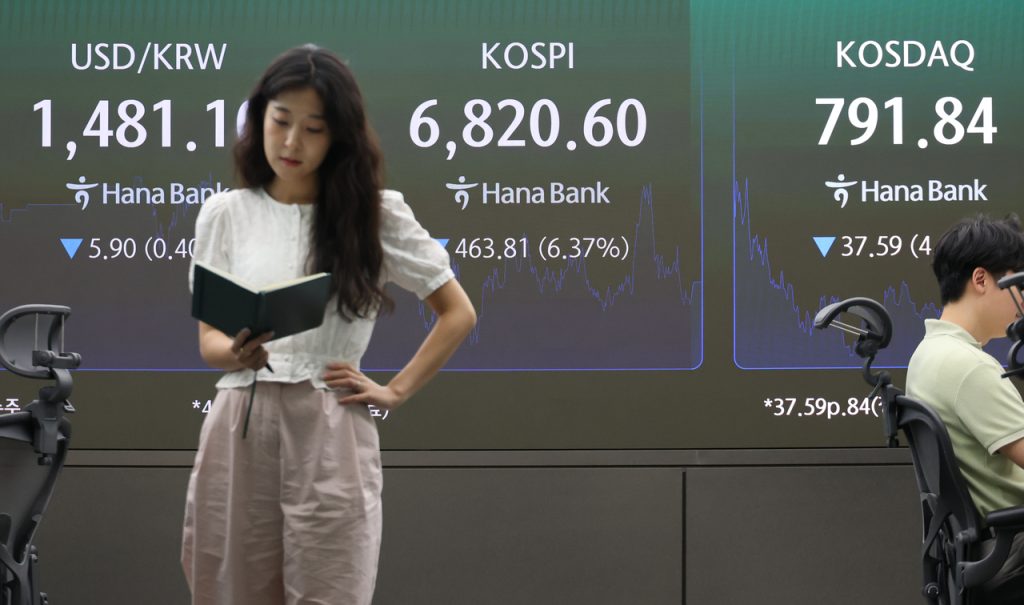
Following an initial drop of 4.45 percent, the KOSPI extended its losses throughout the trading day, ultimately closing at 6,820.60. This represented a sharp fall of 463.81 points, or 6.37 percent, from the previous session’s close, after dipping as low as 6,730.87 during intraday trading.
The severity of the market’s decline prompted the **Korea Exchange**, the nation’s stock market operator, to activate a sell-side sidecar on the KOSPI. This temporary trading halt mechanism was triggered for 20 minutes around 9:10 a.m. after the index fell by more than 5 percent, aiming to stabilize the volatile market conditions.
This sharp reversal came just a day after the KOSPI had surged by 6.24 percent on Wednesday. That rally was fueled by softer-than-expected inflation data from the United States, which had temporarily eased concerns about potential near-term interest rate hikes by the Federal Reserve.
Adding to the prevailing investor jitters, the **Bank of Korea** announced its own monetary policy decision earlier on Thursday. The central bank raised its benchmark interest rate by a quarter percentage point to 2.75 percent. This marked the first such increase in three and a half years, implemented to combat rising inflation, especially in light of the intensifying situation in the Middle East.
The renewed anxieties were primarily driven by reports of fresh **US strikes on Iran**, significantly escalating **Middle East tensions**. These developments reignited widespread concerns across global markets regarding potential disruptions to regional energy supplies, impacting investor confidence worldwide, including the **Korean economy**.
“Profit-taking activities followed the sharp gains observed in **technology stocks** during the previous session, while persistent concerns surrounding the broader **semiconductor industry** continued to exert downward pressure on the index,” explained Kang Jin-hyeok, a prominent analyst at Shinhan Securities Co.
On the investor front, institutional and foreign investors were significant net sellers, offloading shares worth 2.37 trillion won (approximately $1.6 billion) and 1.38 trillion won, respectively. In contrast, retail investors actively engaged in buying, accumulating a net total of 3.66 trillion won worth of shares, attempting to capitalize on the lower prices.
The downturn was predominantly led by the **technology sector**, with major players experiencing substantial losses.
Market leader **Samsung Electronics** saw its shares plunge by 8.77 percent, closing at 255,000 won. Similarly, rival chipmaker **SK Hynix** suffered an even steeper decline, tumbling 11.53 percent to 1,842,000 won.
Other major listed companies also faced headwinds. Top automaker **Hyundai Motor** recorded a 2.07 percent fall, ending the day at 425,000 won, while steelmaker **Posco Holdings** slipped 0.95 percent to 311,500 won.
Despite the overall market slump, a few sectors managed to post gains. Notable performers included shipbuilder **Hanwha Ocean**, which rose 5.73 percent to 86,700 won, and leading beverage firm **Hitejinro**, which gained 2.47 percent to 14,910 won.