
SK Hynix Seoul Shares Slide as Leveraged ETFs Spark Volatility Concerns Post-Nasdaq Debut
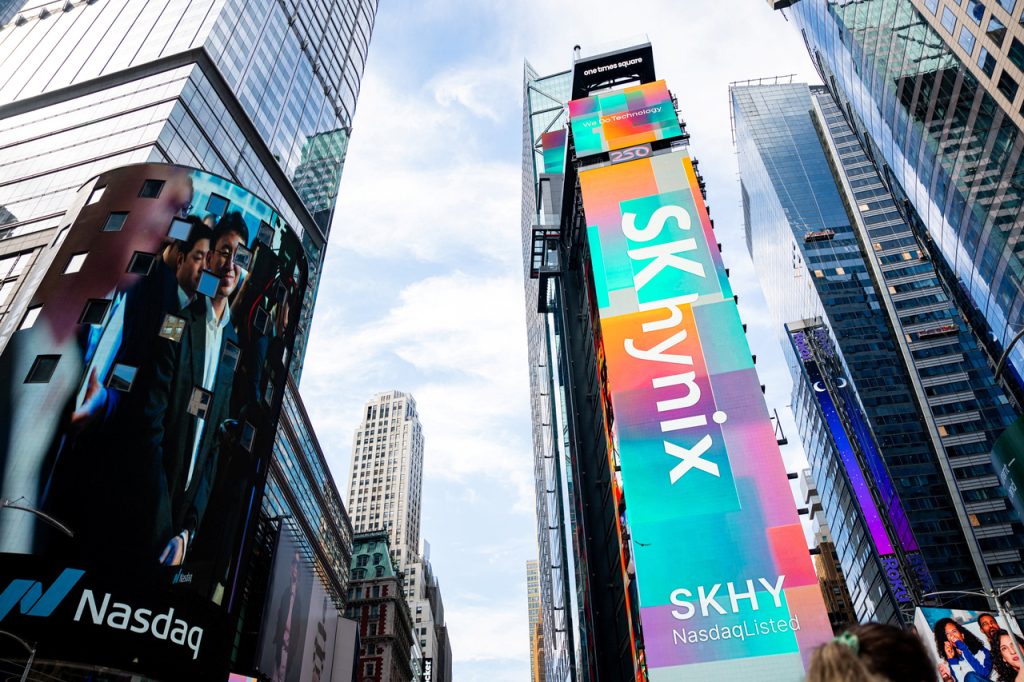
Investor interest in South Korean semiconductor giant SK Hynix is surging, evidenced by a fresh wave of single-stock leveraged exchange-traded funds (ETFs) linked to its newly listed US shares set to enter the market this week. This development follows a robust Nasdaq debut for the chipmaker’s American depositary receipts (ADRs).
Following a strong performance on Nasdaq, where SK Hynix’s American depositary receipts (ADRs) surged 13.08 percent from their offering price to close at $168.49 on Friday, US ETF issuers are actively preparing to launch new investment products tied to the semiconductor firm.
This flurry of new ETF offerings highlights the increasing global investor demand and attention on the Korean chipmaker.
Among the products scheduled for launch this week are the 2x Long SK Hynix Daily ETF, designed to deliver twice the daily return of SK Hynix ADRs, and the 1x Short SK Hynix Daily ETF, which aims to provide the inverse of the ADRs’ daily performance. Both innovative products are brought to market by ETF issuer Leverage Shares.
Further expanding the lineup, the ProShares Ultra SK Hynix ETF, also targeting twice the daily return of SK Hynix ADRs, is in the pipeline. Additionally, GraniteShares is introducing both the 2x Long SK Hynix Daily ETF and the 2x Short SK Hynix Daily ETF, alongside a 2x Leveraged SK Hynix ETF from Corgi Funds.
Direxion, a prominent provider of leveraged ETFs, has also filed for its own 2x Leveraged SK Hynix ETF, though a specific listing date has not yet been announced. Direxion is notably popular among Korean investors for its Direxion Daily Semiconductor Bull 3X Shares ETF, known as SOXL, which is one of the most widely held US-listed equity ETFs by local investors.
Despite the strong demand, the rapid introduction of these leveraged ETFs has triggered significant concerns regarding heightened market volatility. Unlike Korea’s equity markets, which feature daily price limits to curb extreme fluctuations, US markets lack such trading restrictions. This absence leaves leveraged products, including those tied to SK Hynix, considerably more exposed to abrupt and sharp price swings.
Leveraged ETFs are designed to rebalance their exposure near the market close each trading day. Investment banks, acting as swap counterparties, frequently hedge their positions by either buying or selling the underlying ADRs. This active hedging practice can significantly amplify intraday volatility in the underlying security, creating a more unpredictable trading environment.
Market analysts are now cautioning that increased volatility in SK Hynix ADRs could potentially impact the company’s Seoul-listed shares, causing a spillover effect.
Indeed, domestic SK Hynix shares faced intense selling pressure on Monday, despite the ADRs’ impressive Nasdaq debut. The stock plummeted more than 13 percent in intraday trading, reflecting these volatility concerns.
This significant decline pushed the stock below the 2 million won ($1,327) mark in intraday trading for the first time since June 11. The downturn also contributed to the benchmark Kospi falling below the 8,000-point mark, registering a drop of more than 8 percent from the previous session.
During the trading session, market safeguards were triggered to manage excessive volatility, including a sell-side sidecar, which halts program trading for five minutes, and a 20-minute circuit breaker.
The widespread rout also severely impacted Korea-listed leveraged ETFs tracking SK Hynix, with these products experiencing declines exceeding 20 percent during the same session.
Brokerages in Korea remain divided on whether the robust performance of SK Hynix’s ADRs will ultimately boost the valuation of its underlying Seoul-listed shares.
“The US listing has the potential to lead to a re-rating for both its US-listed ADRs and its Seoul-listed shares,” commented Kim Dong-won, head of research at KB Securities, suggesting an optimistic outlook.
However, this view is not universally shared. Roh Dong-gil, an analyst at Shinhan Securities, offered a more cautious perspective, warning that a valuation premium for the ADRs does not automatically translate into a higher valuation for the underlying shares traded in Korea.
“An ADR premium and an upward re-rating of the target valuation for the Seoul-listed shares are not necessarily the same,” Roh emphasized. “The crucial question lies in how much of the US market’s price discovery will effectively be reflected in the Seoul-listed shares.”
silverstar


