
Leading global investment banks have significantly upgraded their average projection for South Korea’s economic expansion this year, now anticipating a robust 3 percent growth. This optimistic revision, reported by the Korea Center for International Finance on Monday, is primarily attributed to a thriving semiconductor-driven export boom.
Specifically, the average real gross domestic product (GDP) growth forecast for 2026 among eight prominent global investment banks climbed to 3 percent by the close of June. This marks a notable increase from 2.8 percent recorded just a month prior and represents the first instance this year that the collective consensus has achieved the 3-percent milestone.
This positive trajectory highlights a consistent improvement in South Korea’s economic outlook throughout the year. Starting from a 2 percent projection at the end of last year, forecasts gradually ascended to 2.1 percent in January, 2.4 percent in April, 2.8 percent in May, and finally settling at 3 percent in June, underpinned by continuously strengthening export momentum.
Among the major institutions, JPMorgan led with the most significant upward revision, elevating its forecast to an impressive 3.7 percent from an initial 3 percent. Citibank followed closely, adjusting its estimate upwards to 3.5 percent from its previous 3 percent.
Other banks also contributed to the revised optimism: Barclays moved its forecast to 2.7 percent from 2.6 percent, Goldman Sachs to 2.7 percent from 2.5 percent, and HSBC to 2.8 percent from 2.6 percent. Conversely, projections from Bank of America, Nomura, and UBS remained consistent at 3.1 percent, 2.4 percent, and 2.8 percent, respectively, reflecting their earlier assessments.
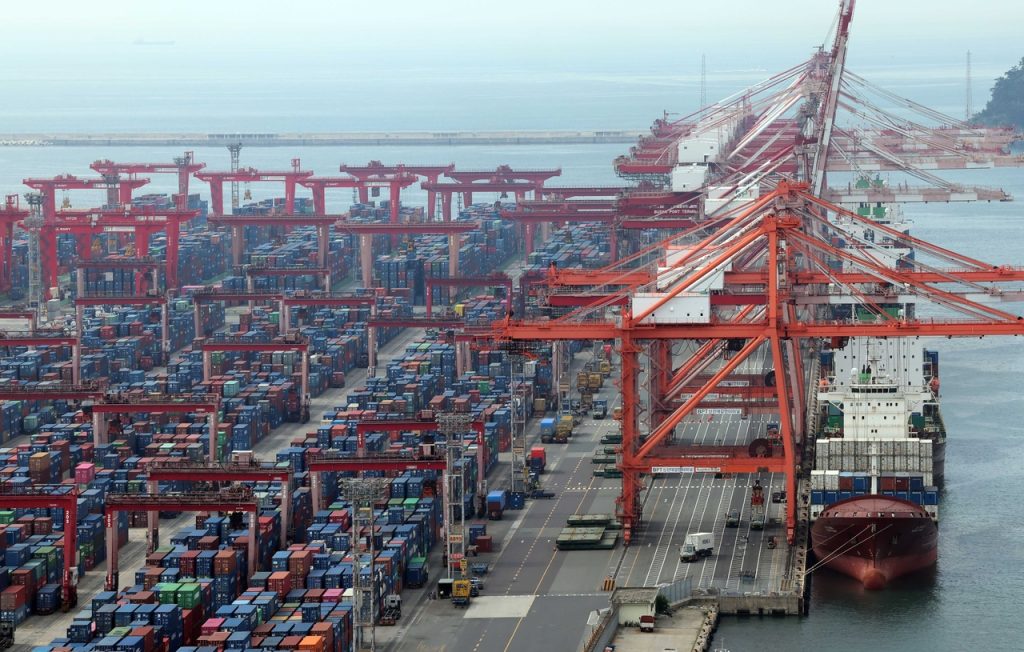
These substantial upward revisions are directly linked to South Korea’s outstanding export performance in June, when shipments surpassed an unprecedented $100 billion for the first time. This surge was primarily propelled by exceptionally robust semiconductor shipments, showcasing the sector’s critical role in the nation’s economy.
Beyond these investment bank adjustments, some independent forecasters express even greater optimism for South Korea’s economic trajectory. Capital Economics, for instance, projects a strong 4.0 percent growth for the economy this year, while Korean Re anticipates an even higher 4.1 percent expansion.
The Bank of Korea (BOK) is similarly poised to elevate its official growth forecast. This highly anticipated revision is expected when the central bank unveils its updated economic projections later in August.
In May, the central bank had initially projected 2.6 percent growth. However, a series of stronger-than-expected economic indicators has since solidified expectations for an upgrade. Notably, first-quarter GDP growth was revised upward to 1.8 percent from an initial 1.7 percent. Reinforcing this sentiment, Bank of Korea Governor Shin Hyun-song explicitly stated on June 19 that this year’s forecast would be “mechanically” revised upward from its current 2.6 percent.
This robust export boom has had a cascading effect, also compelling investment banks to significantly enhance their projections for South Korea’s current account surplus.
The average forecast for South Korea’s current account surplus surged to an impressive 14 percent of nominal GDP by the end of June. This marks a substantial increase from 10.8 percent just a month earlier, and represents more than double the 6.5 percent recorded at the close of last year, underscoring the nation’s strong external sector performance.
With the exception of UBS, all eight institutions revised their current account surplus forecasts upward. HSBC delivered the most significant adjustment, elevating its estimate to 17 percent from a prior 9.8 percent. Citibank also made a substantial revision, raising its forecast to 16.4 percent from 11.8 percent. Other notable increases included Bank of America (16.1 percent from 15 percent), Nomura (15.5 percent from 10 percent), Goldman Sachs (15.1 percent from 12.4 percent), JPMorgan (14.8 percent from 10.2 percent), and Barclays (13 percent from 12.8 percent), collectively painting a picture of robust external economic health for South Korea.
ch0221


