South Korean Stocks Plunge: Kospi Circuit Breaker Triggered Amid Heavy Foreign, Institutional Sell-off
South Korea’s benchmark stock index, the Kospi, experienced a dramatic marketwide circuit breaker on Friday as shares plummeted over 8 percent during intraday trading. This significant event capped an exceptionally volatile week, characterized by drastic swings in the nation’s dominant chip-heavy equities.
The Korea Exchange officially halted trading across the Kospi market for a 20-minute period, commencing at 12:10 p.m. The suspension was triggered after the flagship index sustained a decline exceeding 8 percent below its prior session’s closing value for a full minute, thereby fulfilling the specific criteria for a circuit breaker activation.
This widespread trading halt impacted all equities listed on the Kospi, alongside related stock index futures and options contracts.
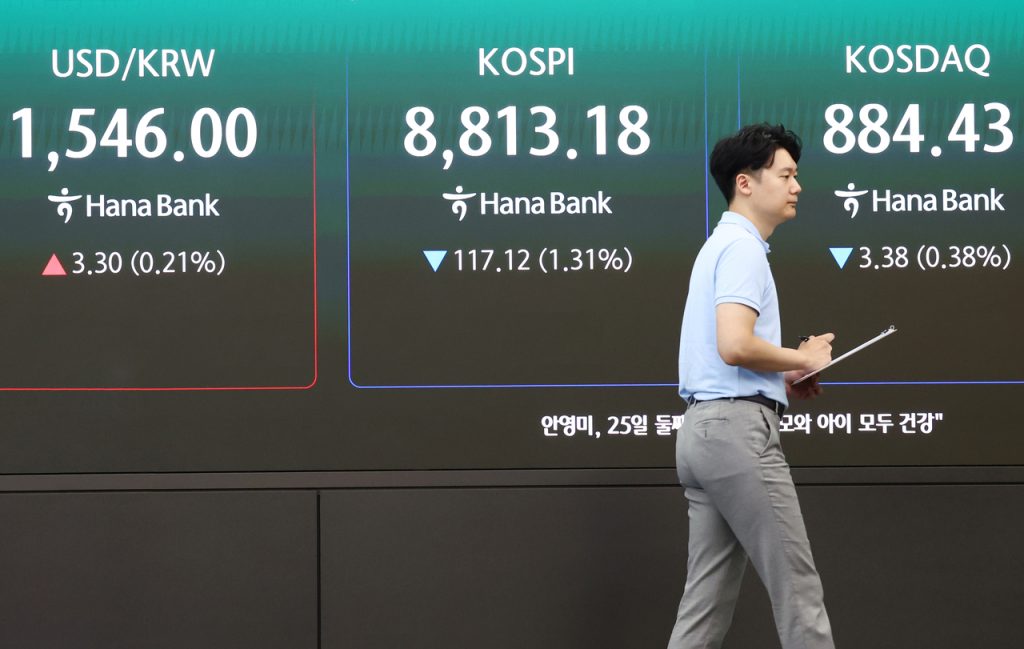
Upon the activation of the circuit breaker, the Kospi index registered a significant drop of 731.97 points, or 8.19 percent, settling at 8,198.33.
Earlier during the trading session, the Korea Exchange had already implemented a sell-side ‘sidecar’ – a temporary program halting orders – following a plunge of over 5 percent in Kospi 200 futures.
Retail investors emerged as significant net buyers, acquiring 3.77 trillion won ($2.44 billion) worth of shares. In stark contrast, foreign investors offloaded a net 3.11 trillion won, while institutional investors sold a net 732 billion won, driving the market’s downturn.
Major semiconductor giants, Samsung Electronics and SK hynix, saw their share prices plummet by over 9 percent at various points during the session, reflecting the severe market pressure.
According to Han Ji-young, a prominent analyst at Kiwoom Securities, the intense market sell-off was primarily fueled by two factors: mounting concerns surrounding a potential slowdown in demand for memory chips, coupled with widespread profit-taking initiatives following the Kospi’s notable rebound over the preceding two trading sessions.
Han further elaborated that semiconductor stocks had been the primary drivers of the recent market rally, which naturally encouraged investors to secure their profits. This subsequent pullback in leading chipmakers, he noted, also instigated selling pressure from passive funds whose portfolios are heavily weighted towards these dominant semiconductor equities.
Despite the immediate market reaction, Han contended that the prevailing concerns regarding memory chip demand might be exaggerated.
“The majority of today’s sharp market decline can be attributed to the South Korean market’s significant concentration in semiconductor stocks and the consequent heightened volatility observed in fund movements,” he concluded.
As of the latest update at 2:42 p.m., the Kospi index remained significantly down by 6.71 percent, trading at 8,336.67.
ch0221