
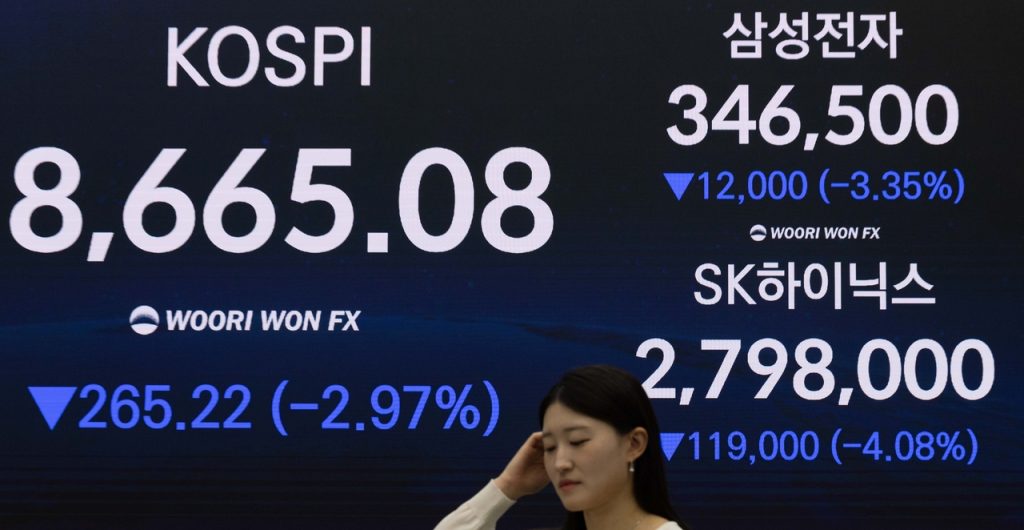
Potential selling could increase to 121 trillion won if benchmark index reaches 10,000, analyst says
South Korea’s National Pension Service (NPS) could offload as much as 74 trillion won ($47.9 billion) in domestic equities if the benchmark Kospi index climbs above 9,000 points. This potential selling by the NPS could further escalate to 121 trillion won, should the prominent South Korean stock market index reach 10,000 points, according to estimates from the nation’s financial investment industry.
These significant estimates emerge as both foreign and retail investors have already become net sellers in the South Korean market following a period of sharp rallies.
Data from South Korea’s financial investment industry indicates that domestic equities would constitute 29.6 percent of the NPS’ total portfolio if the Kospi index reaches 8,500 points, and 30.8 percent should it hit 9,000 points.
The NPS strategically manages its extensive investment portfolio through regular rebalancing, aligned with its long-term asset allocation plan.
This rebalancing mechanism dictates that when a specific asset class surpasses its predefined target weighting, the pension fund responsibly trims its holdings. Conversely, if an asset class falls below its target, the NPS increases its exposure. This established strategy is designed to secure gains during robust market conditions while acquiring assets when valuations are more attractive, ultimately enhancing long-term returns and ensuring portfolio stability.
On May 28, the National Pension Fund Management Committee notably increased the target allocation for domestic equities to 20.8 percent from 14.9 percent. Concurrently, it broadened the Strategic Asset Allocation (SAA) tolerance band to plus or minus 6 percentage points from plus or minus 3 percentage points. When combined with the Tactical Asset Allocation (TAA) band of plus or minus 2 percentage points, the NPS now possesses the flexibility to deviate by as much as 8 percentage points from its set target.
Earlier this year, the NPS had temporarily deferred its rebalancing deadline until the end of June to mitigate potential market disruptions.
However, the Kospi’s sustained rally has since pushed the pension fund’s domestic equity weighting beyond its revised target range. With the temporary rebalancing delay concluding this month, financial analysts widely anticipate the NPS to accelerate its domestic stock sales starting from July.
“We estimate the NPS’ domestic equity weighting would exceed 28.8 percent, the upper limit of its combined SAA and TAA tolerance bands, once the Kospi index rises above 8,175,” explained Cho Yong-gu, a leading analyst at Shinyoung Securities.
“The weighting would further increase to 29.6 percent at 8,500 and 30.8 percent at 9,000, consistently remaining well above the upper limit,” Cho elaborated. “Consequently, required selling by the NPS would escalate sharply once the Kospi index surpasses 9,500.”
Cho subsequently detailed three distinct scenarios, contingent on the level of flexibility the NPS opts to utilize within its established allocation bands: employing the full 2 percentage-point TAA allowance, a more moderate 1 percentage-point allowance, or relying solely on the SAA band.
In the scenario where the NPS fully utilizes both the SAA and TAA buffers, it would be necessitated to sell approximately 37 trillion won worth of domestic equities at a Kospi of 9,000. This figure would climb to 60 trillion won at 9,500 and reach 83 trillion won if the index hits 10,000.
Should the NPS opt to use only a 1 percentage-point TAA buffer, the projected required selling would increase to 56 trillion won, 79 trillion won, and 102 trillion won at the respective Kospi index levels.
Conversely, without deploying any TAA flexibility, the mandated selling by the pension fund would amount to a substantial 74 trillion won at 9,000, 98 trillion won at 9,500, and a staggering 121 trillion won at 10,000 points.
“Despite these projections, the NPS has proactively extended its rebalancing period to 20 trading days from the previous 10, while also strategically reducing daily trading volumes to effectively limit potential market impact,” Cho concluded. “If the market rally continues unabated and the volume of required selling further expands, it is highly probable that the NPS will incrementally spread out its sales and might even consider adjusting its target allocation for domestic equities upwards again by the close of the year.”


