
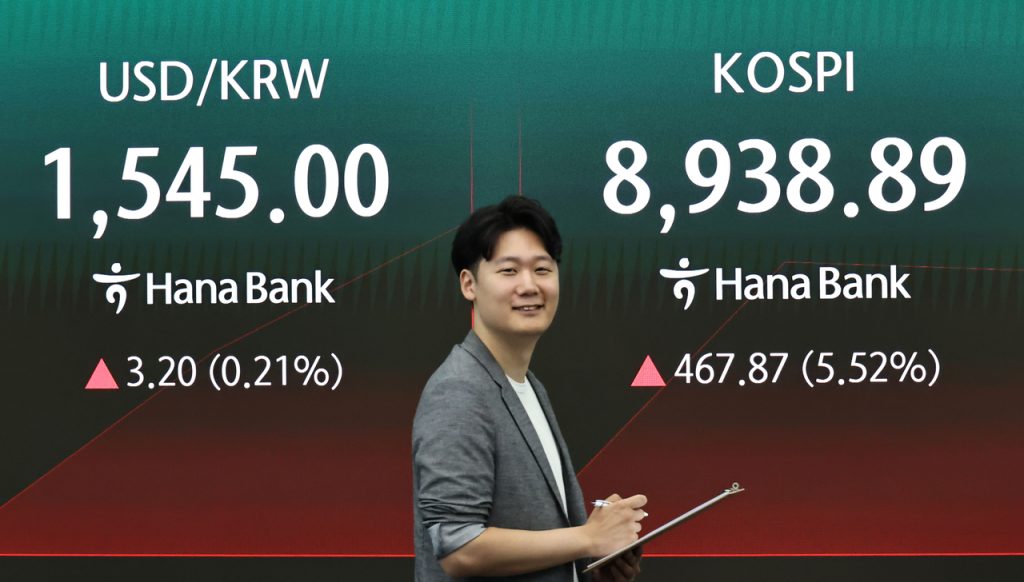
South Korean equities experienced a significant surge on Thursday, with the benchmark KOSPI briefly reclaiming the 9,000-point mark. This robust market performance was primarily fueled by an invigorated tech rally, sparked by US semiconductor giant Micron Technology’s surprisingly strong earnings report, which exceeded market expectations. Concurrently, the Korean won saw a depreciation against the US dollar.
The benchmark Korea Composite Stock Price Index (KOSPI) recorded an impressive gain of 459.28 points, or 5.42 percent, concluding the trading day at 8,930.30. This followed a notable 3.26 percent increase observed on the preceding day.
During the session, the key index momentarily surpassed the critical 9,000-point threshold, reaching an intraday peak of 9,044.04.
This recent climb offers a recovery after the KOSPI had remained within the 8,000-point range following a sharp 9.99 percent dive on Tuesday, just after hitting an all-time high of 9,114.55 on Monday.
The market opened with robust momentum, triggering a buy-side sidecar issuance soon after trading commenced. This strong start was directly attributable to Micron, the world’s third-largest memory chipmaker, whose quarterly earnings report significantly outperformed expectations. The positive news effectively alleviated persistent concerns regarding the long-term sustainability of the ongoing artificial intelligence (AI) rally.
Micron stands as a key beneficiary of the global boom in AI infrastructure spending, alongside South Korean technology giants Samsung Electronics and SK Hynix. This surge is driven by escalating demand for advanced memory chips, particularly high-bandwidth memory (HBM), crucial for AI applications.
Trading activity was exceptionally heavy, with 449.3 million shares exchanged, totaling 50.4 trillion won (approximately $32.7 billion). Despite the overall market rise, declining stocks outnumbered advancing ones, with 588 losers against 289 winners.
Institutional investors significantly bolstered the market, purchasing a net 3.3 trillion won worth of shares. In contrast, foreign investors offloaded a net 819.7 billion won, while individual investors sold a net 2.5 trillion won in stocks.
Commenting on the market’s performance, Kim Seok-hwan, an analyst at Mirae Asset Securities, stated, “Micron’s robust financial results were instrumental in boosting semiconductor shares across South Korea.” He added, “Airline stocks also experienced gains amid expectations of the Strait of Hormuz reopening and a subsequent decline in global oil prices.”
Among the major players, Samsung Electronics, recognized as the world’s largest memory chip producer, saw its shares jump by 5.29 percent to 358,500 won. Its close competitor, SK Hynix, which is the second-largest, experienced an even more dramatic surge of 13.06 percent, closing at 2.9 million won.
Related entities also performed strongly; SK Square, the parent company of SK Hynix, advanced by 5.56 percent to 1.9 million won. Similarly, Samsung C&T, a key shareholder in Samsung Electronics, recorded a significant increase of 7.79 percent, reaching 519,000 won.
In the aviation sector, flag carrier Korean Air’s stock vaulted by 6.4 percent to 29,100 won, while Asiana Airlines also saw a substantial rise of 6.2 percent, closing at 7,710 won.
Brokerage firms also demonstrated strong performance, with Samsung Securities climbing 3.07 percent to 110,800 won, and Kiwoom Securities gaining a robust 7.48 percent, ending the day at 337,500 won.


