
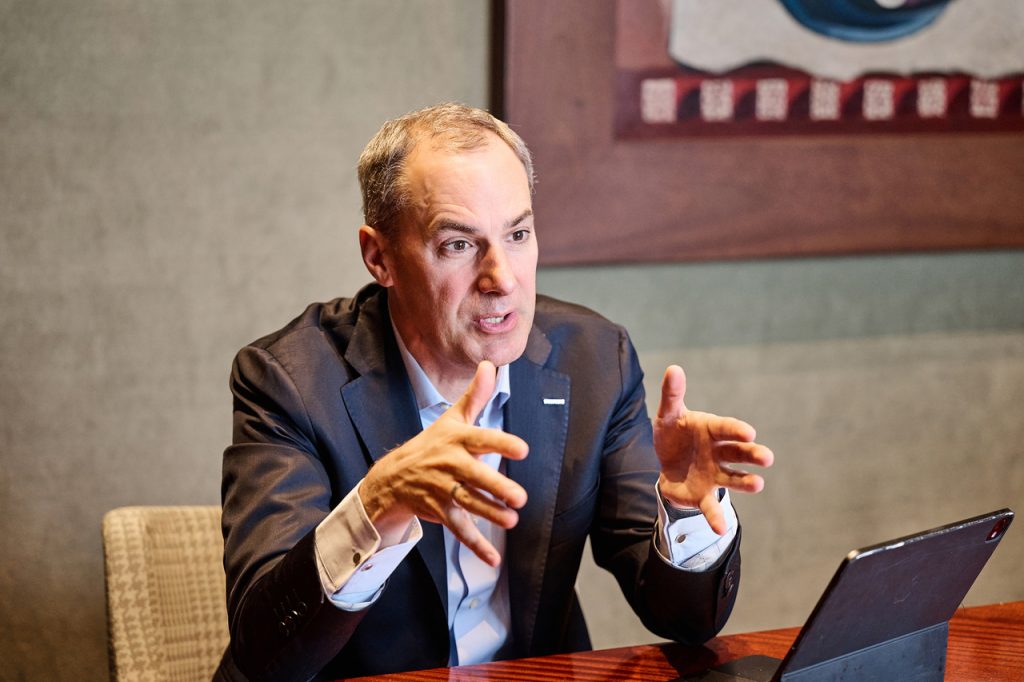
Industrial AI will transform factories, but humans will remain in charge, says Digital Industries CEO Cedrik Neike
South Korea stands at the forefront of shaping the future of artificial intelligence, a potential driven by its robust manufacturing sectors and the immense volumes of data produced within its factories. This insight comes from Cedrik Neike, CEO of Siemens Digital Industries and member of the managing board, highlighting the nation’s pivotal role in the global AI landscape.
During an interview with The Korea Herald in Seoul, Neike emphasized the unparalleled value of “industrial data” for nations like South Korea and Germany. He stated, “The treasure we are sitting on as industrial countries is industrial data,” underscoring its critical role in advancing industrial AI and enhancing global competitiveness.
Neike’s visit to Seoul underscored Siemens’ commitment to deepening its established presence in Korea. A significant outcome of his trip was a new partnership with Naver Cloud, designed to deliver localized industrial AI and advanced software tools directly to Korean manufacturers, bolstering their technological capabilities.
While consumer AI sees increasing dominance from the US and China, Neike highlighted a distinct opportunity for nations such as Korea and Germany to lead in industrial AI. This leadership hinges on leveraging proprietary factory data to train highly specialized AI models, thereby significantly improving manufacturing processes and operational efficiency.
He acknowledged that Korea shares challenges similar to Germany’s, noting, “It is an aging society, and it is a society which needs to find its place in this AI age,” emphasizing the urgency and importance of AI adoption.
“We need to upscale because it’s a huge chance. But it’s also a huge risk,” Neike cautioned. He warned that “If you miss industrial AI, your industrial base could be disappearing very quickly,” highlighting the critical need for rapid adoption to maintain industrial competitiveness.
With manufacturing standards rapidly evolving towards industrial AI—harnessing data-driven insights to manage increasingly complex and flexible production lines—Neike stressed Korea’s exceptional position for leadership. This advantage stems from the nation’s inherent strength across several key industries.
“Korea is extremely industrialized with a very high adoption of robotics,” he observed. “It is very well placed in key industrial segments such as semiconductors, pharmaceuticals, machine tools, batteries, and cars,” further solidifying its potential in the industrial AI era.
Global manufacturing is undergoing fundamental changes, driven by rising geopolitical pressures, persistent supply chain instability, and evolving trade policies. Neike explained that the trend is shifting away from massive, export-focused production hubs towards smaller, more localized facilities positioned closer to end markets. Siemens, he added, is actively embracing this strategic shift.
“I believe that we will build way more smaller factories, instead of building one big factory and exporting for the rest,” he stated, outlining a vision for a more distributed and responsive manufacturing landscape.
He further elaborated that future factories will feature enhanced flexibility, capable of producing a more diverse range of products. This adaptability will enable them to meet shorter product cycles and cater efficiently to specific local demands.
Artificial intelligence is poised to accelerate this profound transition, empowering factories to automate an even wider spectrum of tasks and adapt with unprecedented speed to evolving customer needs. Neike aptly characterized this transformative process as “automating the automation.”
“I think that AI will enable you to talk to your factory,” Neike suggested, envisioning a scenario where AI delivers real-time updates on critical operational metrics. These include productivity levels, identified bottlenecks, efficient production flows, dynamic supply chain insights, and even proposing optimized layout changes to enhance overall operations.
Despite the increasing role of AI, humans will unequivocally retain responsibility for evaluating and approving all major decisions, Neike firmly stressed. He dismissed concerns that the rise of AI-driven factories and humanoid robots would lead to a reduction in human workforces, clarifying the nature of future collaboration.
However, he acknowledged that the nature of these jobs would indeed evolve.
“I think the same amount of people will work,” Neike predicted, “but they will just do less repetitive and more creative jobs in the industrial environment,” focusing on higher-value human contributions.
This transformation means workers will transition from manual tasks to more intellectual roles, including supervising advanced AI systems, expertly interpreting complex production data, and refining industrial models. While AI will continuously optimize factory operations, humans will undeniably remain the ultimate decision-makers, ensuring critical oversight.
“There will always be a human in the loop,” Neike declared, outlining Siemens’ vision. He clarified that this future is not a “dark factory” devoid of human presence, but rather an environment where AI functions as a powerful copilot, significantly augmenting workers’ capabilities.
Neike firmly asserted, “Adopting AI will make a country more competitive and have more jobs than countries not adopting AI,” underscoring the economic imperative of embracing this technology.
Conversely, he warned, “If you don’t adopt AI, you are less competitive on a worldwide basis, and therefore you cannot have your own products and the jobs will disappear,” painting a stark picture of the risks of technological stagnation.
As industrial AI continues its maturation, Neike highlighted that collaboration between South Korea and Germany would become increasingly critical for global progress and innovation.
“Germany has to work with Korea,” he stated, emphasizing the potential for a powerful partnership. This synergy would combine Korea’s established leadership in semiconductors and advanced manufacturing with Germany’s renowned industrial software and sophisticated engineering capabilities, fostering mutual growth and innovation.
Neike’s visit to Seoul also underscored Siemens’ strategic initiative to deepen its engagement across Korea’s major industrial sectors. These include crucial areas such as defense, semiconductors, pharmaceuticals, data centers, and construction, demonstrating a broad commitment to the nation’s industrial development.
Currently, Siemens is actively collaborating with prominent local partners like shipbuilder HD Hyundai. This partnership involves integrating Siemens’ cutting-edge digital twin and industrial software technology to digitalize production processes and significantly enhance efficiency within the shipbuilding industry.
In a significant development on Tuesday, Siemens formalized a partnership with Naver Cloud, aiming to collaboratively develop advanced industrial AI and digital transformation solutions tailored for Korean manufacturers. This strategic alliance will merge Siemens’ expertise in automation, digital twin technology, industrial AI, and IT/OT convergence with Naver Cloud’s robust infrastructure, including its hyperscale and modular data centers and comprehensive cloud services. Both companies are also committed to jointly identifying new customers and expanding their market reach within the industrial sector.
sahn


