South Korea’s currency, the **won**, is projected to see modest strengthening towards 1,450 **won per dollar** in the latter half of the year. Despite this anticipated gain, the **won-dollar exchange rate** is expected to remain relatively elevated, with **volatility** likely to persist, according to expert analysis on Monday.
During a seminar organized by the Federation of Korean Industries, economists highlighted that robust **export performance** and a record **current-account surplus** are key factors poised to bolster the **won**. However, persistent **dollar demand** stemming from overseas investments and the trading activities of **foreign investors** could temper these gains for the **South Korean currency**.
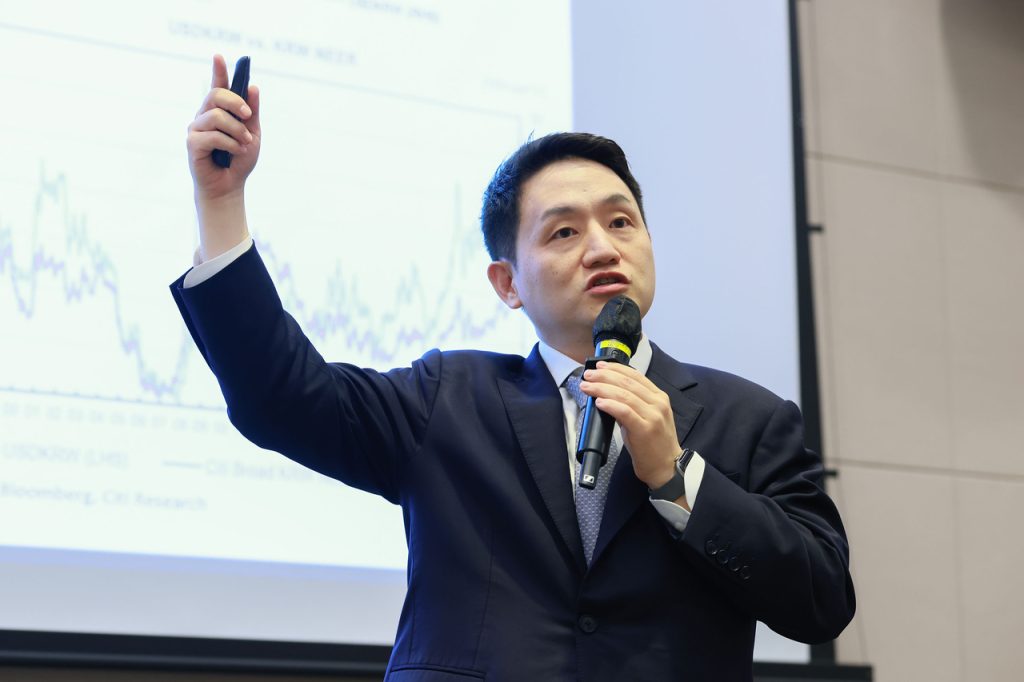
“The **won-dollar exchange rate** is likely to stabilize around 1,480 **won** over the coming three months, before easing to approximately 1,450 **won per dollar** within the next six to twelve months,” stated Kim Jin-wook, Korea chief economist at Citi Research.
Kim attributed his optimistic outlook for the **won** to factors such as stronger **semiconductor exports**, increased domestic stock investments by Korean investors, and the high probability of sustained **current-account surpluses**.
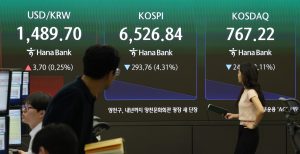
As of Monday, the **won** was trading near 1,540 **won per dollar**, having recently touched its weakest point against the U.S. dollar in nearly three decades, a level not seen since the 1997-98 Asian financial crisis.
Kim further explained that recent sharp increases in the **won-dollar exchange rate** have been predominantly driven by **foreign investors’ portfolio rebalancing** and strategic profit-taking maneuvers.
He pointed out that **foreign investors’ holdings** in **Korean assets** have nearly doubled, escalating from roughly $1 trillion last year to $1.9 trillion by the close of May.
“**Foreign investors’ exposure to Korea** has considerably increased, and their consistent net selling in the spot market has exerted **downward pressure on the won**,” Kim elaborated. “Even when direct stock sales are not occurring, it is estimated that **currency hedging activity** has played a role in pushing up the **won-dollar exchange rate**.”
Kim also emphasized that ongoing uncertainty surrounding **foreign investors’ capital flows** presents a significant risk for the **South Korean currency**.
“The duration of **foreign investment funds** flowing out of **Korea** remains unpredictable,” Kim cautioned. “As global markets frequently oscillate between ‘risk-on’ and ‘risk-off’ modes, it will be challenging to avoid **elevated volatility** in the **won-dollar exchange rate**.”
Looking at the longer horizon, Kim projects the **won-dollar exchange rate** to stabilize around 1,400 **won per dollar** over the next three to five years.
Other experts echoed concerns, suggesting that a primary reason the **won** has struggled to strengthen, despite record export figures, is that **Korean companies** are increasingly opting to retain **dollar earnings overseas** rather than repatriating them to **Korea**.
“The **Bank of Korea** anticipates the **current-account surplus** to more than double this year, with some forecasts suggesting it could be even higher,” commented Jeong Young-sik, senior research fellow at the Korea Institute for International Economic Policy. “However, the reason this is not significantly impacting the **exchange rate** is that not all of this capital is returning to **Korea**.”
This trend is largely due to most **dollar revenues** being utilized to fund **investments abroad**, particularly in the United States, he noted, estimating that **Korean companies** collectively hold over $100 billion in **retained earnings overseas**.
“Many **companies are holding dollars** as a precautionary asset or allocating them for **overseas investment**, thereby creating a structural source of **pressure on the won**,” stated Lee Tae-kyu, senior research fellow at the Korea Economic Research Institute, affirming Jeong’s perspective.
The seminar discussion also included calls for tighter **monetary policy** to aid in the **stabilization of the currency**.
“The current **exchange-rate level** cannot be ignored,” asserted Joo Won, head of the economic research division at Hyundai Research Institute. “While a 1,400 **won** range might be considered the new normal, current levels are unacceptable. A **preemptive rate hike** stands out as one of the few effective remedies.”
“I believe the **Bank of Korea** might consider raising **interest rates** this time, possibly starting from July,” said Hur Joon-young, an economics professor at Sogang University. “Such a move could help narrow the **interest-rate gap with the United States** and alleviate some of the **pressure on the exchange rate**.”
Citi’s Kim also shared his expectation that the **Bank of Korea** will initiate **interest rate hikes** as early as next month, projecting up to four rate increases through next year.
“Taking action as swiftly as possible would be instrumental in mitigating broader economic risks and fostering stability in the **won-dollar exchange rate**.”
sahn