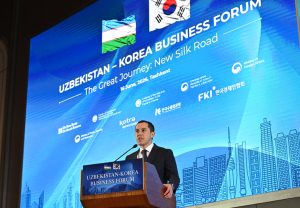
TASHKENT, Uzbekistan — South Korea’s Export-Import Bank (Eximbank) has declared its readiness to finance a new array of Korea-Uzbekistan projects. This commitment comes as Tashkent actively seeks to attract greater Korean investment into critical sectors such as infrastructure development, supply chain optimization, and advanced technology industries, driven by ongoing economic reforms.
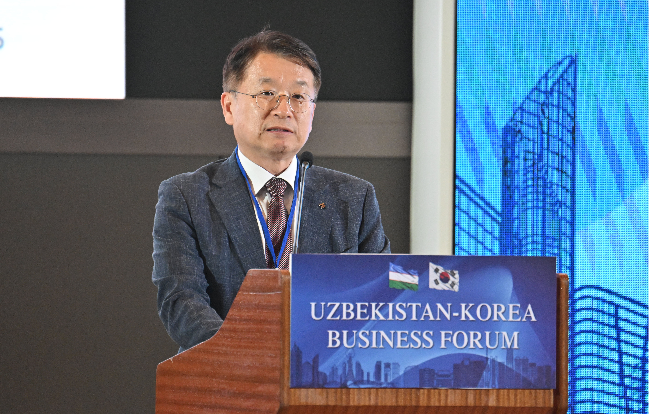
During the Korea-Uzbekistan Business Forum 2026 held in Tashkent, Seo Jung-hwa, senior executive director of the Export-Import Bank of Korea, articulated Eximbank’s ambition to transform high-level government cooperation between the two nations into tangible business ventures and investment opportunities.
“Eximbank aims to move beyond merely providing financial support, aspiring instead to serve as a pivotal bridge connecting governmental cooperation with concrete projects and direct investment,” Seo emphasized.
These statements underscore Uzbekistan’s strategic positioning at the forum as a rapidly expanding and increasingly investor-friendly market, appealing to Korean enterprises looking to establish a strong presence in Central Asia.
Seo highlighted Uzbekistan’s enduring status as a key partner for Korea in the region. Cooperation, she noted, is broadening from traditional areas like energy infrastructure (including gas and power) to encompass artificial intelligence, digital transformation, and other nascent industries.
For these diverse projects, Eximbank deploys a comprehensive suite of financing instruments, including the Economic Development Cooperation Fund (EDCF), export credit agency financing, and specialized supply chain cooperation funds.
The EDCF, Korea’s primary concessional loan program for intergovernmental development cooperation, has already supported 20 projects in Uzbekistan, amounting to approximately $1.4 billion, according to Seo.
Notable examples include the Tashkent Medical Cluster, a flagship development cooperation initiative comprising a children’s hospital, cancer center, general hospital, and a medical university. Another significant project is the Pharmaceutical Cluster, also known as Pharma Park, strategically designed to bolster Uzbekistan’s burgeoning pharmaceutical industry.
Seo further revealed Eximbank’s involvement in major gas chemical and natural gas processing projects in Uzbekistan, each with project costs surpassing $3 billion. The bank is also actively evaluating cooperation prospects for the ambitious New Tashkent Airport project.
The bank is also dedicated to assisting Korean companies expanding their operations in Uzbekistan, particularly within the crucial automotive supply chain. Seo explained that Eximbank maintains credit lines with Uzbek financial institutions, enabling local companies to secure necessary financing through partner banks.
Additionally, Seo drew attention to Korea’s supply chain cooperation fund. Established by the Korean government in September 2024, this fund is designed to bolster projects involving critical minerals, advanced industrial materials, and vital logistics assets. Last year, the fund provided 7 trillion won ($4.6 billion) in support and is projected to allocate another 7 trillion won this year.
Reforms for investor-friendly economy
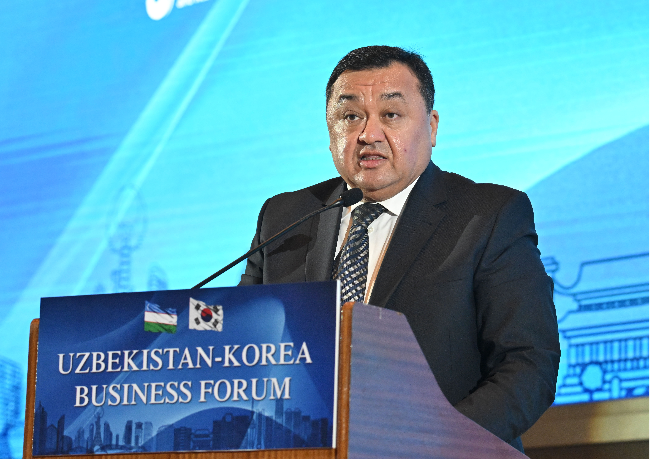
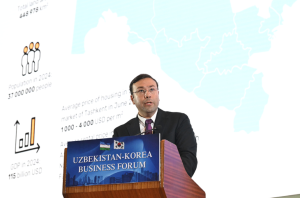
Ilzat Kasimov, Uzbekistan’s deputy minister of investment, industry and trade, expressed his belief that the forum would significantly deepen bilateral trade, economic, and investment cooperation between the two nations.
Kasimov highlighted the presence of over 700 joint ventures currently operating in Uzbekistan, with prominent Korean companies such as Posco, Daewoo, Samsung, and Lotte actively engaged in the market. He cited the local production of Kia-brand vehicles and BoMI E&C’s construction projects as concrete illustrations of successful bilateral collaboration.
He further elaborated on Uzbekistan’s extensive reform agenda under President Shavkat Mirziyoyev, aimed at cultivating an export-oriented and highly investor-friendly economy.
According to Kasimov, the country has undertaken substantial deregulation, abolishing more than 200 regulations, streamlining the number of tax categories from 13 to nine, and reducing the value-added tax (VAT) rate from 20 percent to 12 percent.
“We have also successfully liberalized the foreign exchange market, eliminated restrictions on the overseas transfer of dividends and investment income, simplified business registration procedures, and transitioned land acquisition processes to an efficient electronic system,” Kasimov affirmed.
Kasimov also underscored Uzbekistan’s advantageous preferential access to the European market, noting that the country has been able to export over 6,000 items to Europe duty-free since 2021. He added that negotiations for Uzbekistan’s accession to the World Trade Organization (WTO) have progressed into a substantive stage.
Uzbekistan’s gross domestic product (GDP) has more than doubled in recent years, reaching an impressive $147 billion by the end of 2025, Kasimov stated. The nation is ambitious, aiming to expand its economy further to $240 billion by 2030.
He also detailed various incentives Uzbekistan offers to investors in key areas, including land tax, corporate tax, data centers, crypto-related industries, renewable energy, long-term power supply, and digital infrastructure.
With the inaugural Korea-Central Asia Summit scheduled to take place in Seoul in September, Seo anticipates a further expansion of cooperation, particularly into technology-driven industries, significant public-sector projects, and private investment.
“The upcoming Korea-Central Asia Summit in September is poised to elevate our cooperation to unprecedented levels,” Seo concluded.