TASHKENT, Uzbekistan — Incheon International Airport Corporation (IIAC) is strategically positioning itself to harness Uzbekistan’s rapidly growing air travel demand, aiming to establish it as its next significant overseas growth engine. IIAC is actively engaged in major airport development projects across Tashkent and Urgench, supporting Uzbekistan’s ambition to become a pivotal regional aviation hub in Central Asia.
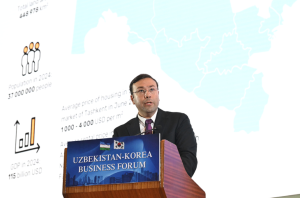
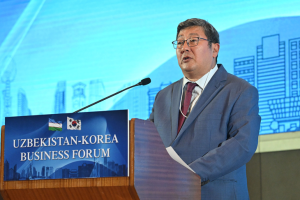
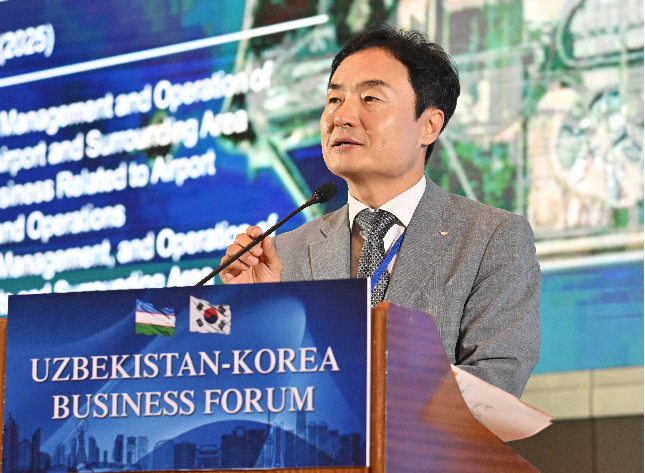
During the Korea-Uzbekistan Business Forum held in Tashkent, Lee Sang-yong, the executive director of IIAC’s new business division, highlighted the Korean airport operator’s commitment. He stated that IIAC intends to deploy its extensive expertise in developing and managing one of the globe’s busiest airports to bolster Uzbekistan’s aviation infrastructure.
“Our core objective at Incheon International Airport is to meticulously apply our world-class airport service capabilities to both Uzbek airports,” Lee articulated. “We aim to build and successfully operate what can be described as a ‘second Incheon International Airport’ right here in Uzbekistan.”
Central to this ambitious expansion is the New Tashkent Airport project, an impressive $2.5 billion initiative set to construct Central Asia’s largest international airport.
For the Tashkent airport project, IIAC is slated to play a crucial role in constructing and operating a new facility designed to handle an initial annual passenger capacity of 17 million, with potential expansion to 47 million upon complete realization. Lee confirmed the project will operate under a robust build-transfer-operate (BTO) model, projecting a four-year construction phase followed by a substantial 31-year operational period.
Approximately 41 percent of the total $2.5 billion investment will be covered by equity contributions from key partners including IIAC, Korea Overseas Infrastructure and Urban Development Corporation, Japan’s Sojitz and Jalux, Saudi Arabia’s Vision Invest, and Uzbekistan Airports. The remaining financial requirements are anticipated to be met through senior secured loans provided by the European Bank for Reconstruction and Development, the U.S. International Development Finance Corporation, the Japan Bank for International Cooperation, and various commercial banks.
Separately, under a distinct build-transfer-operate project, the company plans to complete by 2028 a 39,000-square-meter passenger terminal, designed to efficiently handle 3 million passengers annually. This initiative also includes a 1,400-square-meter cargo terminal and other vital facilities. Following the transfer of ownership upon completion, IIAC will manage the airport’s operations for a period of 19 years.
“We are committed to making every effort to ensure Tashkent Airport evolves into a pivotal hub airport for Central Asia, recognized and cherished by its passengers for unparalleled convenience and comfort,” Lee affirmed.
Furthermore, IIAC is simultaneously advancing the Urgench airport project, following the successful signing of a contract with Uzbekistan Airports in December of the previous year.
Lee elaborated on the robust expansion of Uzbekistan’s aviation market, attributing this rapid growth to strong economic development, increasingly liberalized aviation policies, and a significant surge in foreign visitor arrivals.
According to Lee, Uzbekistan’s total airport passenger traffic surged to 15.5 million in 2025, marking an impressive 3.5-fold increase since 2021, with an average annual growth rate of 36.5 percent. Concurrently, the nation saw 11.7 million foreign visitors in 2025, demonstrating an average annual growth rate of 34 percent since 2020.
Lee outlined IIAC’s strategic vision: to firmly establish Tashkent as a premier Central Asian aviation hub and Urgench as a vital regional gateway. This strategy includes concerted efforts to attract additional airlines and significantly expand international flight networks.
The company further intends to integrate its sophisticated airport operating systems, advanced baggage-handling capabilities, and cutting-edge technologies—including AI, robotics, and various digital tools—into these crucial Uzbek aviation projects.
“Furthermore, we are committed to providing comprehensive training for local airport staff,” he added, “through specialized education programs developed from our extensive experience with leading international aviation bodies such as the International Civil Aviation Organization (ICAO) and Airports Council International (ACI).”
Lee emphasized the significant economic impact, projecting that the Tashkent airport project alone is anticipated to generate $5.3 billion in production inducement effects across the construction, manufacturing, and logistics sectors. This initiative is also expected to create $2 billion in added value and generate over 30,000 new employment opportunities.
This strategic overseas expansion by IIAC follows the successful completion of four development phases at its home base, which have dramatically elevated its annual passenger capacity to an impressive 106 million.
Lee reported that in 2025, IIAC managed 74 million international passengers, securing its position as the third-ranked airport globally in this category, and also achieved fourth place in air cargo volume. Currently, the airport proudly serves 110 airlines, facilitating operations across 187 routes to 57 different countries.
In 2025, IIAC recorded robust financial performance, achieving revenues of $2.1 billion and an operating profit of $450 million, translating into a strong 21 percent operating margin. Lee noted that approximately 66 percent of the total revenue stemmed from non-aeronautical sources, largely driven by successful duty-free shops, diverse food and beverage outlets, and other commercial facilities.
As an experienced global airport operator, IIAC has successfully executed 42 overseas projects across 18 countries, accumulating approximately $600 million in revenue from these ventures. Its diverse international portfolio encompasses comprehensive airport operations and significant investment-development projects in key markets such as Kuwait, the Philippines, and Indonesia.