Kospi Soars: Foreign Investors Drive Buying Spree as Strait of Hormuz Reopens, Easing Oil Supply and Inflation Concerns
The South Korean benchmark Kospi experienced a significant surge on Monday, following the announcement of an interim deal between the US and Iran. This pivotal agreement, aimed at resolving the conflict, immediately alleviated widespread concerns regarding potential disruptions to global energy supplies.
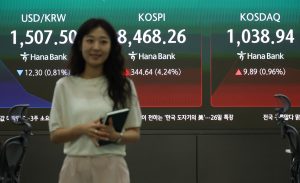
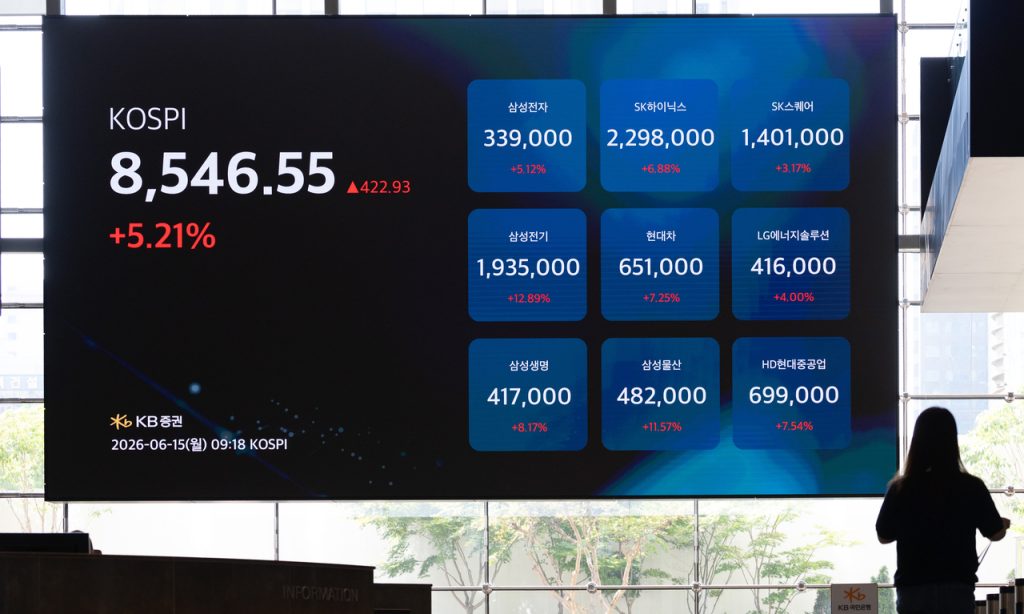
Crucially, the deal included provisions for the swift reopening of the Strait of Hormuz, a vital global shipping lane. This news propelled the Kospi to open 4.95 percent higher at 8,526.12, with the index extending its impressive gains throughout early trading. The rally momentarily breached the 8,600-point mark, reaching an intraday high of 8,603.48.
By 2 p.m. local time, the Kospi maintained strong momentum, trading at 8,560.55, marking a robust 5.38 percent increase for the session.
Market enthusiasm was so profound that a buy-side sidecar, a five-minute trading curb designed to manage volatility, was triggered just minutes after the 9:06 a.m. opening bell. This latest activation brought the total number of such sidecars on the main board this year to 26, comprising 14 buy-side and 12 sell-side instances.
The significant reduction in geopolitical uncertainty spurred a wave of foreign investment, with overseas investors acquiring a net 640 billion won ($743.4 million) worth of shares on the main board. Institutional investors also demonstrated strong confidence, purchasing a net 1.29 trillion won. Conversely, domestic retail investors were the primary net sellers, offloading 1.89 trillion won, likely taking profits after the market’s recent upturn.
Leading the charge were large-cap shares, particularly in the technology sector. South Korean market heavyweights saw substantial increases, with Samsung Electronics climbing 4.65 percent to 337,500 won, and semiconductor giant SK hynix surging an impressive 7.26 percent to 2.306 million won.
Further underscoring the market’s robust health, SK Square advanced 2.72 percent to 1.395 million won, while Samsung Electro-Mechanics experienced a significant leap of 14.06 percent, reaching 1.955 million won.
This widespread rally successfully pushed the total market capitalization of companies listed on the Kospi index back above the crucial 7,000 trillion won threshold, settling at 7,005.93 trillion won.
The Kospi’s market capitalization had previously surpassed the 7,000 trillion won mark on June 1, driven largely by a strong performance in semiconductor stocks. However, it had subsequently retreated below this level amidst escalating Middle East conflict concerns and warnings regarding the chip boom. Monday’s surge in share prices effectively reclaimed this significant milestone.
Complementing the stock market’s performance, the Korean won also demonstrated considerable strength against the US dollar, reflecting an overall easing of risk aversion among investors. The local currency opened onshore trading at 1,511.4 per dollar, marking an appreciation of 8.4 won from its previous close.
During the trading day, the won briefly touched 1,504 per dollar, reaching its strongest point since June 1. By 2 p.m., it had pared some of these gains, trading at 1,511.38 per dollar.
This landmark peace deal between the US and Iran is widely anticipated to provide substantial support to the broader Korean economy. In recent months, South Korea has faced economic headwinds due to geopolitical uncertainty and its significant reliance on energy imports, making this resolution particularly impactful.
According to its revised economic outlook released last month, the Bank of Korea (BOK) had previously estimated that a US-Iran peace agreement, coupled with the rapid reopening of shipping routes through the Strait of Hormuz, would boost the nation’s economic growth by 0.1 percentage point and reduce inflation by 0.2 percentage point this year. These forecasts now appear to be materializing.
The anticipated easing of inflationary pressures could grant the central bank increased flexibility in formulating its monetary policy. However, despite the immediate relief provided by the ceasefire, experts caution that a complete recovery and stabilization of global energy supply chains will likely require a sustained period.
Kim Du-eon, an analyst at Hana Securities, commented on the shift in market focus, stating, “A decline in global oil prices and an easing of inflation will naturally prompt investors to refocus their attention on corporate earnings.”
He further elaborated, “Corporate earnings will undoubtedly emerge as the primary driver for the domestic stock market, with memory semiconductors playing a central role. Investor attention will increasingly gravitate towards identifying key players and leaders within the evolving Artificial Intelligence (AI) supply chain.”
silverstar