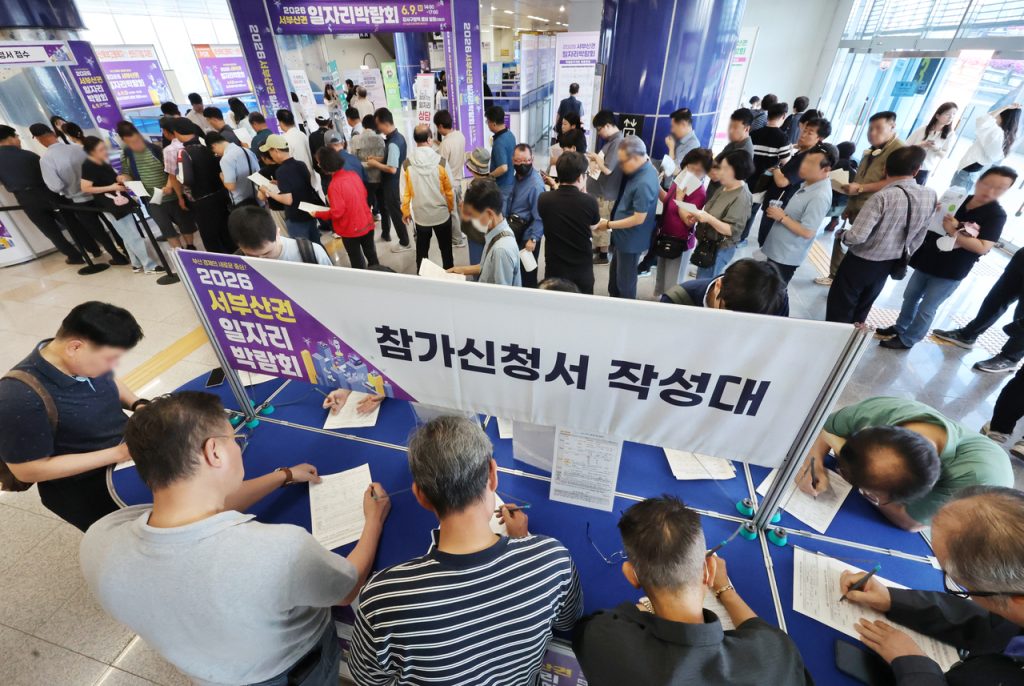
South Korea’s job market experienced its first contraction in 17 months during May, with 40,000 fewer positions compared to a year ago, government data revealed Thursday. This downturn highlights growing economic uncertainties, further exacerbated by the prolonged Middle East conflict.
Statistics from the Ministry of Data and Statistics confirmed the dip, showing the total number of employed individuals in May stood at 29.12 million, down from 29.16 million in the same month last year.
This marks the first decline in job figures since December 2024, a period when job numbers dipped by 52,000 following an incident widely reported as former President Yoon Suk Yeol’s martial law attempt, which significantly impacted the South Korean economy.
Prior to this May downturn, South Korea had seen robust job growth, with increases hovering around 200,000 in February and March, before moderating to 74,000 new positions in April.
Concurrently, the nation’s unemployment rate edged up to 2.9 percent last month, a 0.1 percentage point increase year-over-year. The total number of unemployed individuals in May reached 878,000, representing an increase of 25,000 from the previous year.
Employment rates for specific age demographics also saw shifts. The employment rate for South Koreans aged 15 to 64 decreased by 0.3 percentage points year-over-year, settling at 70.2 percent in May. Conversely, the employment rate for seniors aged 65 and older demonstrated resilience, increasing by 0.5 percentage points to 41.6 percent.
Breaking down age groups further, the employment rate for younger individuals, aged 15 to 29, experienced a notable drop of 2.4 percentage points from the previous year, reaching 43.8 percent.
Examining job trends by sector, the health and social welfare services industry saw substantial growth, adding 212,000 jobs year-over-year. The arts, sports, and recreation-related services sector also expanded, contributing an additional 44,000 jobs.
Further positive contributions came from the transportation and logistics sector, which grew by 36,000 positions.
Conversely, several key sectors faced significant job losses. The manufacturing sector alone shed 140,000 jobs in May compared to the previous year, while the agriculture, forestry, and fisheries sector saw a reduction of 121,000 positions.
This downturn marks the 23rd consecutive month of year-over-year job losses in manufacturing, with May’s drop being the steepest observed since February 2019, when 151,000 jobs were lost.
Commenting on the sectoral shifts, Bin Hyun-joon, a senior statistics official, noted, “The automobile and plastics industries specifically experienced job reductions. While recent export growth has been heavily driven by the semiconductor sector, this industry, while vital, does not significantly contribute to the overall job market.” This quote clarifies the disconnect between export performance and general employment.
Additionally, the science and technology services industry recorded a loss of 89,000 jobs during the same period.